
Quantitative analysis of deer mouse placental structure during early pregnancy under environmental hypoxia
Category: Research Poster
Author(s): Ellery Myers, Kathryn Wilsterman
Presenter(s): Ellery Myers
Mentors(s): Megan Hemmerlein
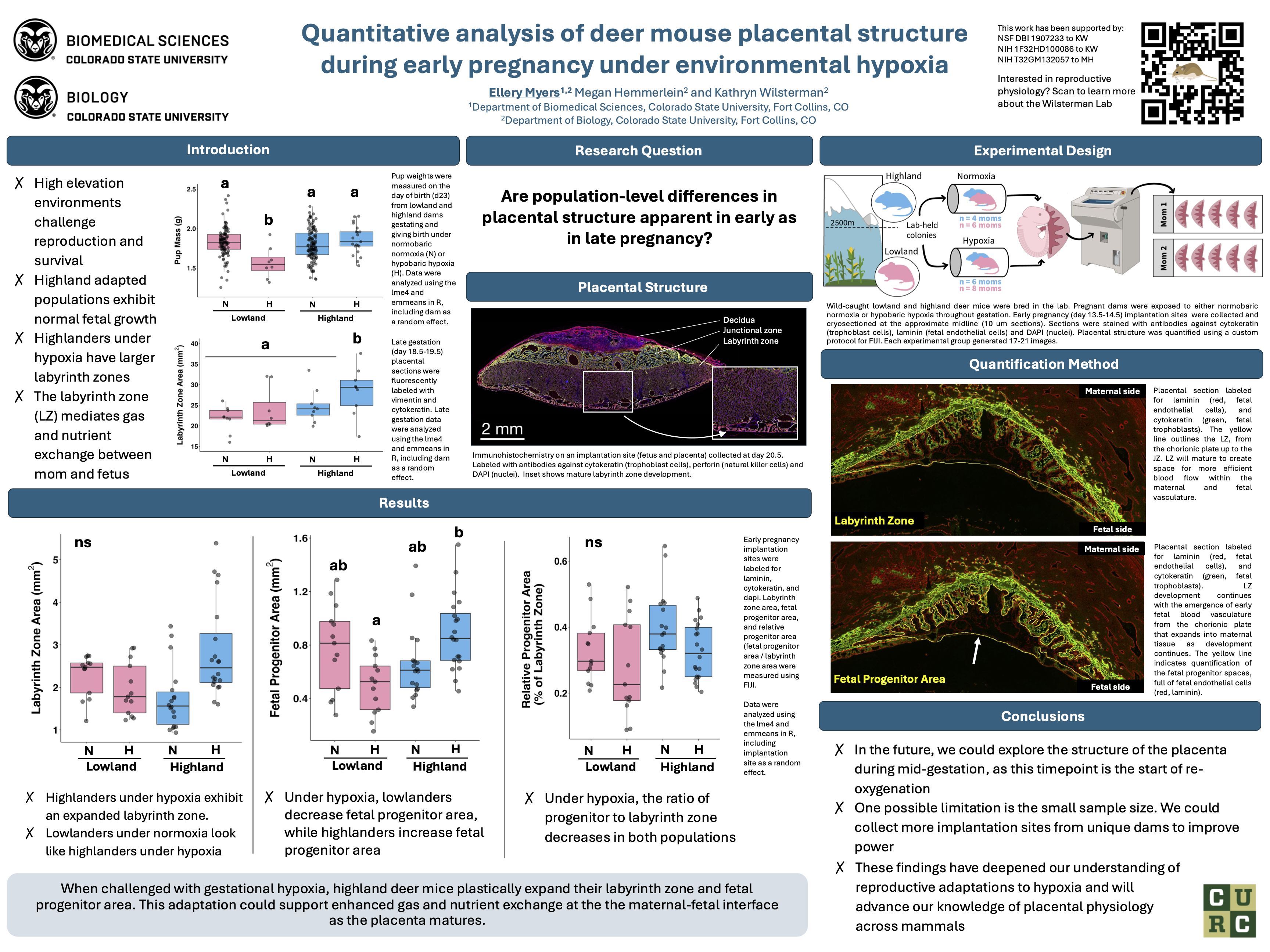
Evolutionary adaptations can play an important role in supporting successful reproduction and survival in novel and challenging environments. Lowland-ancestry populations experience fetal growth restriction at high elevations, while adapted populations exhibit normal fetal growth. However, the developmental origins of these differences remain unclear. The Wilsterman Lab at CSU uses a comparative model system (Peromyscus maniculatus), to understand the physiological and developmental adaptations that contribute to fetal growth protection. To understand how early developmental adaptations impact fetal growth, we subjected deer mice derived from Mt. Blue Sky, CO (4300 m ASL; highlanders) and Lincoln, NE (616 m ASL; lowlanders) to either normobaric normoxia or hypobaric hypoxia (equivalent to 4300 m) throughout pregnancy. We collected early pregnancy (day 13.5-14.5) implantation sites (intact fetus + placenta) from 4-8 unique dams within each experimental group. We collected 10 um cryosections from each implantation site at the approximate midline for immunohistochemistry. We labeled the placentas with antibodies against cytokeratin to mark trophoblast cell structures, laminin to outline the basal membrane, and DAPI to highlight nuclei. Together, these labels provide a comprehensive view of placental structure. We captured 17-21 images per experimental group and quantified the labyrinth zone and the fetal blood spaces within it using a custom protocol created for FIJI. We predict highlanders will have more developmentally mature placenta that can withstand adverse environments, thus protecting fetal size in highland adapted deer mice. Our findings will deepen our understanding of reproductive adaptations to hypoxia and advance our knowledge of placental physiology across mammals.