
Exploring Storage Features at Bull Draw Shelter, Site 5MF607, Moffat County, Colorado
Category: Research Poster
Author(s): Ella Lang
Presenter(s): Ella Lang
Mentors(s): Jason La Belle
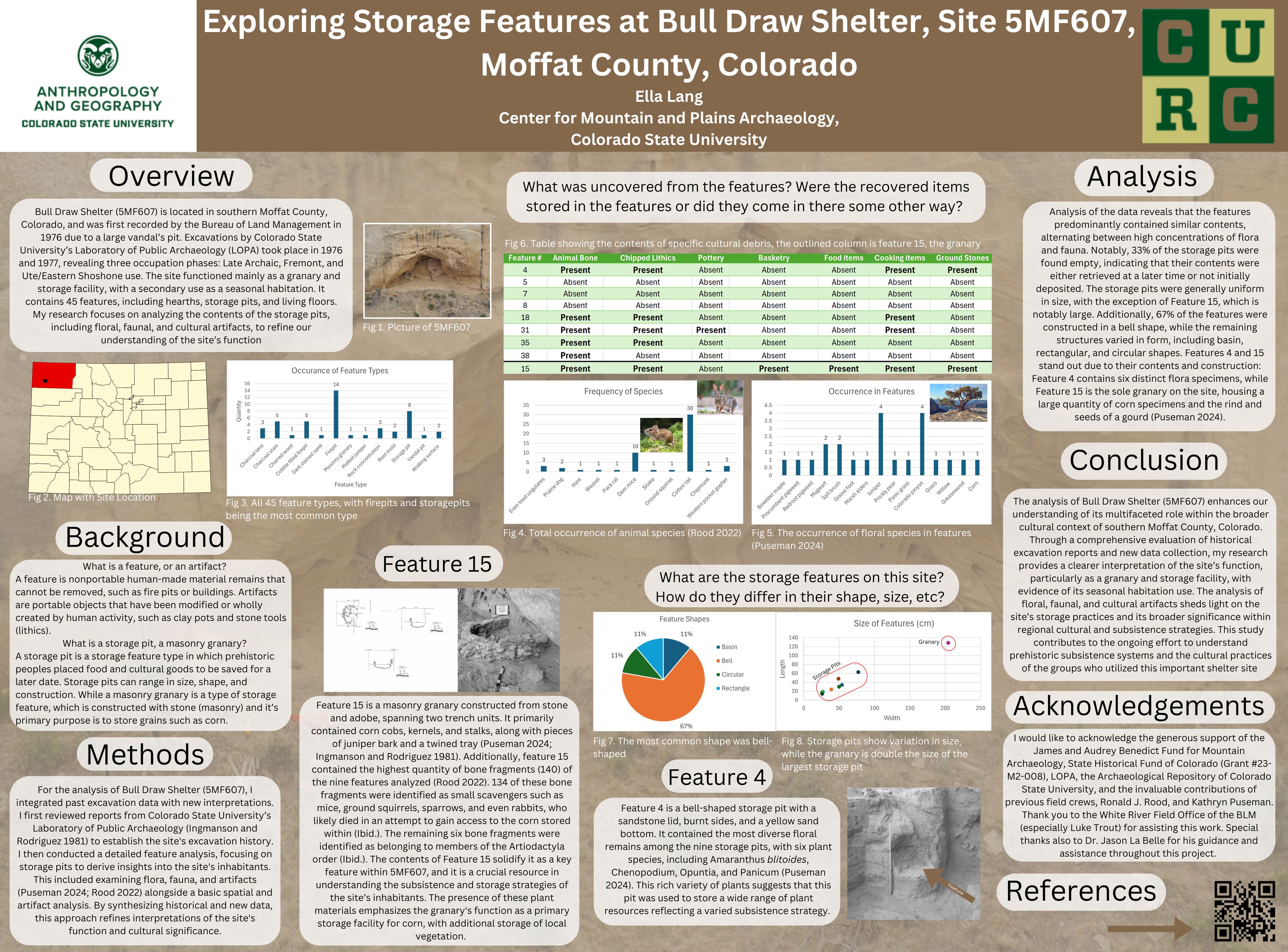
Bull Draw Shelter (5MF607) is located in a small canyon in southern Moffat County, Colorado. The Bureau of Land Management first recorded the site in 1976, noting a large vandal’s pit in the interior of the shelter. Colorado State University’s Laboratory of Public Archaeology followed this initial recording and undertook excavations in the shelter in both 1976 and 1977. LOPA first exposed and profiled the looted pit and then expanded horizontally to expose other areas of the shelter. They produced a draft report of the excavation in 1981, though no final report was ever completed. Recently, CSU’s Center for Mountain and Plains Archaeology has revisited and remapped the site and begun systematic work with the collections in preparation for a final report. Based on LOPA’s work, this large rock shelter exhibits three distinct occupation phases, including Late Archaic, Fremont, and later Ute and/or Eastern Shoshone use, and is argued to have functioned primarily as a granary and storage facility, with secondary use as a seasonal habitation. 5MF607 contains 45 features, including hearths, storage pits, and living floors. As part of the final reporting, my poster provides a thorough examination of the 5MF607 features, focusing on the contents of the storage pits and granary, in terms of floral, faunal, and cultural artifacts. My work aims to refine our understanding of the site’s function and the relationship between these features and what was stored within them thousands of years ago.