
Identifying Short-Term Occupation through Mass Analysis: Insights from Texas Creek Overlook (5RB2435) Rio Blanco County, Colorado
Category: Research Poster
Author(s): Katie Calhoon
Presenter(s): Katie Calhoon
Mentors(s): Jason La Belle
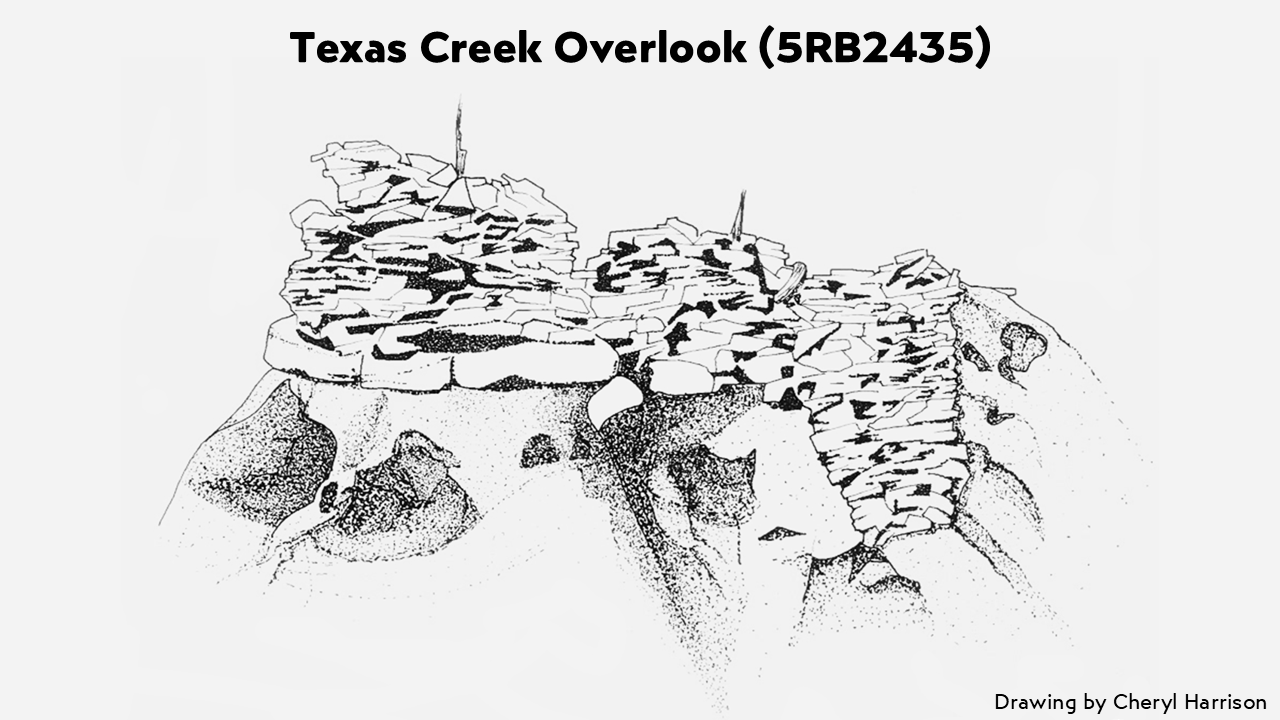
Texas Creek Overlook (5RB2435) is an archaeological site located in Rio Blanco County, Colorado. It features a wet-laid masonry structure situated atop a small sandstone pinnacle overlooking the Colorado Plateau. The site is culturally affiliated with the Fremont, a pre-contact Native American culture that inhabited the region until approximately A.D. 1300. In 1983, Western Wyoming College conducted excavations at Texas Creek Overlook and identified three rooms within the masonry structure. Of the artifacts recovered, 98% consisted of flaked lithic debris. Based on these findings, Creasman and Scott (1987) argued the site functioned as a habitation and faunal procurement camp. However, the nature of habitation, in terms of the duration of site occupation (short-term versus long-term), remains unknown. Additionally, the spatial distribution of flaked lithic debris via density per square meter, per excavated room, remains unknown. Such facets of Texas Creek Overlook can be explored primarily through mass analysis, supplemented by image analysis software and lithic tool analysis. This research deepens our collective understanding of the Fremont culture while demonstrating the importance of curated collections—preserved not only to examine the past, but to support ongoing inquiry as new technologies and questions emerge. By integrating archaeological investigation with museum curation, this project emphasizes the power of hands-on, interdisciplinary learning, which offers students a rare opportunity to engage directly with the past and develop skills, along with a sense of purpose, that extends far beyond the classroom.