
Bioinformatic Analysis of Crustacean Myostatin
Category: Research Poster
Author(s): Leah Hasstedt
Presenter(s): Leah Hasstedt
Mentors(s): Donald Mykles, Talia Head
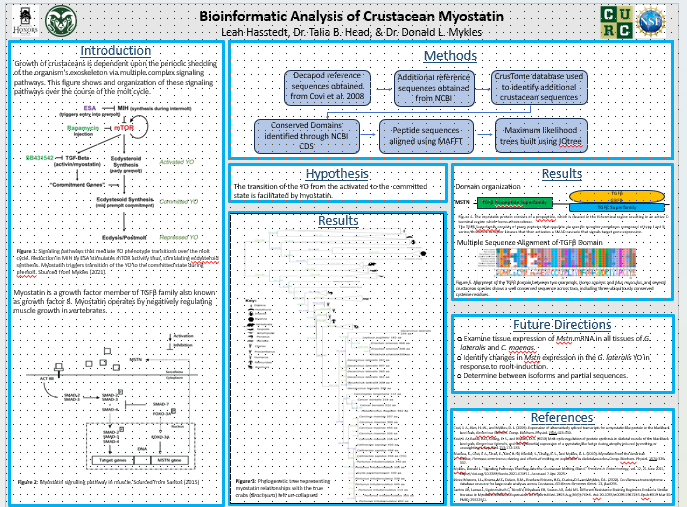
Molting in crustaceans is the process through which a crustacean sheds its exoskeleton to grow. This process is hormonally regulated by two endocrine glands, the X-organ (XO) and the Y-organ (YO). The YO synthesizes and secretes molting hormones called ecdysteroids that cause an animal to progress towards molting. Molting is a cyclical process through which the YO transitions through four physiological states, basal, activated, committed, and repressed. Myostatin, also called growth differentiation factor 8 (GDF8), is characterized as an inhibitor of protein synthesis in muscles, however we believe that it may also play a role in the transition from the activated to the committed state in the YO. The purpose of this research is to characterize myostatin in crustaceans. Phylogenetic analysis of crustacean myostatin was inferred using a transcriptomic database from 189 crustaceans. Preliminary data suggests that crustaceans express two isoforms of myostatin, which differ by eight amino acids in the propeptide domain. Expression of myostatin in the YO of the blackback land crab, Gecarcinus lateralis, in response to the molt induction techniques multiple leg autonomy (MLA) and eye stalk ablation (ESA) was assessed from transcriptomic data. Future work will characterize the myostatin receptor, an activin type 2 receptor, to predict the role of myostatin signaling in the crustacean YO across the molt cycle.