
Signs of Accelerated Brain Aging in Young Adults with Mild Traumatic Brain Injuries
Category: Research Poster
Author(s): Riley Budzien
Presenter(s): Riley Budzien
Mentors(s): Jaclyn Stephens
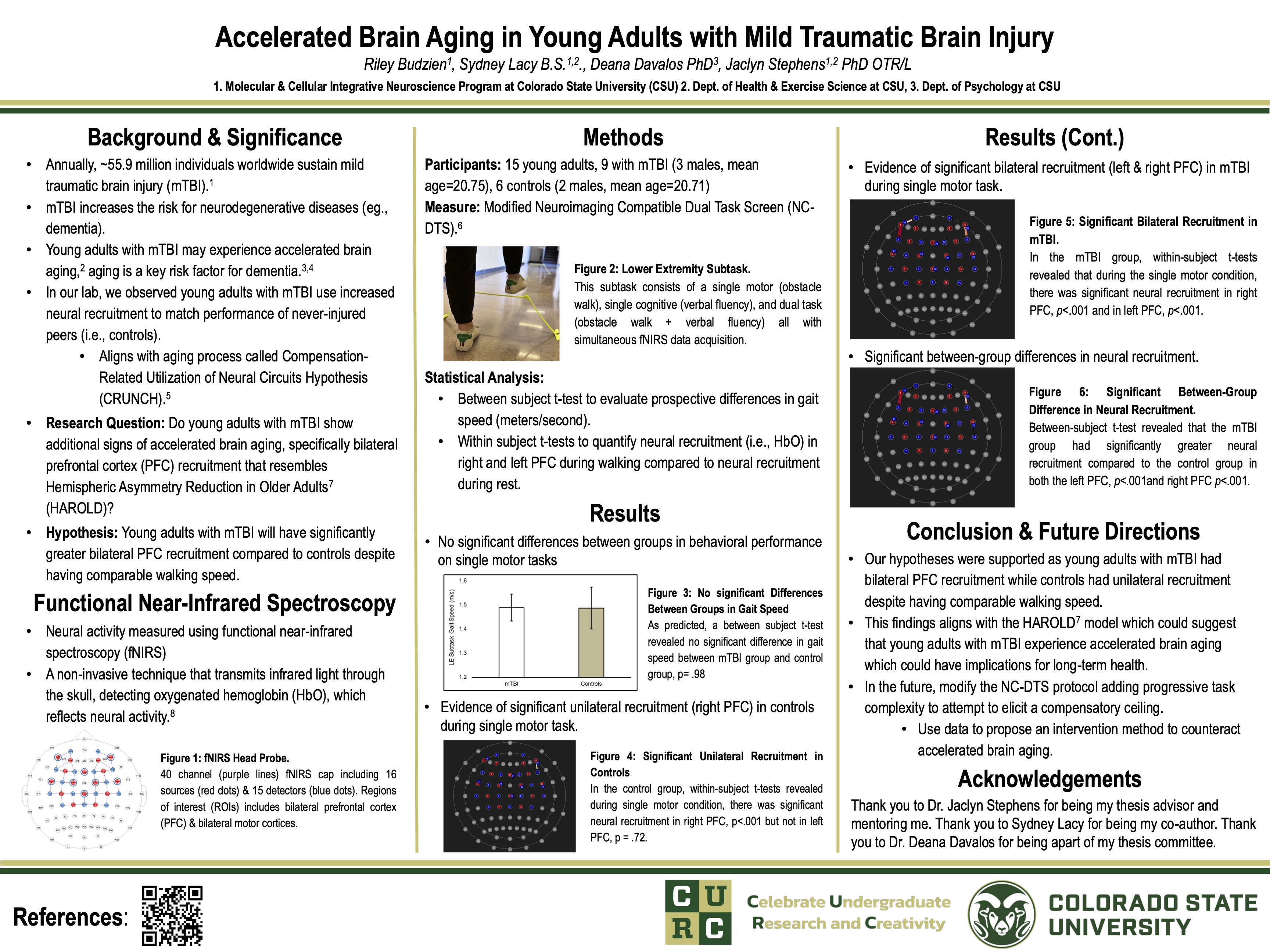
Background: Young adults with mild traumatic brain injury (mTBI) have an increased risk of developing neurodegenerative diseases (e.g., dementia) and may experience accelerated brain aging. Our lab has found evidence of accelerated brain aging in young adults with mTBI; specifically, we observed compensatory neural recruitment in right prefrontal cortex (PFC) which resembles recruitment patterns of older adults. Methods: To test for additional signs of accelerated brain aging, we tested 15 young adults, 9 with mTBI (3 males, mean age=20.75) and 6 controls (2 males, mean age=20.71). We hypothesized that young adults with mTBI would show greater bilateral PFC recruitment compared to controls during a walking task. We used the functional near-infrared spectroscopy to measure neural recruitment (using a proxy measure of oxygenated hemoglobin, HbO) during walking. We used within subject t-tests to quantify neural recruitment (i.e., HbO) in right and left PFC during walking compared to neural recruitment during rest. Results: In the control group, within-subject t-tests revealed that during the single motor condition, there was significant neural recruitment in right PFC, p <.001 but not in left PFC, p =.72. However, in mTBI, within-subject t-tests revealed that during the single motor condition, there was significant neural recruitment in both right PFC, p<.001 and left PFC, p<.001. Conclusions: Our hypotheses were supported, as we saw that young adults with mTBI had bilateral PFC recruitment while controls had unilateral recruitment. These findings may suggest that young adults with mTBI experience accelerated brain aging which could have implications for their long-term health.