
Seasonal and Diel Regional Temperature-Elevation Gradients across Northern Colorado
Category: Research Poster
Author(s): Ryder Hunt, Benjamin Thompson
Presenter(s): Ryder Hunt
Mentors(s): Steven Fassnacht
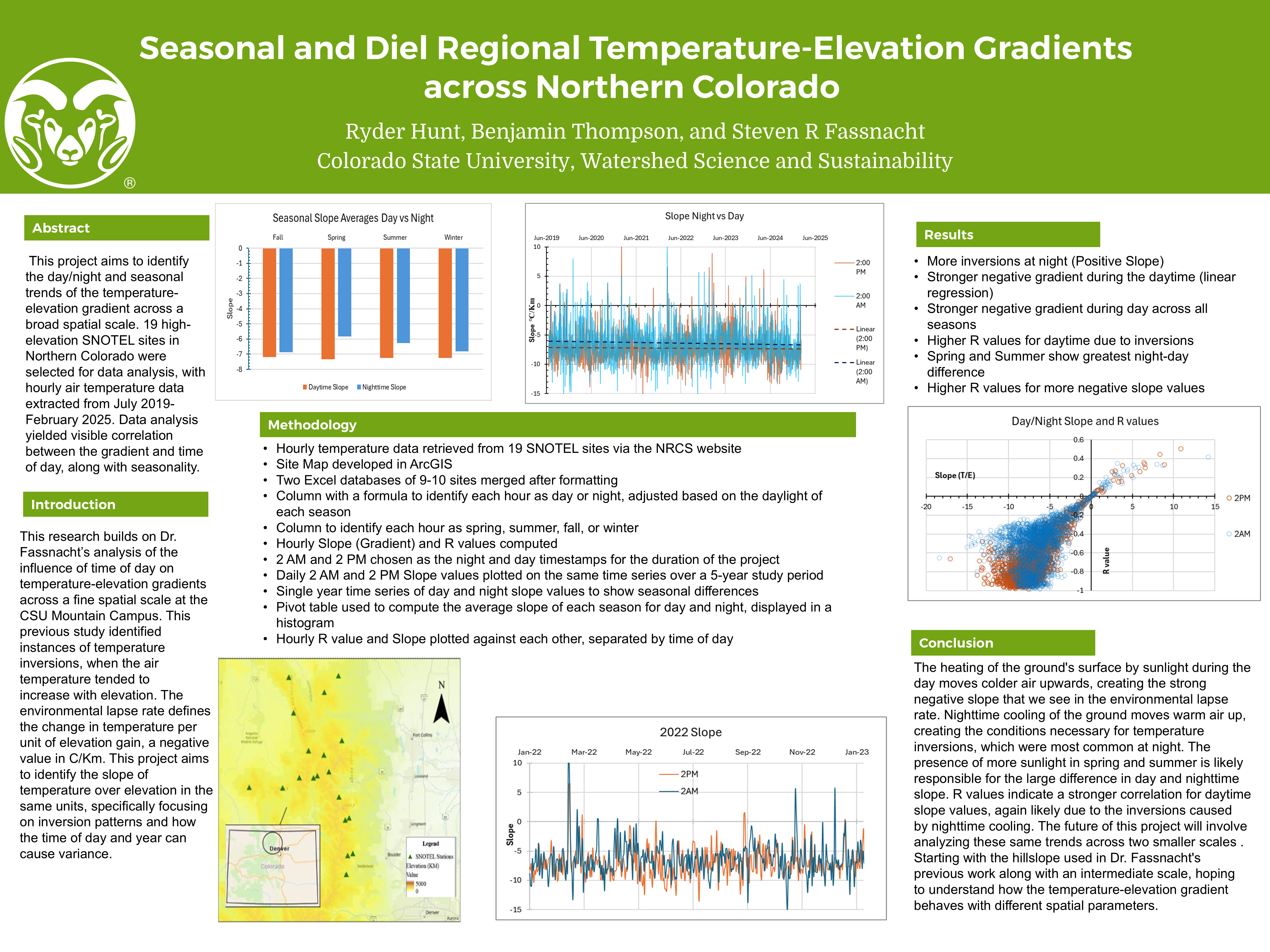
Air temperature decreases with increased elevation, and physics dictates that the change in temperature of free air is a function of the moisture in the air, called the lapse rate. For wet air, this is about 5.5 degrees Celsius per kilometer, and for dry air, it is about 9.8 C/km. However, for air temperature near the ground, this change in temperature with elevation can vary very locally, and even regionally. We used the hourly temperature data from 20 Natural Resources Conservation Service (NRCS) SNOTEL stations for six years (2019 to 2025) to assess the temperature-elevation gradient (Γ) over Northern Colorado. We also examined the fit of the Γ correlation from the Pearson correlation coefficient (ρ) as a function of time of day and time of year. It was found variability in the gradient (Γ) and in the fit (ρ) for day versus night (diel) and seasonally. Spring exhibited the strongest correlation (R²) in a regression model of mean seasonal temperatures and elevation. Further, certain stations were persistent outliers from the Γ correlation. We examined the specific location and magnitude of those outlier stations.