
DNA Damage: The Role Enzymes Play in Deaminated Base Repair
Category: Research Poster
Author(s): Rayia Adams
Presenter(s): Rayia Adams
Mentors(s): Thomas Santangelo
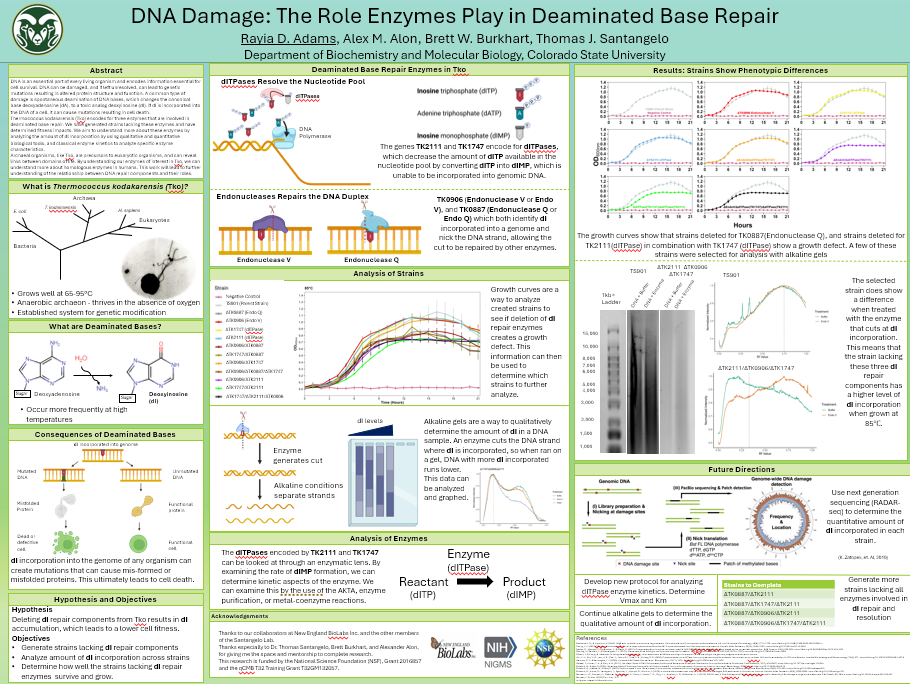
DNA is an essential part of every living organism and encodes information essential for cell survival. DNA can be damaged, and if left unresolved, can lead to genetic mutations resulting in altered protein structure and function. Cells encode enzymes that resolve many types of DNA damage. A common type of damage is spontaneous deamination of DNA bases, which changes the canonical base deoxyadenosine (dA), to a toxic analog deoxyinosine (dI). If dI is incorporated into the DNA of a cell, it can cause mutations resulting in cell death. Thermococcus kodakarensis (Tko) is an archaeal organism that thrives at high temperatures, which result in increased rates of deamination, making it a great model organism for us to study. Tko encodes for four enzymes that are involved in deaminated base repair. We have generated strains lacking all four of these enzymes in every possible combination and have determined fitness impacts. We aim to understand more about these enzymes by analyzing the amount of dI incorporation by the use of qualitative and quantitative biological tools, and classical enzyme kinetics to analyze specific enzyme characteristics. Archaeal organisms, like Tko, are precursors to eukaryotic organisms, and can reveal links between domains of life. By understanding our enzymes of interest in Tko, we can understand more about homologous enzymes in humans. This work will lead to further understanding of the relationship between DNA repair components and the role these components play in differing domains of life.