
Changes in hydro-climate variables for the Loch Vale Watershed
Category: Research Poster
Author(s): Bradley Beck
Presenter(s): Bradley Beck
Mentors(s): Carolina Barbosa, Jill Baron
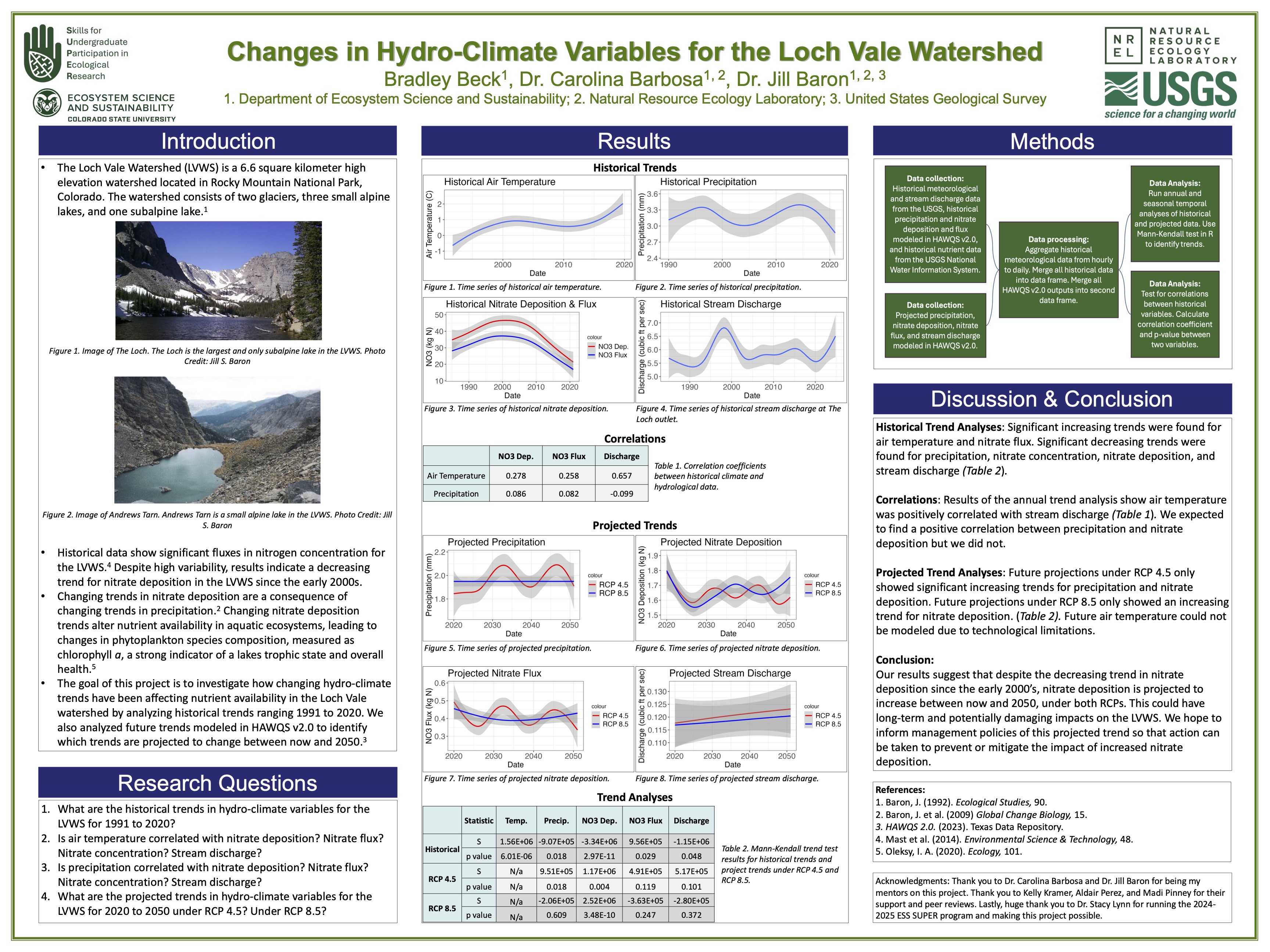
The Loch Vale Watershed (LVWS) is a high elevation watershed located in Rocky Mountain National Park, Colorado. Past studies on high elevation watersheds, such as the LVWS, have shown that these ecosystems are particularly vulnerable to the effects of climate change. The goal of this project is to analyze and discuss historical seasonal trends in hydro-climate data and their impact on nutrient concentrations in the LVWS. The historical data being analyzed was collected by the LVWS Long-term Ecological Research & Monitoring Program, starting in 1982. The historical data analyzed in this project ranges from 1991 to 2020. We will compare historical with future trends modeled using the Hydrologic and Water Quality System (HAWQS ) version 2.0. Significant historical trends of increasing daily mean temperatures and decreasing nitrate deposition were only found in winter seasons. Three global climate scenarios (GCM’s) were used to model the LVWS under RCP 4.5 and RCP 8.5 scenarios. Future trends were modeled from 2020 to 2050. Future outputs modeled by HAWQS show increasing annual trends in precipitation and nitrate deposition. Further analysis shows that precipitation and nitrate deposition trends are correlated.