
The Effect of Exogenous Quinolinate on Mycobacterium tuberculosis Growth
Category: Research Poster
Author(s): Cice Kim, Linda Fischbacher
Presenter(s): Cice Kim
Mentors(s): John Belisle
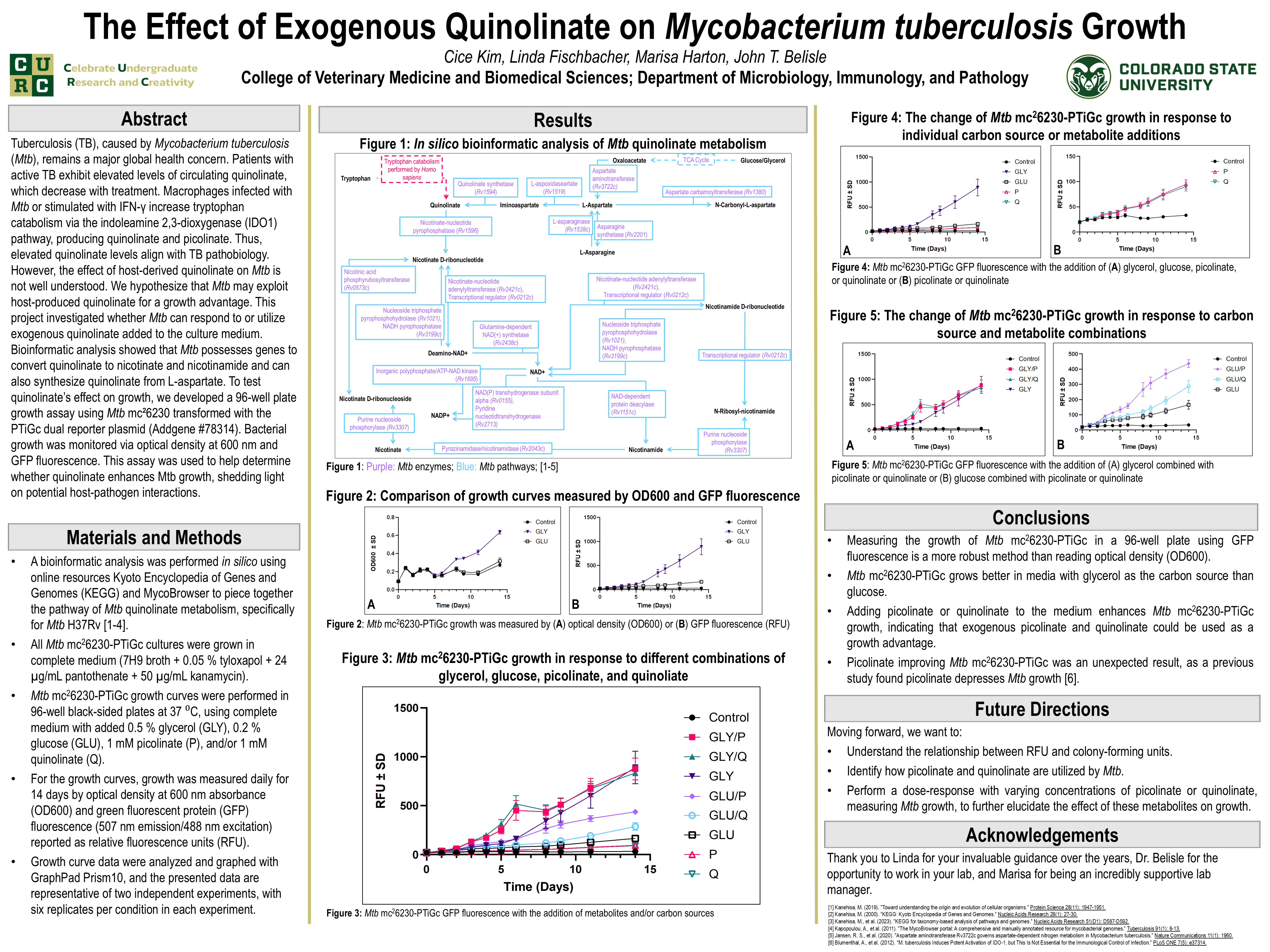
Tuberculosis (TB), caused by Mycobacterium tuberculosis (Mtb), remains a leading global health concern. Previous analyses demonstrate increased levels of circulating quinoa intake in patients with active TB and a drop in these levels with treatment. Innate immune cells, such as macrophages, infected with Mycobacterium spp. or stimulated with IFN-gamma increase the catabolism of tryptophan via the indoleamine 2,3-deoxygenate (IDO1) pathway, resulting in quinolinate production. Thus, elevates levels of circulating quinolinate are consistent with the underlying pathobiology of TB. However, the direct impact of host derived quinolinate on the Mtb pathogen remains unclear. Our overall hypothesis is that Mtb can use the host-produced quinolinate to achieve a growth advantage. This project aims to test wether Mtb can respond to or utilize exogenous quinolinate when added to the culture medium. A bioinformatics analysis of quinolinate metabolism in Mtb showed that Mtb has the genes for the enzymes to convert quinolinate to nicotinate and nicotinamide, but is also capable of forming quinolinate from aspartate. To assess the growth of Mtb in the presence of quinolinate, we are establishing a 96-well plate growth curve using Mtb mc26230 transformed with the PTiGc mycobacterial dual reporter plasmid (addgene: #78314). The assay measures bacterial growth by reading optical density at 600 nm and GFP fluorescence. Using this growth curve assay, Mtb-PTiGc growth in the presence of quinolinate is being assessed to help elucidate wether Mtb benefits from host quinolinate.