
Dwarfing Plants through the Genetic Manipulation of GA Signaling Pathways
Category: Research Poster
Author(s): Liz Carlsen
Presenter(s): Liz Carlsen
Mentors(s): Arjun Khakhar, Tawni Bull
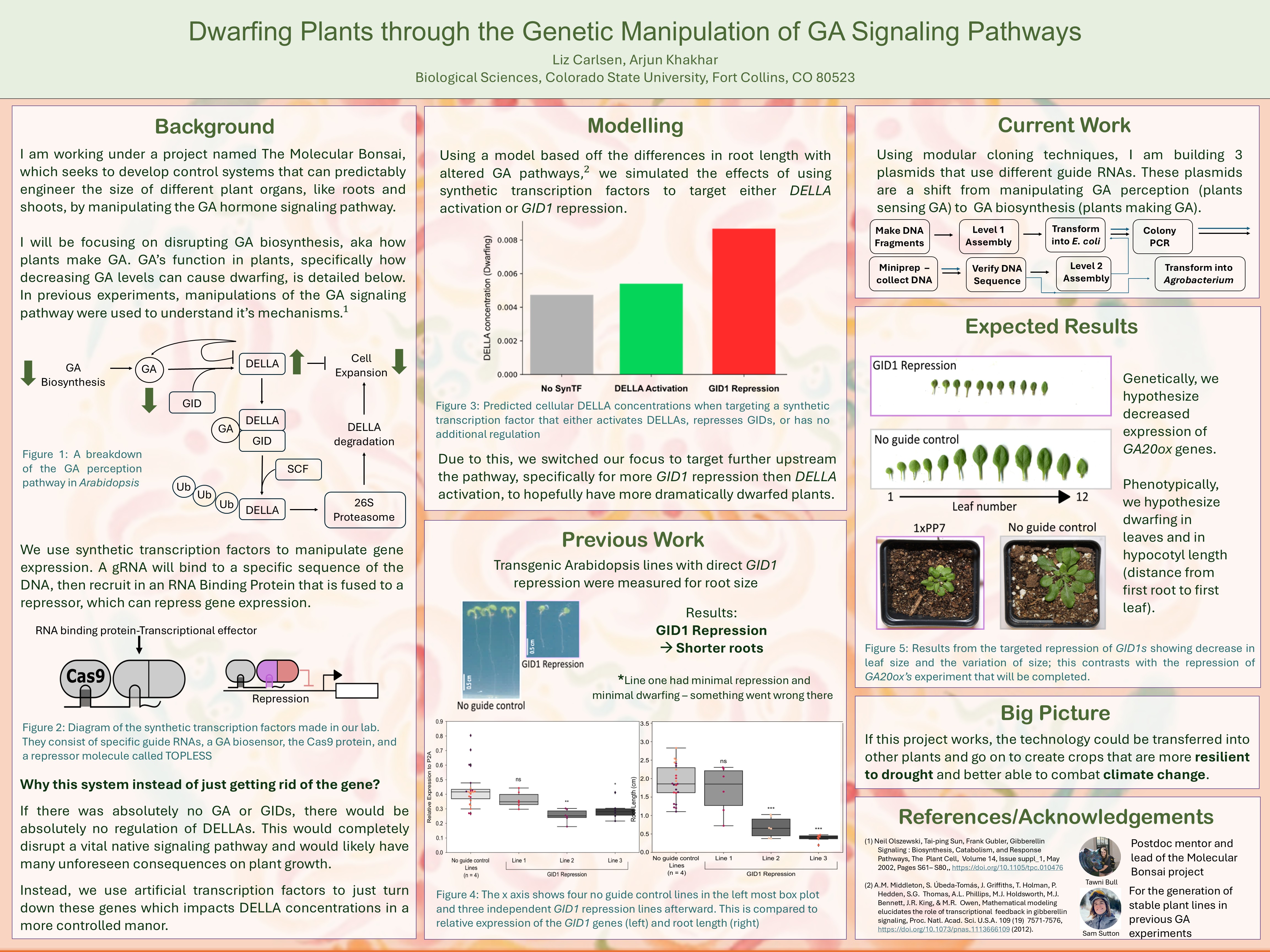
I am working under a project named The Molecular Bonsai, which seeks to create inducible systems in plants to artificially increase their root size while decreasing stem size. This should lead to them being more drought resistant, and in turn more resistant to climate change. Previously my lab directly activated a ‘growth suppression protein’ called DELLA in order to get a dwarfed plant, but a new modelling system predicted a larger effect with GID1 repression then with DELLA activation. We have already seen some root dwarfing in GID1 repression concurrent with the expression of our added genetic material, so this appears to be a fruitful line of experimentation. I am currently building three different plasmids containing different guide RNAs, a GA biosensor, some Cas9, and a repressor using modular cloning. This will target an enzyme called GA20ox which is vital for the biosynthesis of GA. Specifically, the GA20ox gene will be repressed by having Cas9 and a repressor bound to it, preventing the binding of DNA polymerase and therefore preventing transcription of the gene. Less GA means there are fewer GID1-GA complexes, and because GID1-GA complexes degrade DELLA, should lead to an increased concentration of DELLA, which would theoretically then dwarf plant growth. If this project works, it could be used in the Molecular Bonsai project for a more effective dwarfing of part of a plant, and hopefully go on to create crops that have resilience to climate change.