
Associations between Thalamic Volume and Motor Impairment in People with Multiple Sclerosis
Category: Research Poster
Author(s): Kaylee Sandefur
Presenter(s): Kaylee Sandefur
Mentors(s): Brett Fling
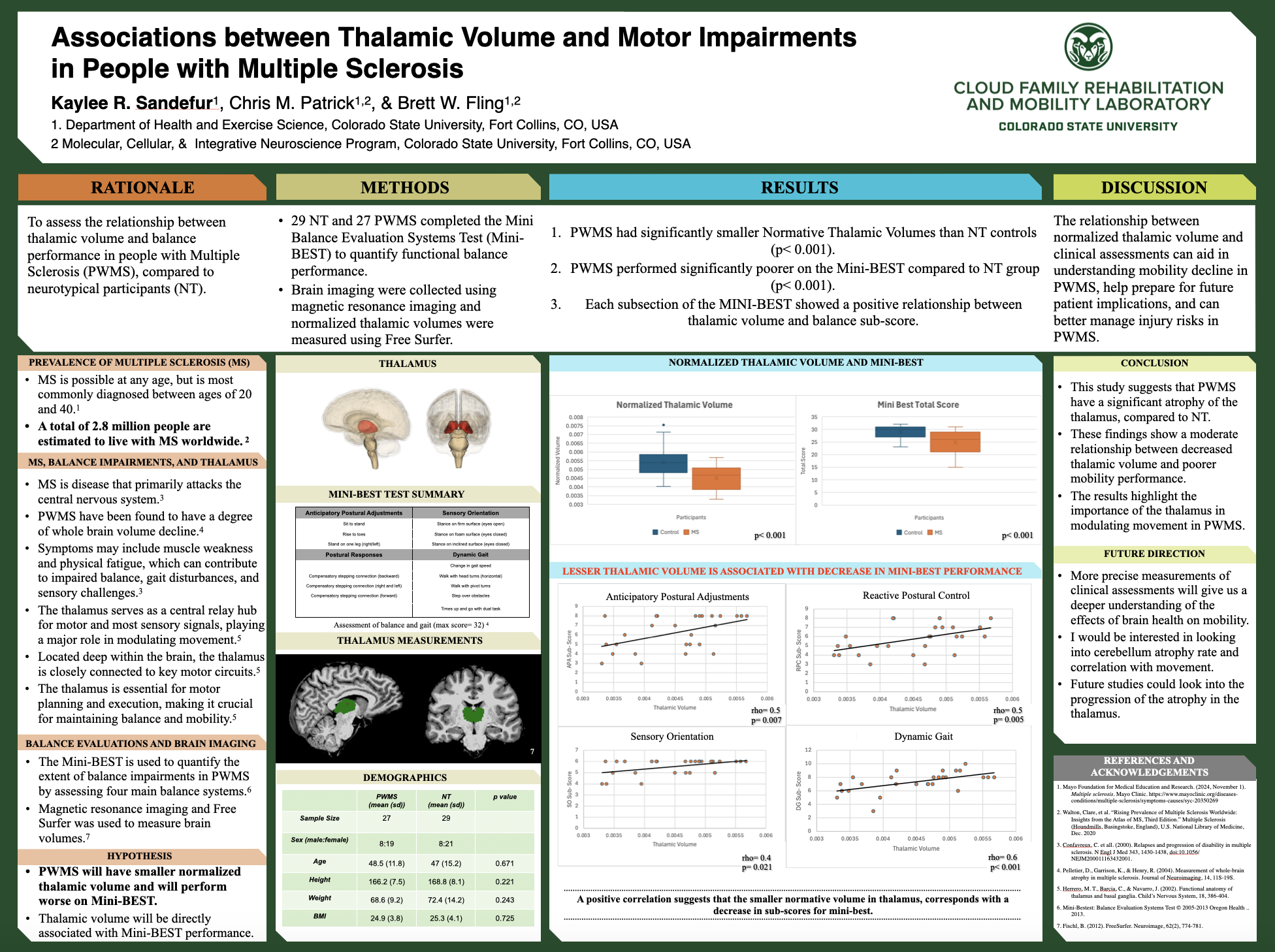
Multiple Sclerosis (MS) is a nervous system disease in which the immune system abnormally attacks the myelin sheath, a fatty layer that insulates and protects neurons. Damage to the myelin sheath leads to impaired neural communication and subsequent adverse health. Our understanding of these neural impairments, including their identification, monitoring, and treatment, remains limited. Brain imaging offers a tool for connecting brain health and symptomology in MS, by identifying areas of atrophy, injury, or structural changes, and linking these to clinical symptoms. The thalamus is a vital brain region that receives all sensory information entering the nervous system, except for smell, and relays it to cortical regions for processing. The thalamus is also highly interconnected with motor circuits, highlighting its role in modulating movement. While recent research has linked thalamic volume to impaired cognitive function and aerobic fitness, its relationship with clinical mobility and balance tests remains unclear. Therefore, the purpose of this study was to assess the relationship between thalamic volume and balance performance in individuals with MS compared to healthy controls. Brain scans were collected using magnetic resonance imaging and brain and thalamic volumes were measured for each participant using Free Surfer. Participants completed the Mini Balance Evaluation Systems Test to evaluate four main balance systems: anticipatory postural adjustments, postural control, sensory orientation, and dynamic gait. This study builds on efforts to characterize the impact of brain health on mobility and balance, by examining the relationship between thalamic volume and clinical assessments of mobility and balance.