
Monitoring insecticide resistance in major sugar beet pests
Category: Community Engagement Poster
Author(s): Ana de Zoeten, Ashley Raffa, Punya Nachappa
Presenter(s): Ana de Zoeten
Mentors(s): Max Schmidtbauer
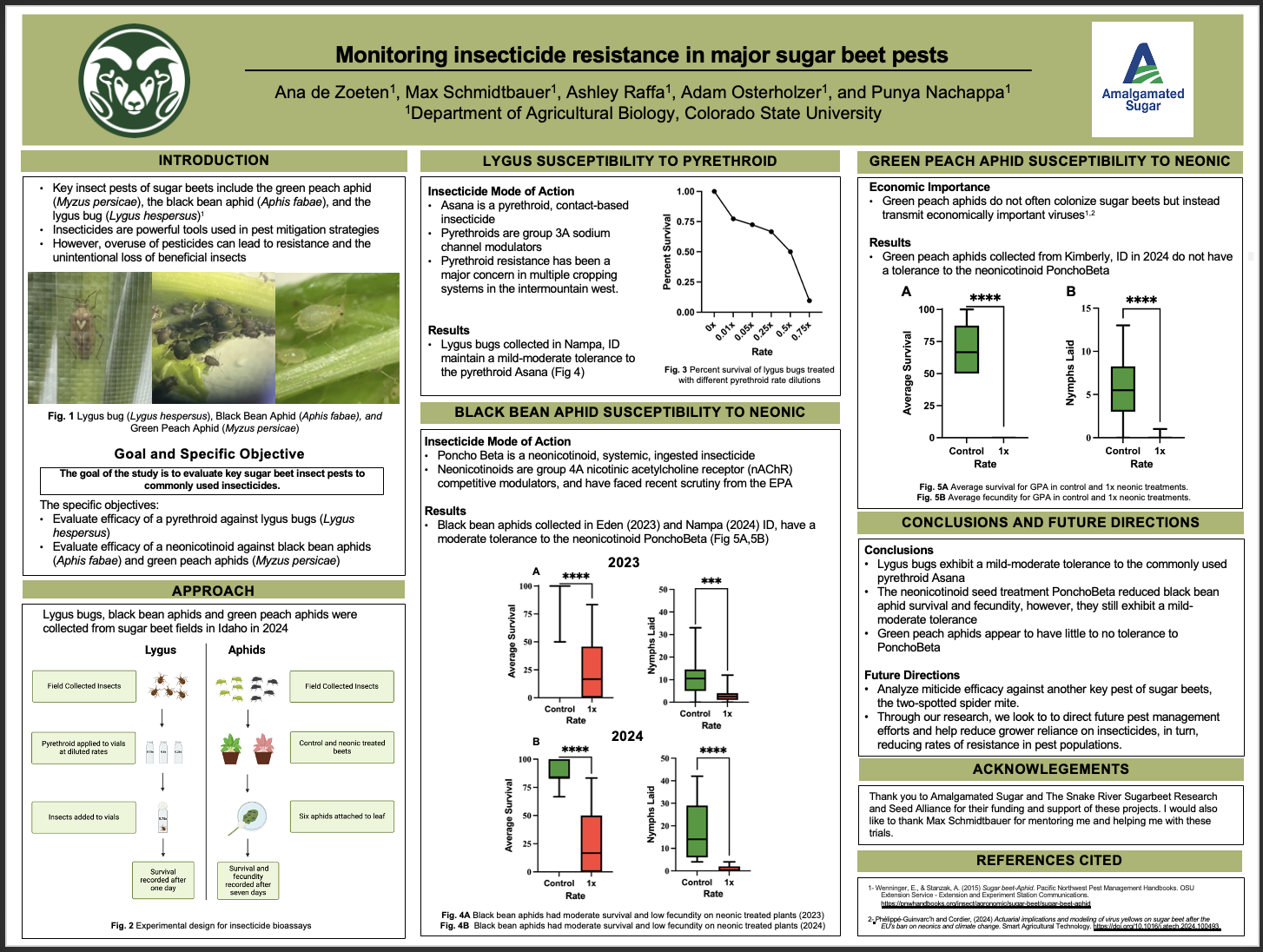
The Intermountain West is home to a thriving sugar beet industry. Idaho, with its temperate climate and access to the Snake River Basin, is consistently one of the top sugar beet producing states in the country. Sugar beet profits are based primarily on three criteria: yield, sucrose content, and sucrose recovery efficiency, but these criteria are certainly affected by insect pests. Insecticides are therefore a powerful tool used in pest mitigation strategies; however, overuse can lead to resistance within pests and the unintentional loss of beneficial insects. As a result of this, there is an apparent need to assess key pest susceptibility to commonly used insecticides. The goal of this research is to determine black bean aphid (Aphis fabae) and green peach aphid (Myzus persicae) resistance to a neonicotinoid, and lygus bug (Lygus hespersus) resistance to a pyrethroid. We hypothesize that our field collected insects will express some level of resistance to both insecticides. Preliminary data suggests that black bean aphids have some resistance to the neonicotinoid, but green peach aphids do not. It also shows that lygus bugs have a moderate resistance to the pyrethroid Asana. The future direction of this project is to evaluate insecticide efficacy on spider mites, another devastating pest of sugar beets. The long-term goal for this research is to help direct future pest management efforts to reduce the overuse of insecticides, in turn, mitigating rates of resistance in pest populations.