
Spatial and Temporal Patterns in Snowpack Density over 1-km2 Areas to Inform Sampling for Mountain Sites in Colorado
Category: Community Engagement Poster
Author(s): Carson Bainbridge, Steven Fassnacht
Presenter(s): Carson Bainbridge
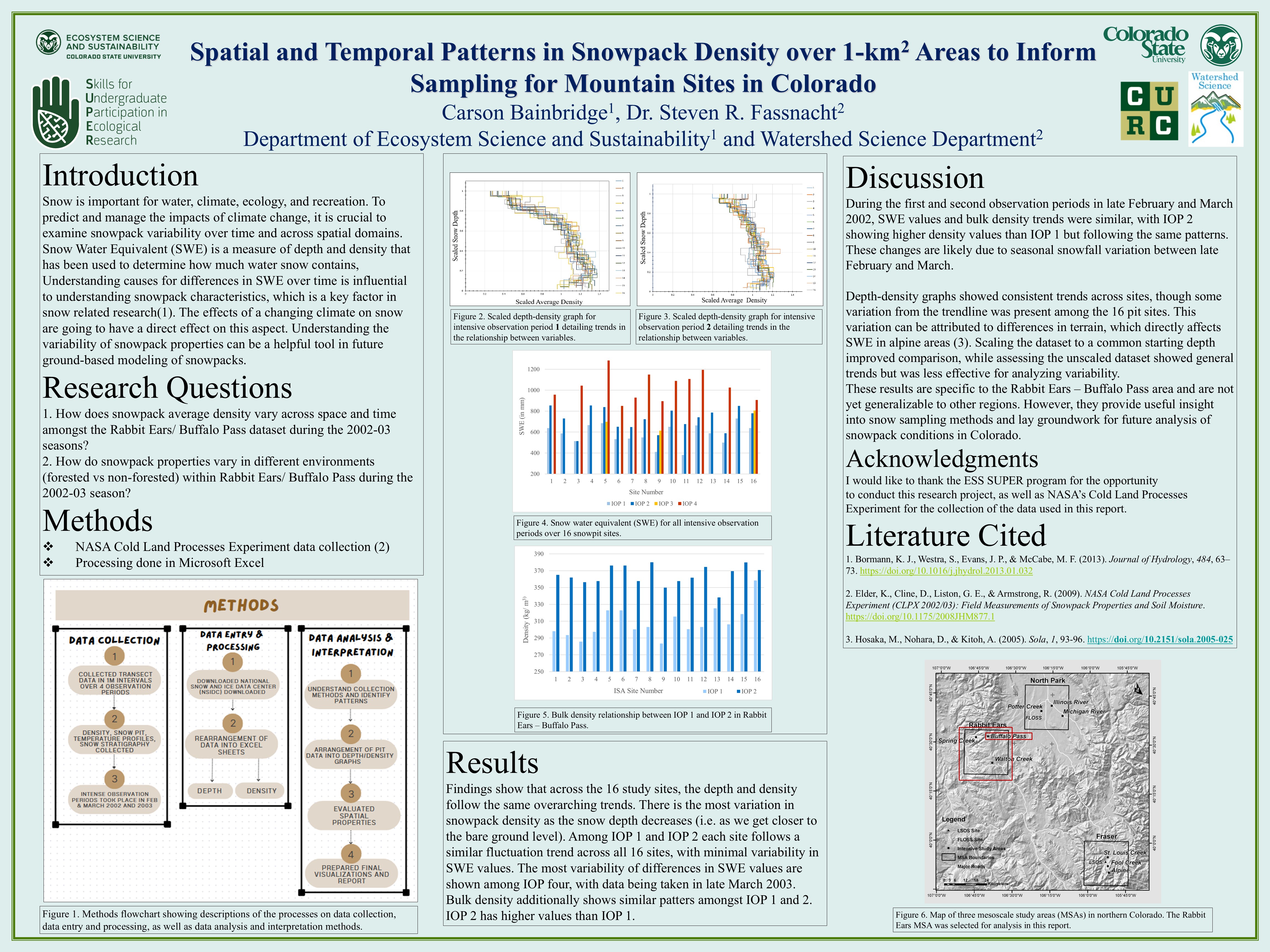
Snowpack properties vary over both space and time and can be important to understand when dealing with water resource management, understanding and modeling climate, estimating ecological health, and managing winter recreation. The data was downloaded from the National Snow and Ice Data Center (NSIDC) to understand the properties of snowpack in Rabbit Ears/ Buffalo Pass Colorado. Data collection took place during NASA’s Cold Land Processes Experiment in 2002 and 2003 in late February and late March. Ground-based sampling measured density, depth, temperature, and stratigraphy. The Rabbit Ears Pass dataset was analyzed spatially and temporally to determine trends within and amongst different terrains and elevations. Density and depth were analyzed to determine variability amongst 16 randomized sites within the area. Results found little variation within the RBSP data for observation periods one and two. Bulk density and snow water equivalent analysis for each IOP showed results, but they are explained by the increase in snowfall from late February to late March. This information will inform future research on sampling snowpack in high-alpine areas such as Colorado.