
Insect-Specific Virus Presence in Mosquitos at the Center for Vector-Borne and Infectious Diseases at CSU
Category: Research Poster
Author(s): Lila Domenico
Presenter(s): Lila Domenico
Mentors(s): Gregory Ebel, Kaitlynn Williams
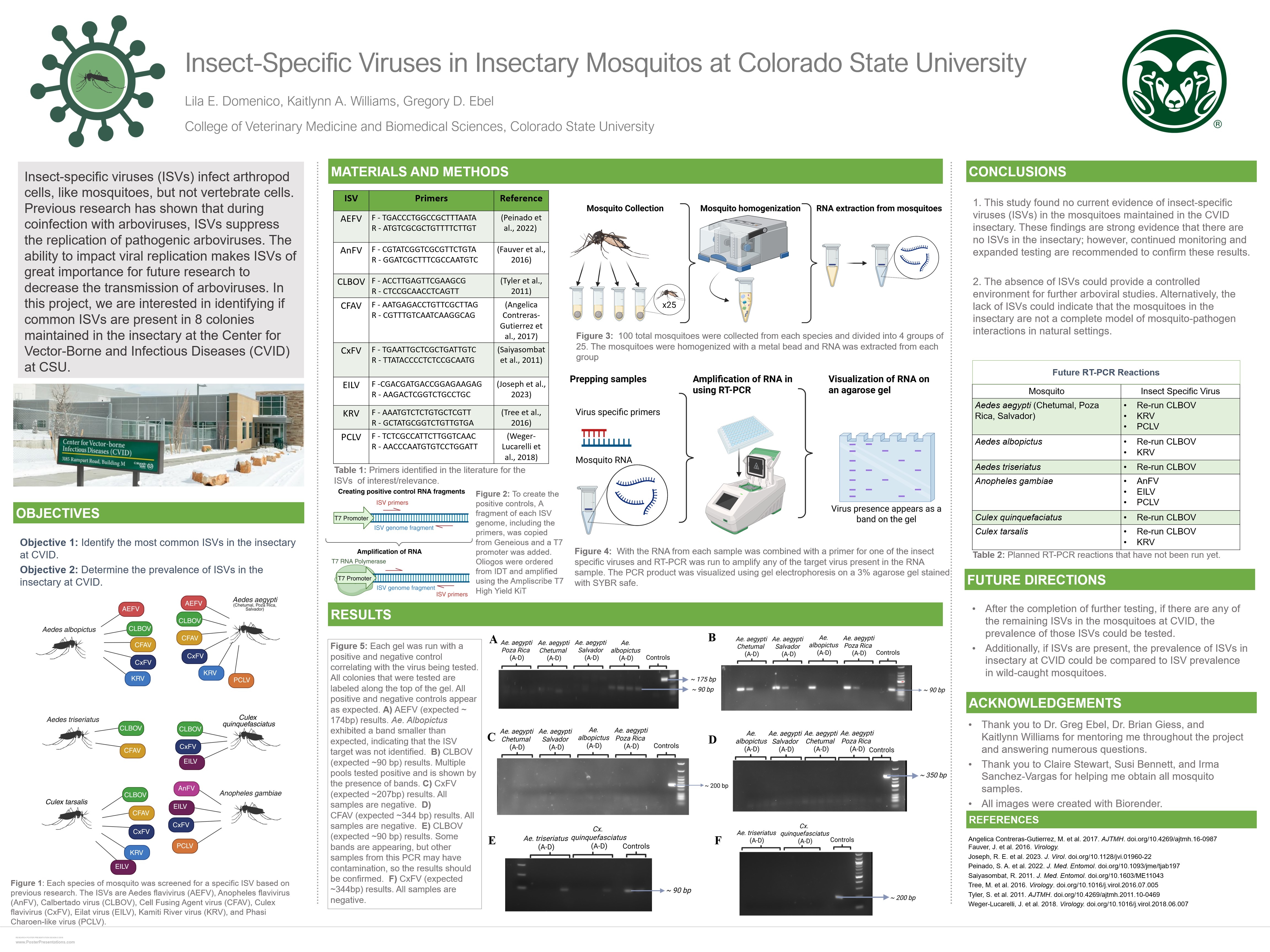
Insect-specific viruses (ISVs) infect arthropod cells, like mosquitoes, but not vertebrate cells. Previous research shows that ISVs decrease the growth of other arboviruses like West Nile virus when mosquitoes are coinfected. Because of this ability to decrease arboviral growth and their inability to replicate in vertebrate cells, future research is expanding on biocontrol applications of ISVs. With research into arboviruses being completed at facilities like the Center for Vector-Borne and Infectious Diseases (CVID), ISV presence in the mosquitoes used to study these diseases could impact the results dependent on infecting mosquitoes with arboviruses. We determined which ISVs are commonly found in mosquito populations and used RT-PCR to screen multiple colonies of mosquitoes in the insectary at CVID. We screened for Culex flavivirus, Aedes flavivirus, Anopheles flavivirus, Cell fusing agent virus, Phasi Charoen-like virus, Kamiti River Virus, Eilat Virus, and Calbertado virus. We collected mosquitoes from different colonies of Aedes triseriatus, Aedes aegypti, Aedes albopictus, Culex quinquefasciatus, and Culex tarsalis from the insectary for screening. RNA was extracted from homogenates for each species and we will run RT-PCR on each sample using previously published primers for common ISVs. Knowing the presence and prevalence of ISVs in mosquitoes in the insectary at CVID could help establish our ability to obtain accurate results from future experiments on arboviruses.