
Characterization of Beet Curly Top Virus Strains and Their Transmission Dynamics in Hemp in Colorado
Category: Research Poster
Author(s): Raiyaa Huntress, Punya Nachappa, Max Schmidtbauer, Jacob MacWilliams, Jinlong Han
Presenter(s): Raiyaa Huntress
Mentors(s): Punya Nachappa
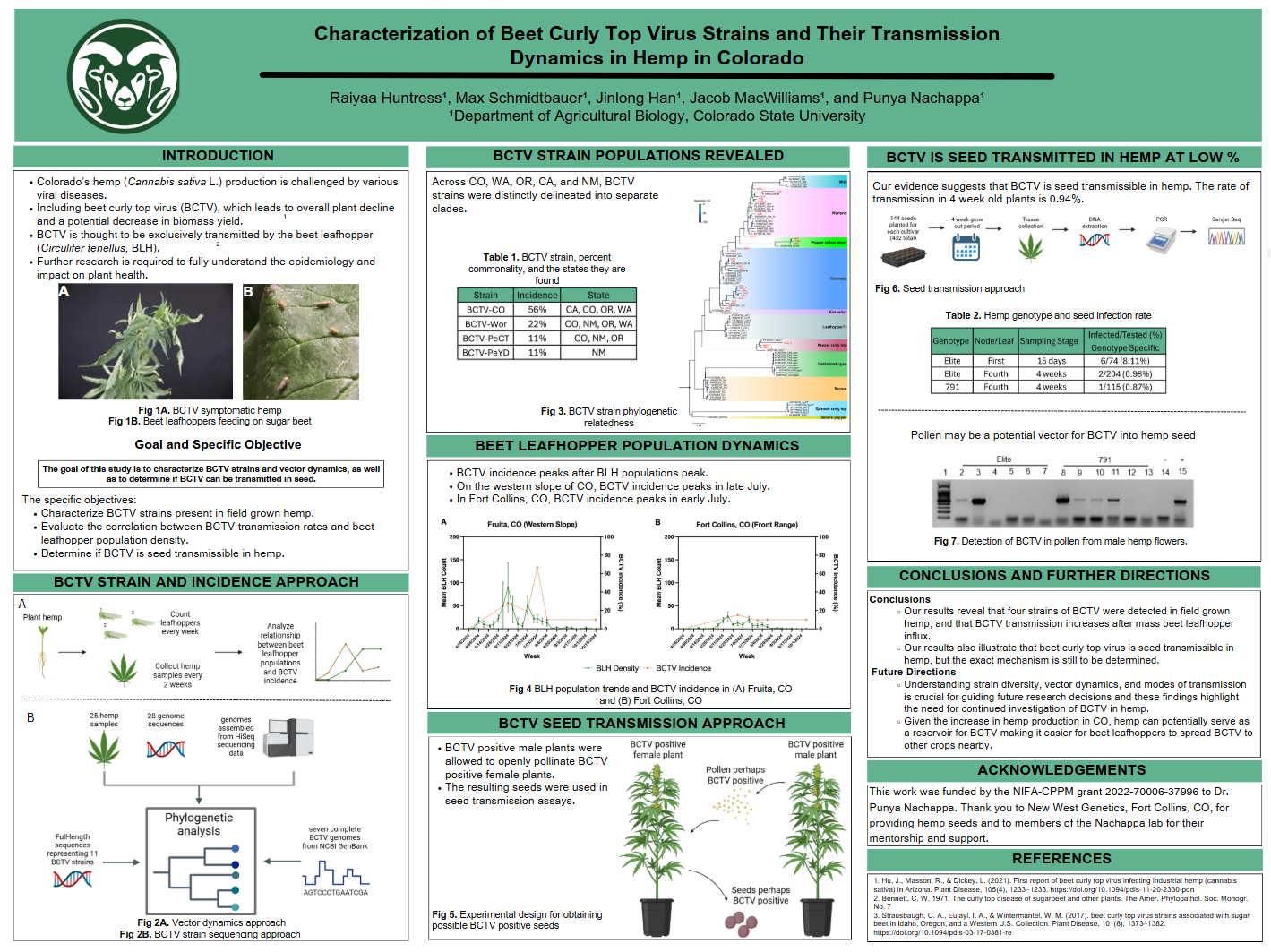
After a nearly fifty-year hiatus, the 2018 United States farm bill reintroduced industrial hemp (Cannabis sativa L.) back into the agricultural landscape. Colorado’s dry climate and high altitude create optimal growing conditions, in part due to a reduced prevalence of diseases common in more precipitous regions. Instead, the West faces challenges from various viral diseases, including beet curly top virus (BCTV). BCTV is thought to be exclusively transmitted by the beet leafhopper (Circulifer tenellus) and has recently been identified as infectious to hemp. While infection in hemp leads to overall plant decline and a potential decrease in biomass yield, further research is required to fully understand the epidemiology and impact on plant health. Therefore, the goal of this research is to characterize BCTV strains and vector dynamics, as well as to determine if BCTV can be transmitted in seed. We hypothesize that in field grown hemp, there will be a variety of BCTV strains present and BCTV transmission rates will positively correlate with increased beet leafhopper populations. We also hypothesize that despite previous literature, BCTV is seed transmissible in hemp. Our results reveal that four strains of BCTV were detected in field grown hemp, and that BCTV transmission increases after mass beet leafhopper influx. Our results also illustrate that beet curly top virus is seed transmissible in hemp, but the exact mechanism is still to be determined. Understanding strain diversity, vector dynamics, and modes of transmission is crucial for guiding future research decisions and these findings highlight the need for continued investigation of BCTV in hemp.