
Will Your Pennsylvania Walks Be Soiled? An analysis of how the changing Pennsylvanian soil conditions will affect native plants present throughout the state
Category: Research Poster
Author(s): Leanna MacBello
Presenter(s): Leanna MacBello
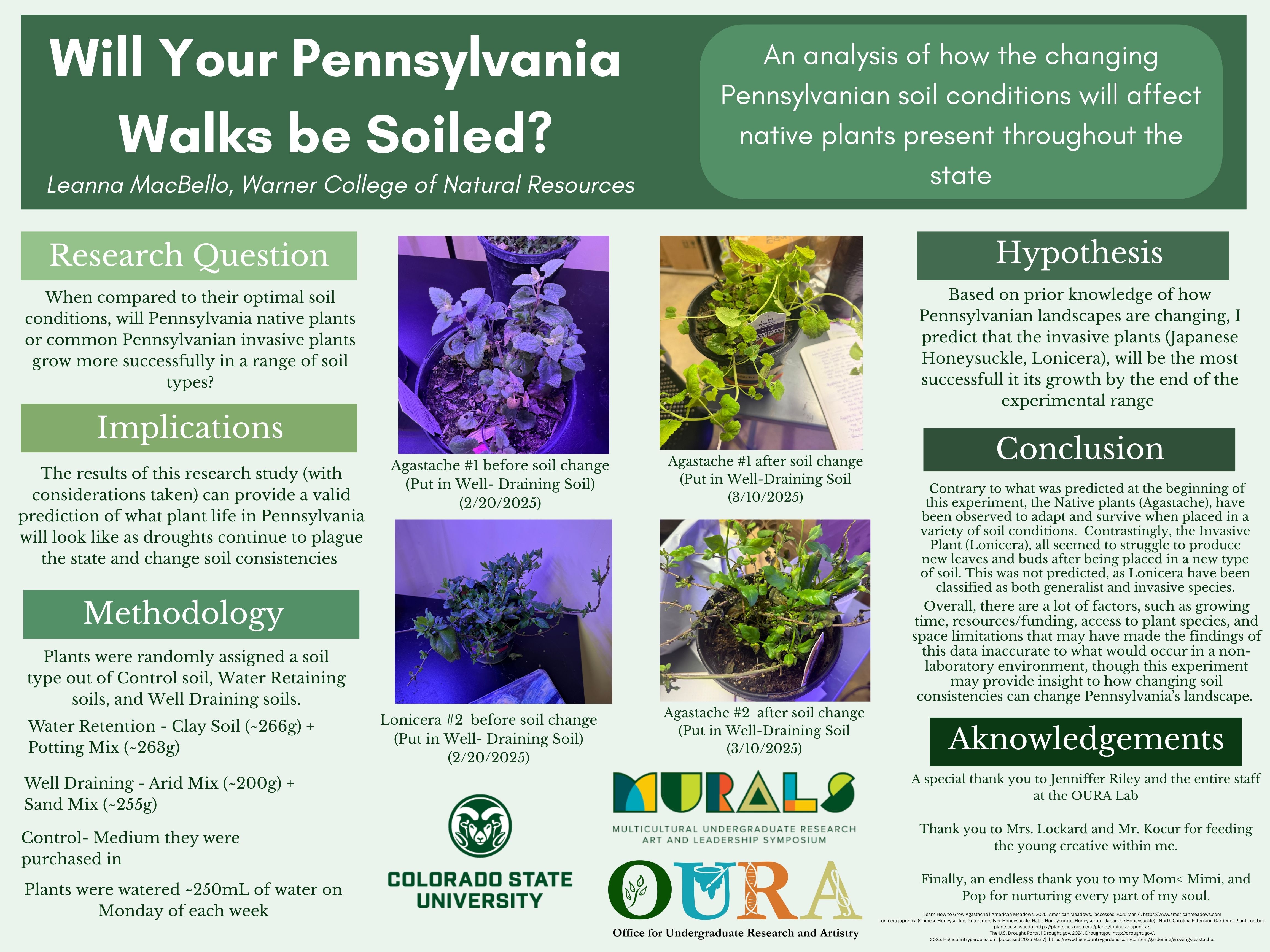
As the effects of climate change echo across the country, each region of the United States has endured different complications related to the changing Earth. Pennsylvania, a state that is usually covered with a cloud of humidity and rain due to its lush forests and proximity to major bodies of water, has been subjected to extended periods of droughts. These droughts have been practically unheard of in the region, with ecosystems taking severe hits due to lack of rainfall. As extended periods of dryness increase in frequency and intensity, effects have been seen everywhere, most notably, within the soil. As the soil consistency changes from its mineral-rich consistency to less nutritious, loose textures, one of the biggest concerns has been attempting to understand how the plants present in Pennsylvania, both native and non-native, will react to these changes. Within this preliminary observational experiment, Agastache (Hyssop morello) and Japanese Honeysuckle (Lonicera japonica) were placed in a range of soil types, including soils of their optimal consistency, clay soils with high water retention, and sandy soils that release water quickly. This experiment monitored the growth, measured by physical success and attributes, of each of the individual species to determine which genre of plants, native or non-native, would perform the best under a range of soils. As the effects of climate change echo across the country, each region of the United States has endured different complications related to the changing Earth. Pennsylvania, a state that is usually covered with a cloud of humidity and rain due to its lush forests and proximity to major bodies of water, has been subjected to extended periods of droughts. These droughts have been practically unheard of in the region, with ecosystems taking severe hits due to lack of rainfall. As extended periods of dryness increase in frequency and intensity, effects have been seen everywhere, most notably, within the soil. As the soil consistency changes from its mineral-rich consistency to less nutritious, loose textures, one of the biggest concerns has been attempting to understand how the plants present in Pennsylvania, both native and non-native, will react to these changes. Within this preliminary observational experiment, Agastache (Hyssop morello) and Japanese Honeysuckle (Lonicera japonica) were placed in a range of soil types, including soils of their optimal consistency, clay soils with high water retention, and sandy soils that release water quickly. This experiment monitored the growth, measured by physical success and attributes, of each of the individual species to determine which genre of plants, native or non-native, would perform the best under a range of soils.