
Establishing the Contributions of dUTPase in Thermococcus Kodakarensis
Category: Research Poster
Author(s): Emily Staton
Presenter(s): Emily Staton
Mentors(s): Thomas Santangelo
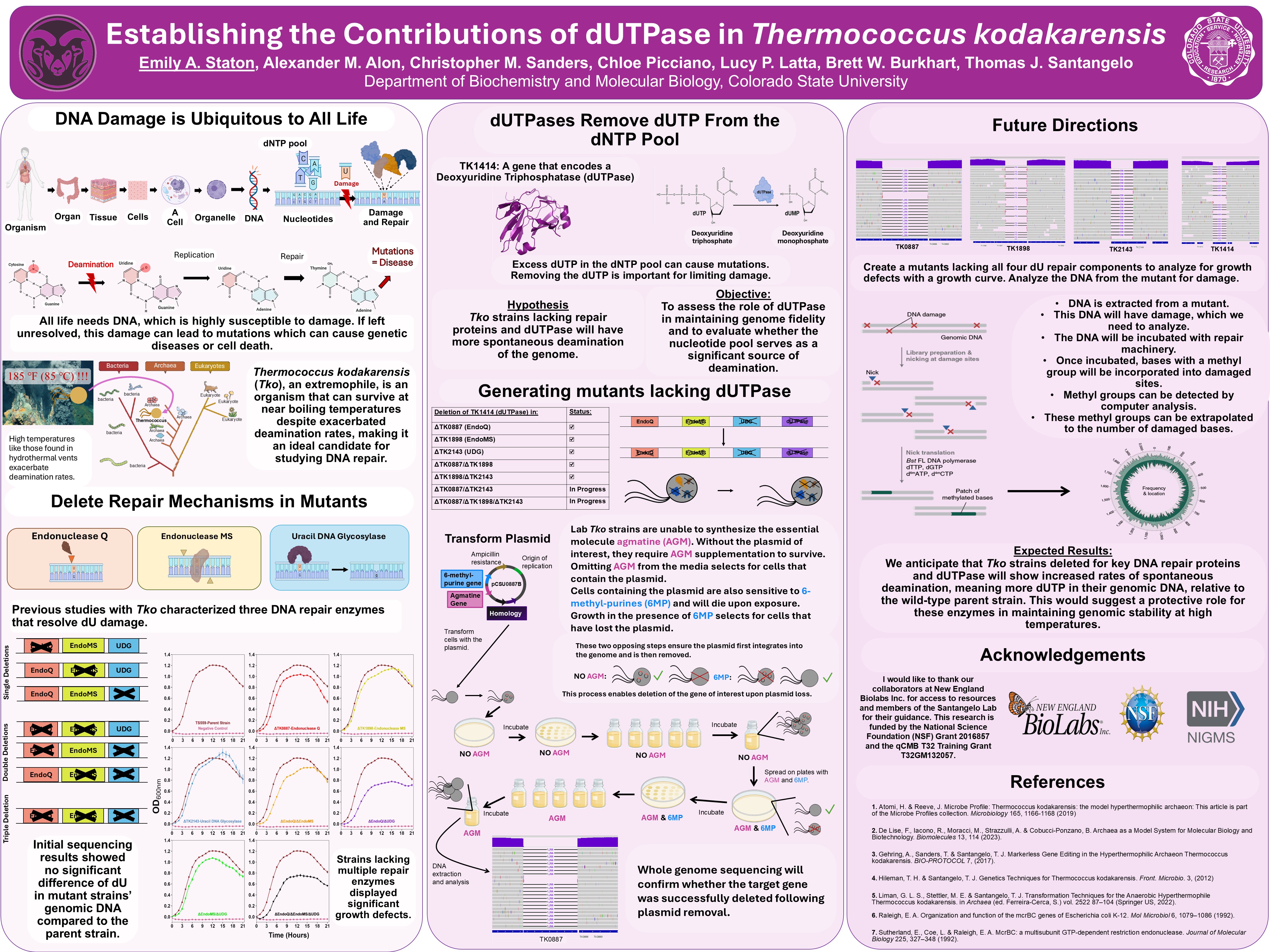
All life stores genetic information as DNA. DNA is highly susceptible to damage from endogenous and exogenous sources, which, if left unresolved, can contribute to genetic diseases or cell death. The maintenance of genome fidelity is thus vital for the survival of living organisms. One of the more common forms of DNA damage is the deamination of the canonical nucleotide base deoxycytidine (dC) to deoxyuridine (dU). Studying how cells handle environmental stress that promotes dU damage can be a promising avenue for disease research. Extremophiles are a group of single-celled organisms that can thrive in extreme conditions and surprisingly maintain their genomes despite exacerbated deamination rates. One ideal candidate for further study is Thermococcus kodakarensis (Tko), a heat-loving ancient microorganism that thrives at 85°C (185°F). Previous studies with Tko characterized three DNA repair enzymes that resolve dU damage. Strains lacking multiple repair enzymes displayed significant growth defects. However, quantitative sequencing methods showed minimal dU damage in mutant strain genomes compared to the parental strain. An additional enzyme in Tko, dUTPase, has been identified to resolve dU in the nucleotide pool but has not yet been studied for its potential role in maintaining genome fidelity. To characterize dUTPase, we will use the same methods: growth curves and genome sequencing of strains lacking repair proteins and dUTPase. Our results will demonstrate potential differences in the abundance of dU damage for mutant strains compared to the parent strain and reveal the contributions of dUTPase in maintaining genome integrity.