
Development of a CRISPR-Cas system to investigate the impact of UDP-galactosyltransferase 8 and galactosylceramidase knockout on dengue virus life cycle in human hepatoma cells
Category: Research Poster
Author(s): Kylee Pham, Kaitlyn Dirks, Samantha Pinto, Hannah Laurence
Presenter(s): Kylee Pham
Mentors(s): Rushika Perera
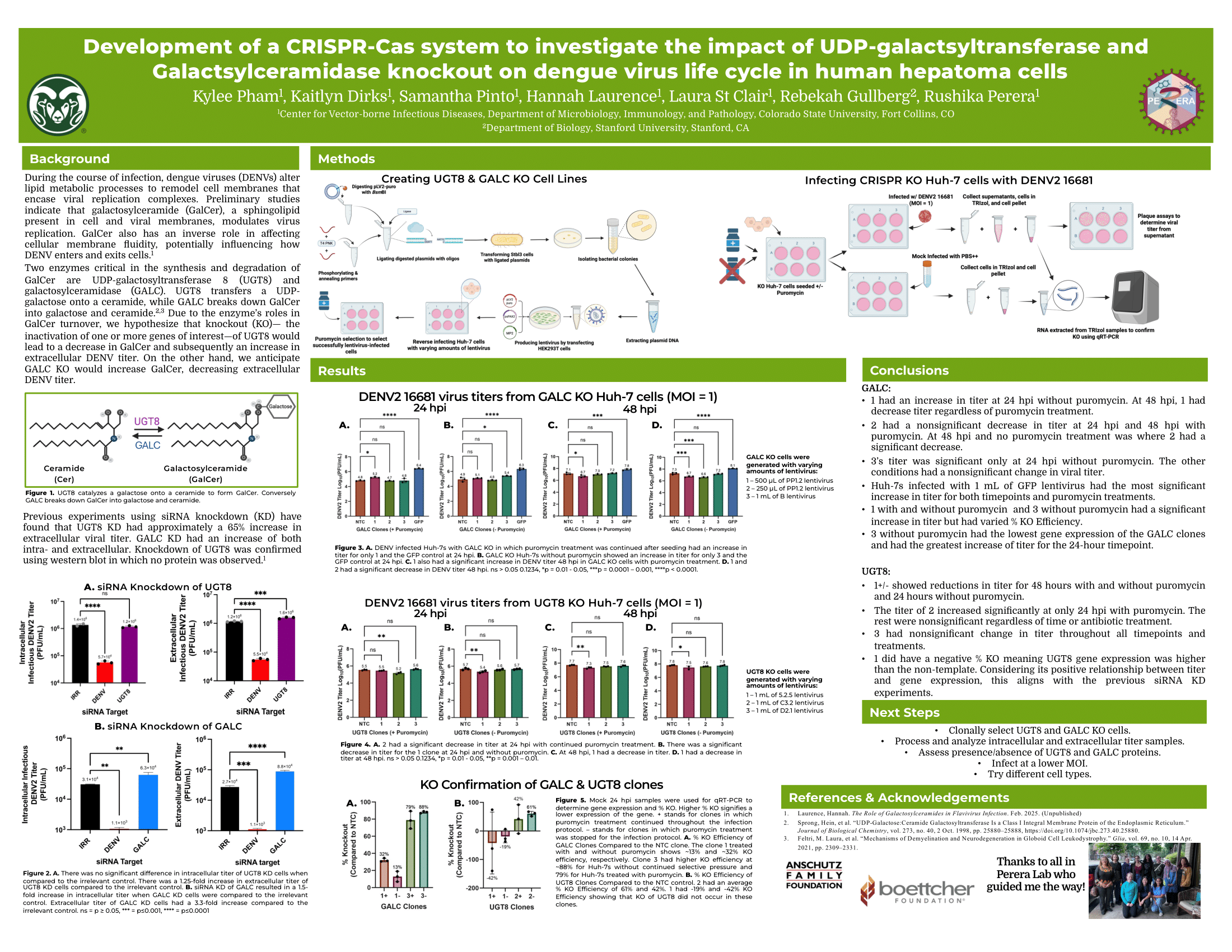
Dengue viruses (DENVs) belong to Flaviviridae and are transmitted to humans by the bite of an infected mosquito. They cause ~400 million infections per year. DENVs alter lipid metabolic processes in the host to remodel host cell membranes that encase viral replication complexes. Preliminary studies indicate that galactosylceramide (GalCer), a sphingolipid, modulates virus replication. Two enzymes critical in the synthesis and degradation of GalCer are UDP-galactosyltransferase 8 (UGT8) and galactosylceramidase (GALC). We hypothesize that knockout (KO) of UGT8 will result in a decrease in GalCer and an increase in membrane fluidity. We anticipate the resulting increase in fluidity will facilitate virus release. Conversely, GALC KO will result in an accumulation of GalCer, reducing membrane fluidity, therefore decreasing extracellular DENV titer. We aimed to study the effects of CRISPR-Cas mediated KO of UGT8 and GALC on DENV infection in-vitro. To create KO cell lines, pLV2 puro plasmids were digested with BsmBI, a restriction enzyme. We then ligated each gene with pLV2 puro. Transformed bacterial colonies were isolated and cultured for DNA extraction. Ligation accuracy was confirmed by sequencing. Lentivirus produced by transfecting human embryonic kidney cells with plasmid DNA were used to infect Huh-7 cells, creating unique KO cell lines. We infected these cell lines with DENVs and analyzed the impact of the KO on virus titer. Results of these analyses will be presented.