
The Effect of Natural Food Availability on the Diet of Black Bears in the Methow Valley
Category: Research Poster
Author(s): Alex McDulin, Rebecca Windell
Presenter(s): Alex McDulin
Mentors(s): Rebecca Windell
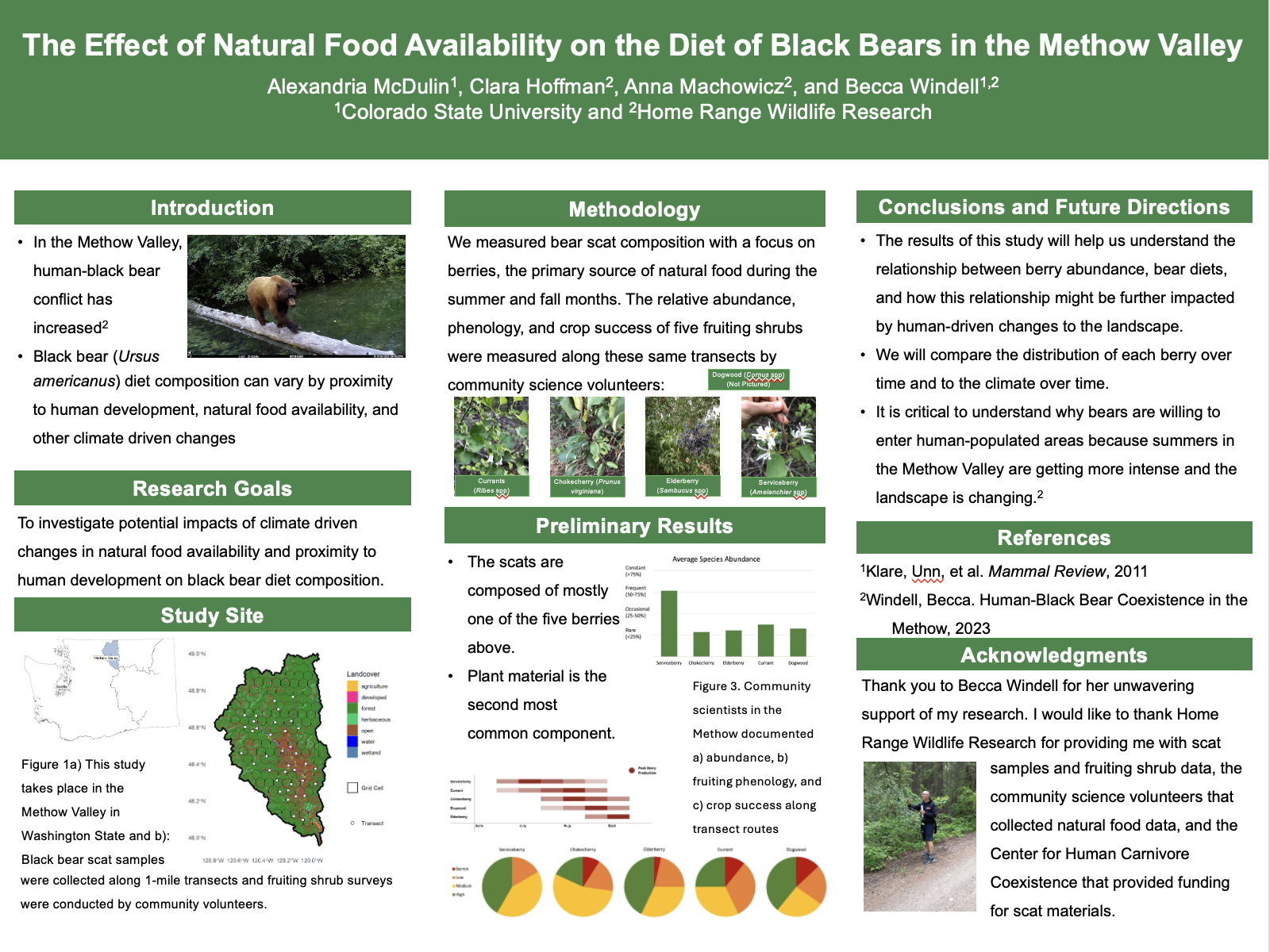
Black Bear (Urus americanus) use of human populated areas is affected by many factors, including natural food availability, behavioral differences, climate, and proximity to human development. Our goal for this study is to understand how changes in black bear diet composition relate to variation in natural food availability, proximity to human development, climate, and bear behavior during the summer and fall months. We used black bear scat samples collected along 1 mile transects by community volunteers to assess their diet using morphological diet analysis. To do this, we measured the volume and mass of each scat as well as the individual diet components such as non-food items, plant material, mammal remains, and berries. Of these individual diet components, we focused on black bear diet in relation to berry availability, the primary source of natural food during the summer (and fall) months. The relative abundance and phenology of five fruiting shrubs important to black bears - Serviceberry (Amelanchier spp), Elderberry (Sambucus spp), Dogwood (Cornus spp), Chokecherry (Prunus virginiana), and Currants (Ribes spp) – were measured along these same transects by community science volunteers. The results of this study will help us understand the relationship between berry abundance, bear diets, and how this relationship might be further impacted by human-driven changes to the landscape. It is more important now than ever to understand why bears are willing to enter human-populated areas because summers in the Methow Valley are getting more intense and the landscape is changing.