
Remote Deployment Of a Smartphone-Based Sit-to-Stand Power Test
Category: Community Engagement Poster
Author(s): Caroline Bauer, Brian Tracy
Presenter(s): Caroline Bauer
Mentors(s): Brian Tracy
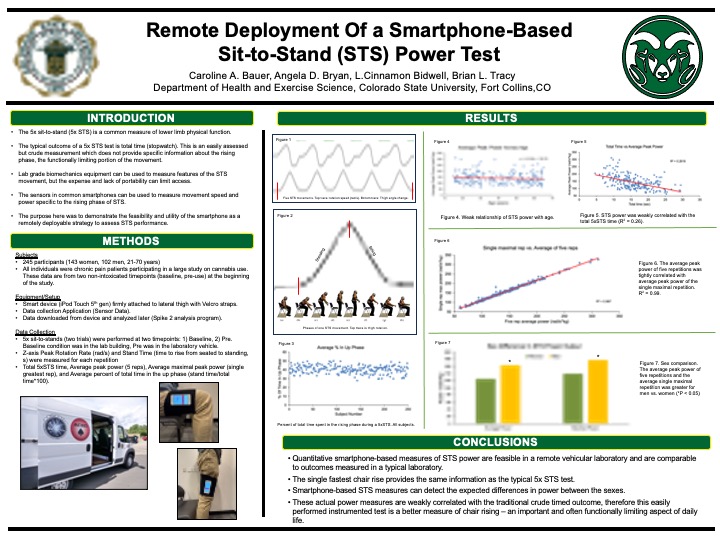
The 5x sit-to-stand (STS) is a common measure of physical function. The typical outcome is simply total time. However, common smartphone sensors may provide more detailed information on movement speed and power of the rising phase of STS. In a large study (N = 240, 21-70 yrs) of chronic pain patients, smartphone-instrumented STS tests were performed in a remote van lab. The smartphone was attached to the lateral thigh and for each STS the peak rotation rate and rise time was measured during the rising phase with the onboard gyroscope sensors. The total 5xSTS time was also measured from movement data. Measures were performed both in the lab building (baseline, BL) and ~1wk later in the van. At BL: the sum of the rise times was 40% of the total 5xSTS time. Across the age range, STS power declined by 0.31 rads/s*kg per year. STS power was weakly negatively correlated with total 5xSTS time (R^2=0.28). Avg peak power of 5 reps was tightly correlated with Avg peak power of the single max rep (R^2=0.99). From BL to Pre: Total 5xSTS time and rise time measures decreased very slightly (P< 0.05) but rotation rate values did not change. Quantitative smartphone-based measures of STS power are feasible in a remote vehicular lab, and are comparable to outcomes measured in a typical lab. These actual power measures are weakly correlated with the traditional timed outcome, therefore this instrumented test is a better measure of chair rising, which is functionally limiting.