
Primate-Lizard Interaction During Early Eocene Climate Change
Category: Research Poster
Author(s): Sami Conca
Presenter(s): Sami Conca
Mentors(s): Kimberly Nichols
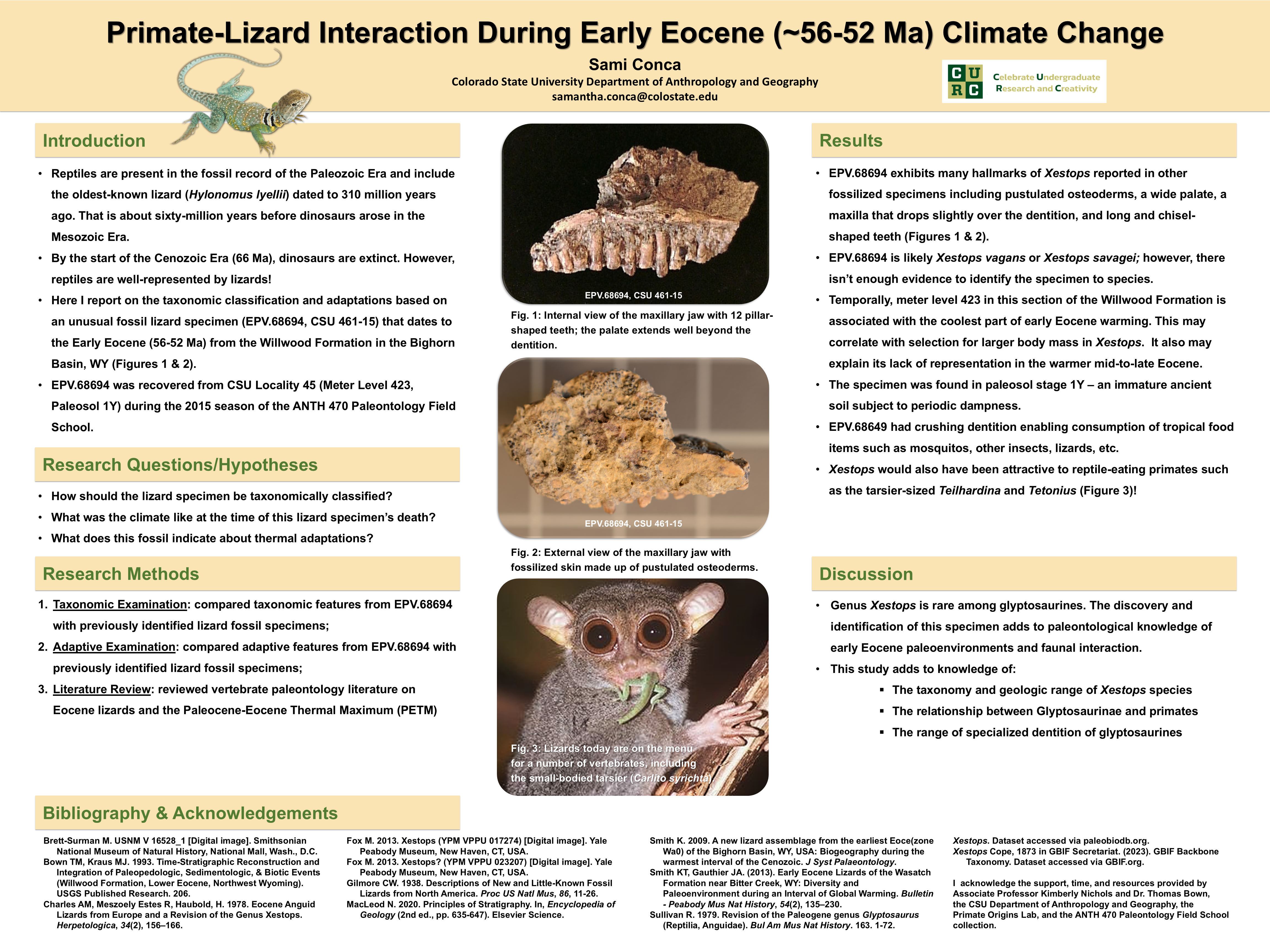
Fossil glyptosaurine (Glyptosaurinae) lizards, particularly in the genus Xestops, are fairly rare in North America. They have recently been found in the early Eocene (~56 Ma), providing evidence of environmental change and predation. Here I report on fossil lizards obtained from the Willwood Formation (~56-53 Ma) in the Bighorn Basin, Wyoming. The early Eocene was a time of rapid environmental warming that attracted novel fauna, including glyptosaurines, whose presence is evidenced by fossils and marked by a unique set of adaptations, coinciding with the appearance of certain mammalian predators. Among the early Eocene lizards is a fossil glyptosaurine maxilla (EPV.68694) recovered in 2015 by the CSU Department of Anthropology & Geology Field School (ANTH 470). This unusual specimen is the subject of taxonomic debate. Its preserved dermal scutes exhibit pustulation -- a characteristic associated with the Glyptosaurinae genus Xestops. Based on anatomical features, I provide my hypotheses regarding the phylogeny of this fossil lizard, as well as its relation to the changing climate and primate predators.