
Experiential student lab project: Measures of the electromyogram during eccentric and concentric contractions
Category: Research Poster
Author(s): Lauren Brunell
Presenter(s): Lauren Brunell
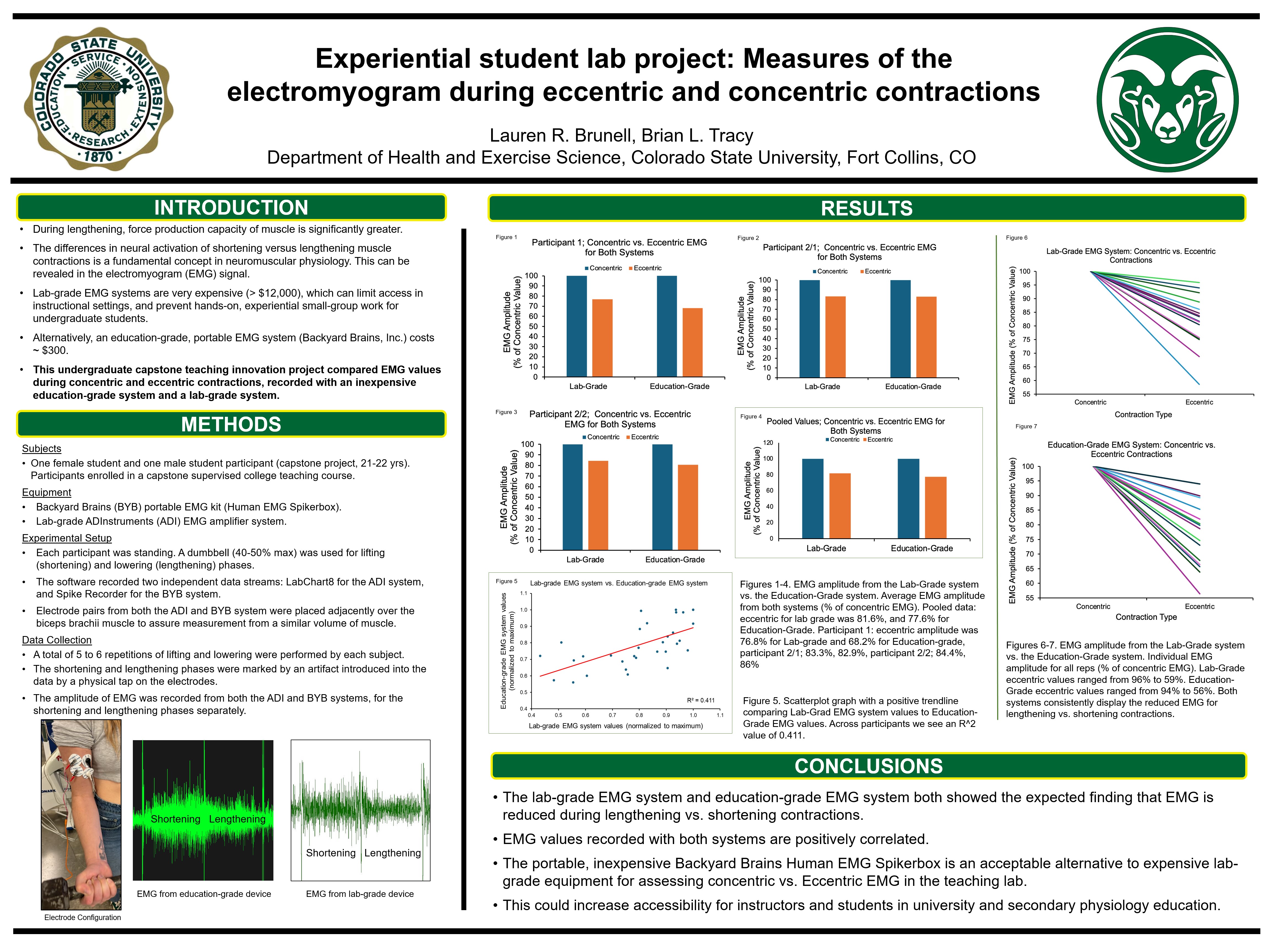
The differences in neural control of shortening (CON) versus lengthening (ECC) muscle contractions is a fundamental concept in neuromuscular physiology. For equivalent loads, reduced neural drive to the muscle (electromyogram, EMG) during ECC is classically observed, due to the inherently greater force production capability in ECC. Here we describe EMG of CON and ECC contractions measured with an expensive lab system (ADInstruments, ADI) and an inexpensive education-grade EMG system (Backyard Brains, BYB), to provide a teaching method that is accessible to more institutions. During an in-class teaching development exercise, two students lifted and lowered a weight 5-7 times (40-50% max) using 3s lifting and lowering phases, while the EMG of the biceps brachii was concurrently measured with the lab-grade and education-grade device. Electrodes serving each system were placed immediately adjacent to each other. The root mean square (RMS) of the EMG signal was measured from both systems in the middle of the CON and ECC phase. EMG during ECC was 81% of CON for ADI and 77% for BYB. For CON and ECC pooled, EMG values from the two devices were positively correlated (R squared = 0.58). The findings show that an education-grade EMG device is suitably sensitive to quantify neural activation during CON and ECC in a teaching lab setting. This equipment could increase access to instructors and students at institutions with varying instructional resources.