
Investigation of PIE-1 Contribution to nos-2 mRNA Localization within P Granules Using RNAi
Category: Research Poster
Author(s): Kaelie Sellers
Presenter(s): Kaelie Sellers
Mentors(s): Steven Graham
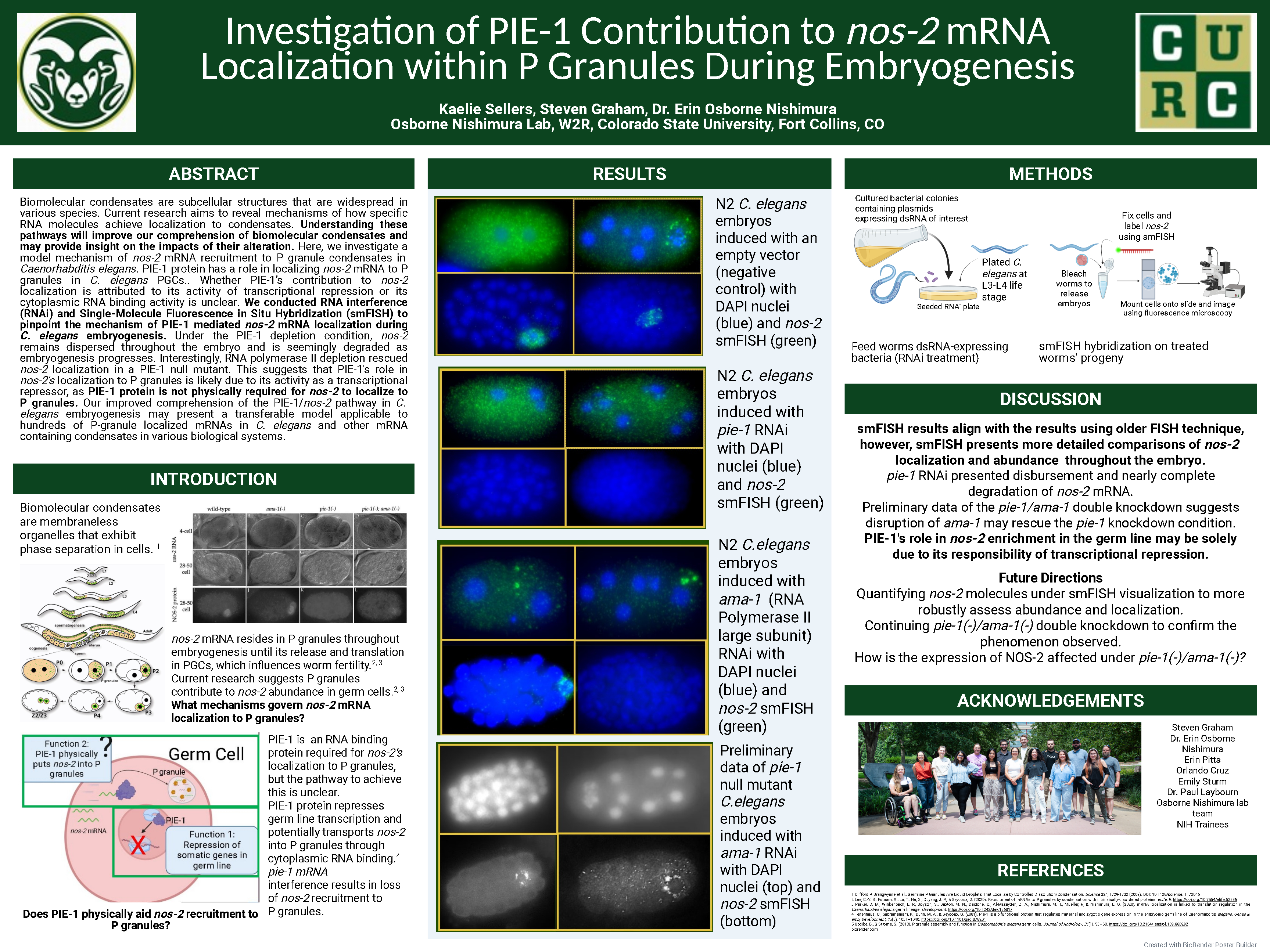
Biomolecular condensates are subcellular structures that are widespread in various species, such as humans, mice, and bacteria. Various condensate types exist throughout biology, and form through phase separation of RNAs and RNA binding proteins. Many RNAs localize to condensates, and current research aims to reveal mechanisms of how specific RNA molecules achieve this localization. Understanding these pathways will improve our comprehension of biomolecular condensates and may provide insight to their alteration in cancer and neurodegenerative diseases. Here, we investigate a model mechanism of nos-2 mRNA recruitment to P granule condensates in Caenorhabditis elegans. PIE-1 protein has a role in localizing nos-2 mRNA to P granules in C. elegans PGCs.. Whether PIE-1’s contribution to nos-2 localization is attributed to its activity of transcriptional repression or its cytoplasmic RNA binding activity is unclear. We conducted RNA interference (RNAi) and Single-Molecule Fluorescence in Situ Hybridization (smFISH) to pinpoint the mechanism of PIE-1 mediated nos-2 mRNA localization during C. elegans embryogenesis. Under the PIE-1 depletion condition, nos-2 remains dispersed throughout the embryo and is seemingly degraded as embryogenesis progresses. Interestingly, RNA polymerase II depletion (via ama-1 RNAi) rescued nos-2 localization in a PIE-1 null mutant. This suggests that PIE-1's role in nos-2's localization to P granules is likely due to its activity as a transcriptional repressor, as PIE-1 protein is not physically required for nos-2 to localize to P granules. Our improved comprehension of the PIE-1/nos-2 mechanism in C. elegans germ line development may present a transferable model applicable to hundreds of P-granule localized mRNAs in C. elegans and other mRNA containing condensates in various biological systems.