
Comparing qPCR Detection of Mycobacterium leprae in Human and Armadillo Samples
Category: Research Poster
Author(s): Ria Janapati, Brendan Dosenbach, Bettina Broeckling, Mary Jackson
Presenter(s): Ria Janapati
Mentors(s): Charlotte Avanzi
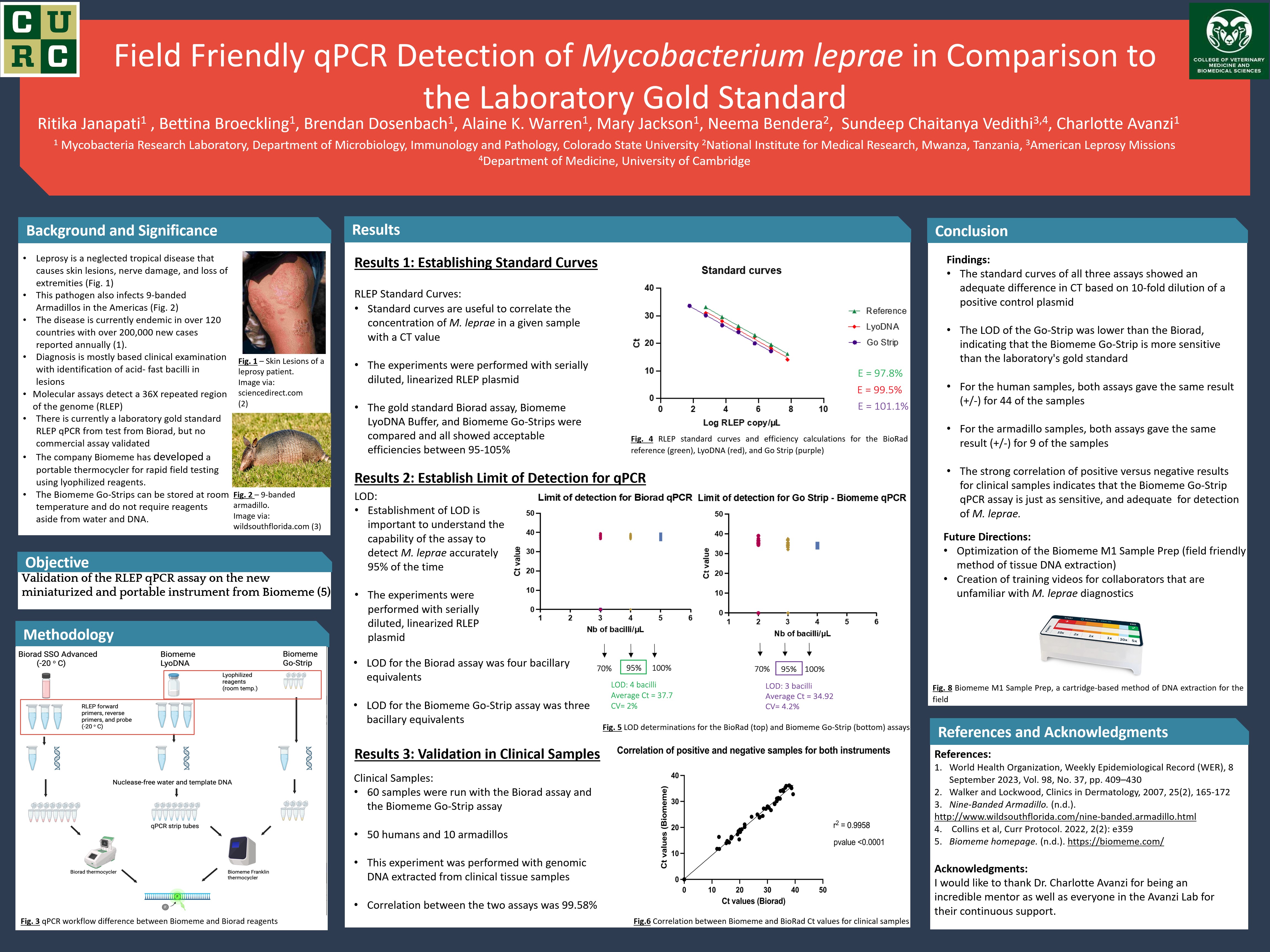
Diagnosing leprosy is based on three cardinal signs: skin lesions, nerve thickness, and identifying the causative agent, Mycobacterium leprae. A quantitative polymerase chain reaction (qPCR) targeting the 36x repeated region RLEP is currently the most sensitive method for pathogen detection. This qPCR requires a molecular laboratory setting and temperature-sensitive reagents. Moreover, leprosy is endemic in communities lacking immediate access to laboratories, leaving a need for rapid testing in the field. Biomeme has developed a portable, rechargeable battery-operated thermal cycler that is controlled by a smartphone and uses unrefrigerated, lyophilized reagents. This project aims to validate the qPCR assay using Biomeme materials with the same quality as the laboratory’s gold standard. We optimized the qPCR assay with Biomeme reagents using positive control DNA, human clinical samples, and armadillo samples. Standard curves using a linearized RLEP plasmid showed 100% similarity between the Biomeme and the gold standard. We extracted DNA from skin biopsies using the Qiagen QIAmp prep kit, and used the CFX Biorad thermal cycler to perform the gold standard qPCR to compare with the Biomeme Franklin instrument. The standard curves using the two assays showed 100% similarity to each other. qPCR was performed on 50 human skin samples, and 10 armadillo ear/spleen samples. For the humans, both assays showed 5 negative samples, 39 positive samples, and 6 samples with discordant results. For the armadillos, both assays showed 1 negative sample, 8 positive samples, and one result was discordant. The linear regression showed a strong correlation between the two assays, suggesting that the Biomeme assay is as effective as the CFX Biorad.