
Shedding Kinetics for Murine versus Rhesus Rotavirus in a Mouse Model
Category: Research Poster
Author(s): MacKenzie Demmel, Gregg Dean, Allison Vilander, McKenzie Fletcher
Presenter(s): MacKenzie Demmel
Mentors(s): Gregg Dean
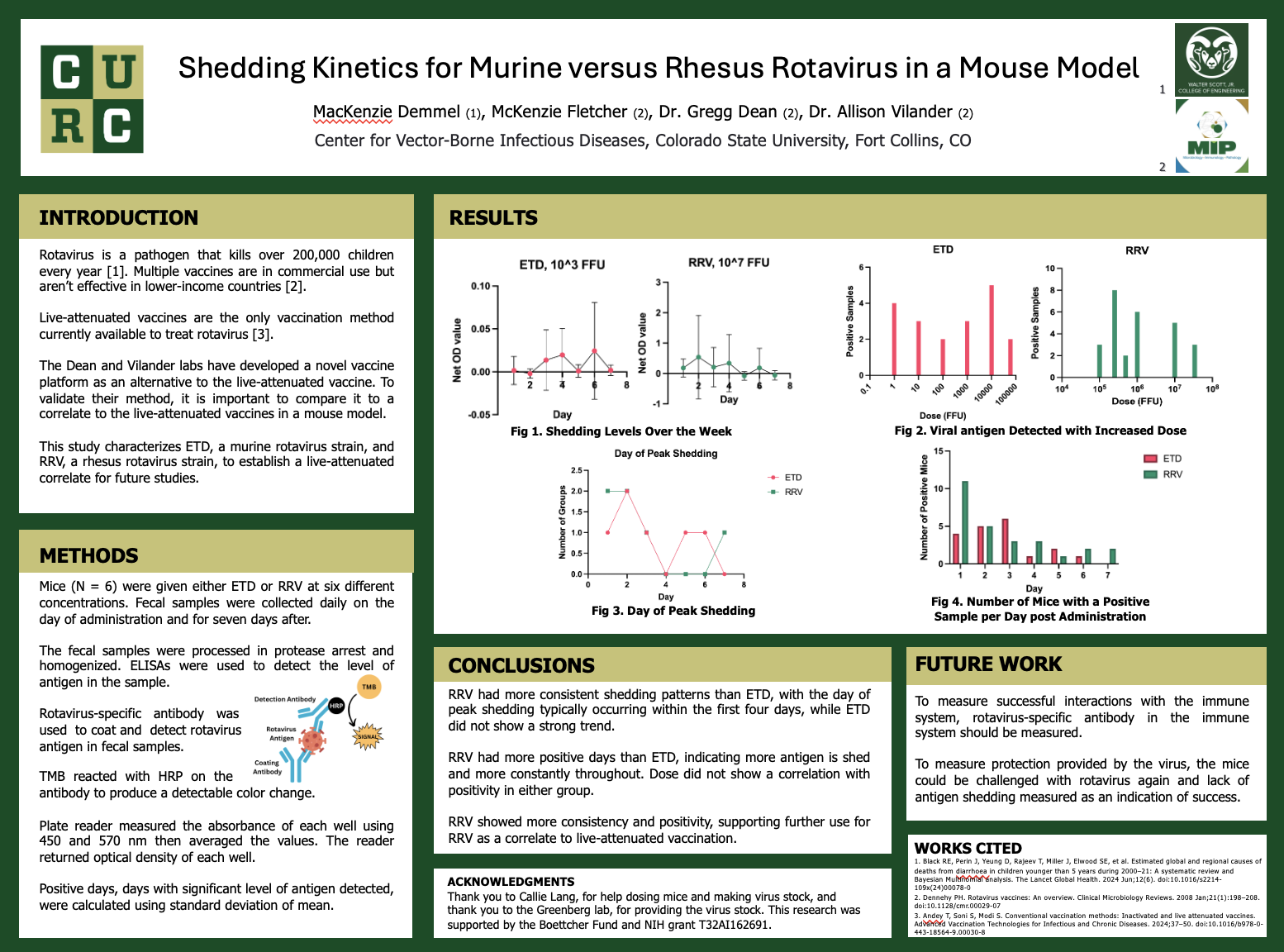
Rotavirus is a pathogen that disproportionately affects lower- and middle-income countries, killing over 200,000 children every year. Existing rotavirus vaccines used in people are attenuated-live, meaning they are a replicating version of the pathogen that does not cause disease. We are developing a subunit vaccine that exploits a probiotic bacteria platform. In order to compare our novel vaccines to the current gold-standard live-attenuated approach, we sought to test two candidate live-attenuated rotaviruses in an adult mouse model. This study analyzed virus shedding kinetics in the intestine and immune responses of adult mice after inoculation with a cell-culture adapted murine virus strain (ETD) versus a rhesus rotavirus strain (RRV). Enzyme-linked immunosorbent assays (ELISA) were used to detect viral antigen and anti-rotavirus antibodies in feces. The duration of shedding, day of peak shedding, and level of shedding was recorded to characterize the virus strains. RRV had more shedding in the first three days post inoculation, whereas ETD continued to shed through day six. Additionally, the level of viral antigen in the fecal sample increased as RRV dose increased while ETD did not show a strong correlation between dose and antigen level. Positive days were calculated as days where the antigen level was two standard deviations higher than the mean of the inoculation day, and RRV also had more positive days than ETD at every dose other than the lowest. Since RRV displayed more consistent shedding kinetics and had more positive days, it can be used as the gold-standard live-attenuated comparison.