
Decoding Fractional Killing: The Role of Substrate Stiffness and Cell Cycle on Cancer Cell Death
Category: Research Poster
Author(s): Natalie Calahan, Scott Burlingham, Ashok Prasad, Soham Ghosh
Presenter(s): Natalie Calahan
Mentors(s): Soham Ghosh
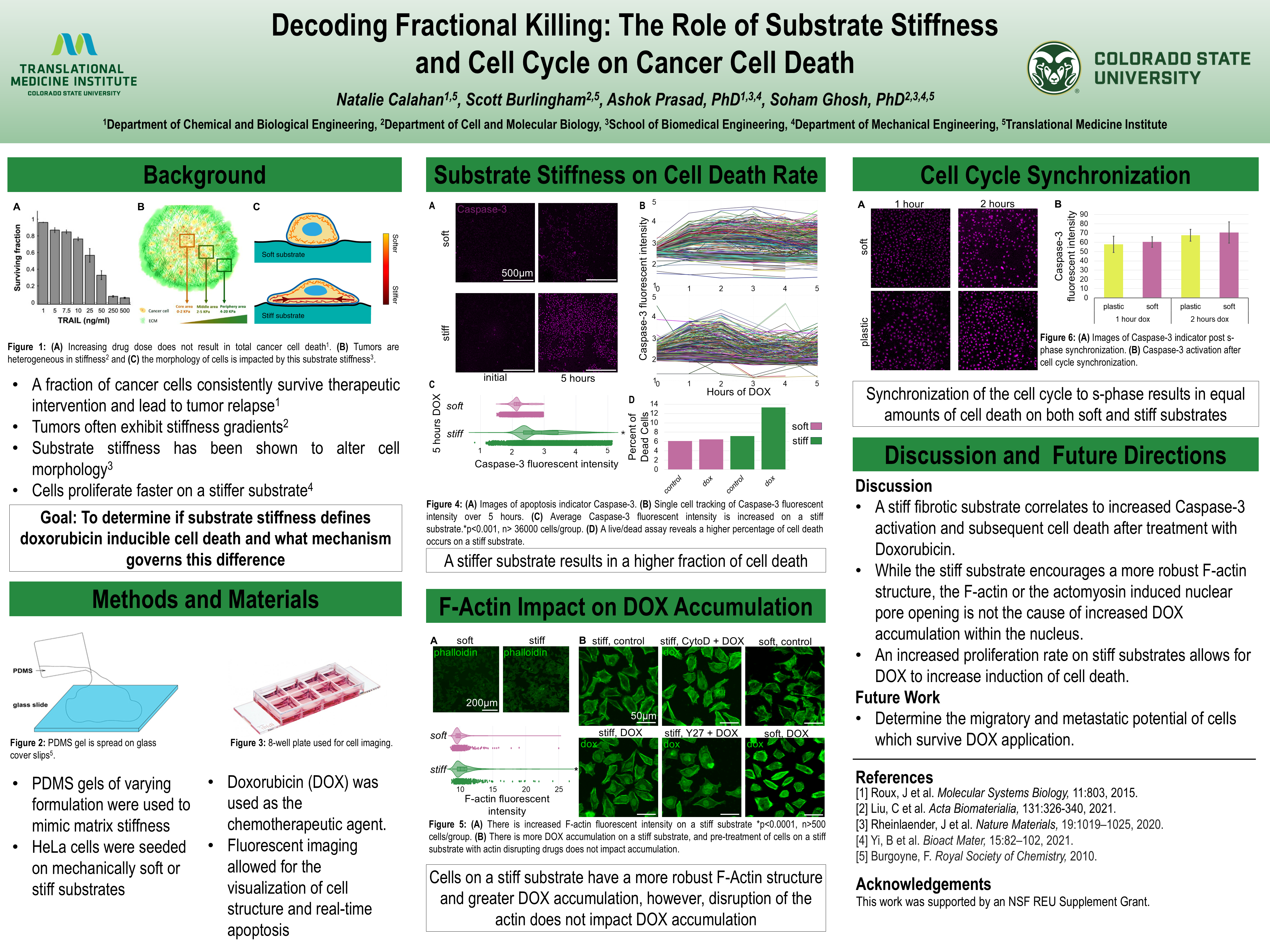
In cancer treatment, a major challenge lies in fractional killing, where a fraction of cells survive therapeutic intervention. This phenomenon is often linked to heterogeneous cellular mechanisms that enhance cancer cell resilience and evasion of apoptosis. Tumors exhibit stiffness gradients, with spots of extremely stiff regions and relatively soft regions, creating treatment challenges as cell behavior and response to therapy can be attributed to microenvironment mechanics. The objective of this study is to find if substrate stiffness defines doxorubicin (DOX) inducible cell death and what mechanism governs this change. We found that stiffer substrates result in faster and greater activation of Caspase-3 in HeLa cells treated with DOX. Cells on stiff substrates showed a more robust F-actin structure, prompting us to explore if the actomyosin complex affects DOX uptake by altering nuclear pore size. DOX accumulation was greater in cells on stiff substrates, suggesting increased entry. However, inhibiting actin structure formation and actomyosin contraction on stiff substrates did not reduce DOX uptake. Interestingly, synchronizing cells to the G1/S phase boundary before DOX application showed similar Caspase-3 activation on both soft and stiff substrates. These findings suggest that substrate stiffness influences apoptosis activation, and while the actomyosin complex is not the governing factor, the stiffness-driven cell cycle plays a key role in modulating this variability.