
Eocene Mammal Responses to Climate Change
Category: Research Poster
Author(s): Reagan Kuhn
Presenter(s): Reagan Kuhn
Mentors(s): Kimberly Nichols
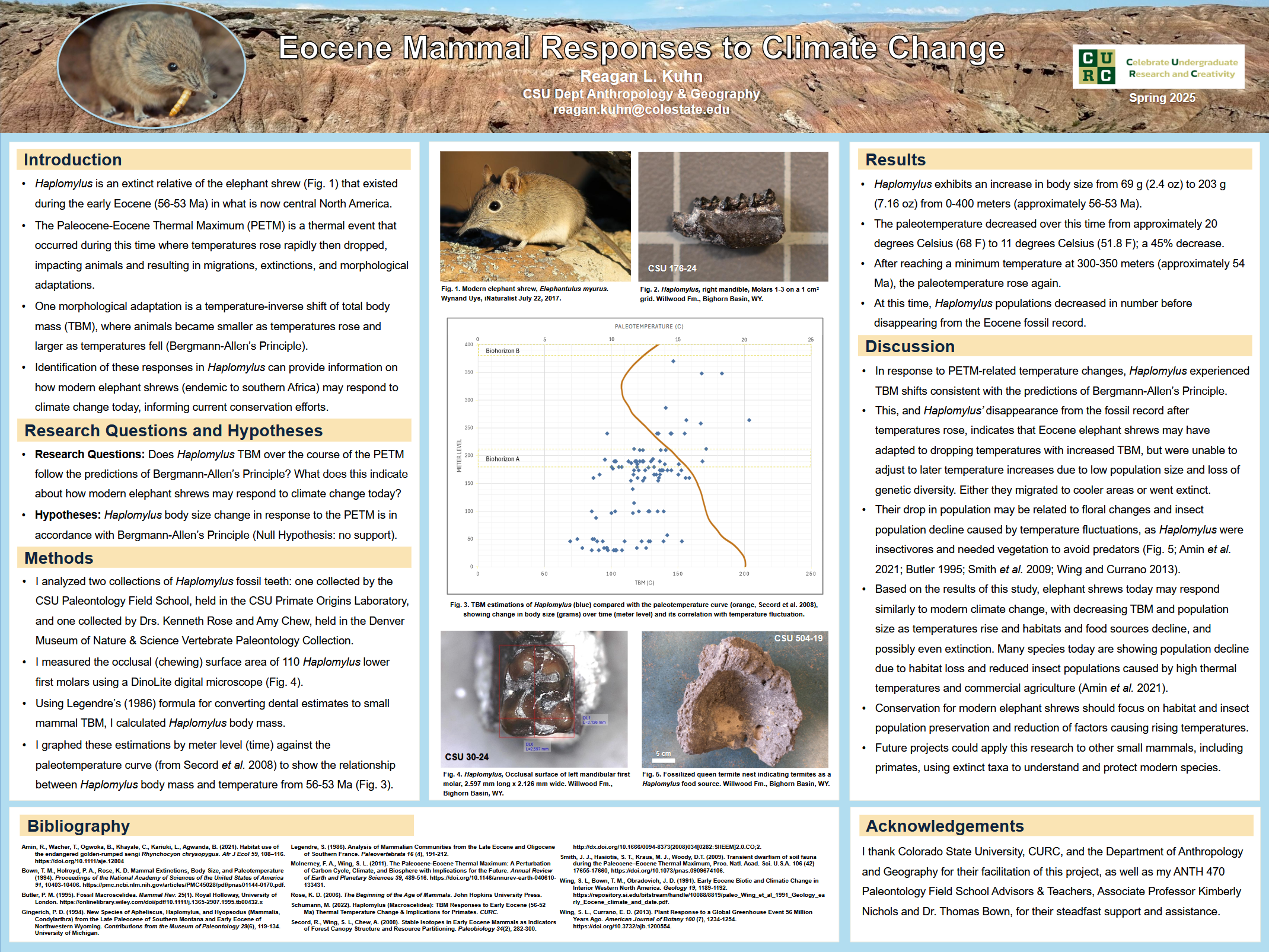
Haplomylus is an extinct relative of the elephant shrews (Macroscelidea) that existed during the early Eocene (56-52 Ma) in what is now central North America. This time period is characterized by the occurrence of a significant thermal event known as the Paleocene-Eocene Thermal Maximum (PETM), during which global temperatures rose rapidly then dropped, affecting climates around the world. The effects of this event are ubiquitous within the vertebrate fossil record, with many Eocene mammal species disappearing from the record (via migration or extinction) and others exhibiting morphological adaptations that helped them survive the changing climate. One of these adaptations is a temperature-inverse shift of Total Body Mass (TBM) - animals became smaller as temperatures increased and larger as temperatures decreased. This research examines Haplomylus fossil tooth specimens from the Willwood Formation in Bighorn Basin, Wyoming, as tooth size can be used to estimate TBM, and their associated geologic context. Using this data, I aim to identify if Haplomylus exhibited this type of shift in TBM as a result of the PETM. The results will have significant implications for the evolutionary trajectory of modern elephant shrews and will inspire future plans for conservation, as Haplomylus’ response to climate change in the Eocene can provide an analogue for understanding the potential effects anthropogenic climate change may have on their living relatives.