
Evaluating LTR Promoter Strength in Diverse HIV-1 Strains Using an H2B-RFP Reporter
Category: Research Poster
Author(s): EJ King, Ryan Jeep, Liangqun Huang
Presenter(s): EJ King
Mentors(s): Chaoping Chen
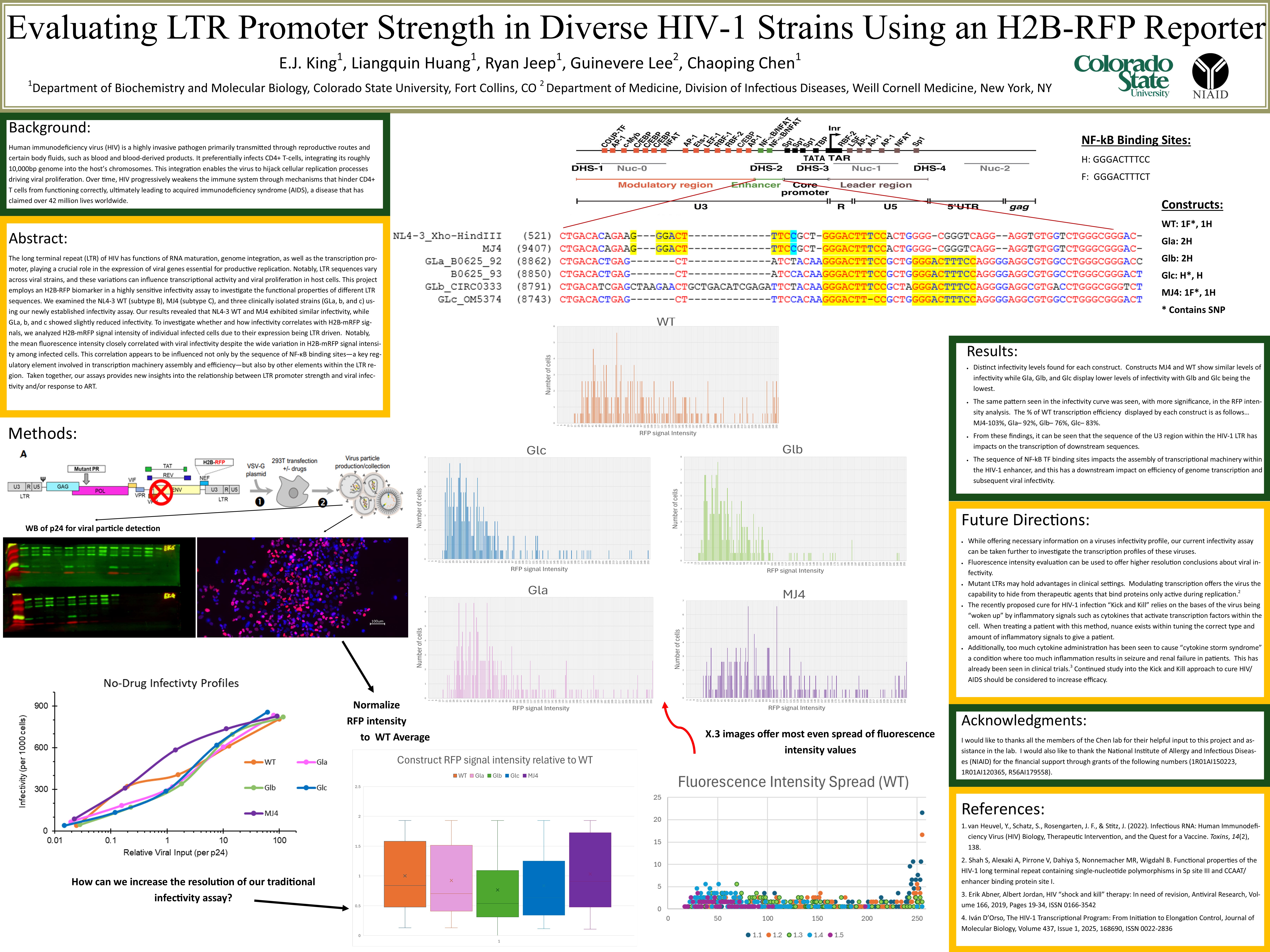
Human immunodeficiency virus (HIV) is a highly invasive pathogen primarily transmitted through reproductive routes via blood/blood-derived products. It preferentially infects CD4+ T-cells, integrating its genome into the chromosomes of these cells. Over time, HIV progressively weakens the immune system through CD4+ T-cell hindrance, ultimately leading to acquired immunodeficiency syndrome (AIDS). The long terminal repeat (LTR) of HIV has functions of RNA maturation, as well as the transcription promoter, playing a crucial role in the expression of viral genes. Notably, LTR sequences vary across viral strains, and these variations can influence transcriptional activity and viral proliferation in host cells. This project employs an H2B-RFP biomarker in a highly sensitive infectivity assay to investigate the functional properties of different LTR sequences. We examined the NL4-3 WT (subtype B), MJ4 (subtype C), and three clinically isolated strains (GLa, b, and c) using our newly established infectivity assay. Our results revealed that NL4-3 WT and MJ4 exhibited similar infectivity, while GLa, b, and c showed slightly reduced infectivity. To investigate whether and how infectivity correlates with H2B-mRFP signals, we analyzed H2B-mRFP signal intensity of individual infected due to their expression being LTR driven. Notably, the mean fluorescence intensity closely correlated with viral infectivity despite the wide variation in H2B-mRFP signal intensity among infected cells. This correlation appears to be influenced not only by the numbers of NF-κB binding sites, but also other elements within the LTR region. Our assays provide new insights into the relationship between LTR promoter strength and viral infectivity.