
Zephyr: Tracking the air you breathe
Category: Research Poster
Author(s): Brenna Wolf
Presenter(s): Brenna Wolf
Mentors(s): Shrideep Pallickara
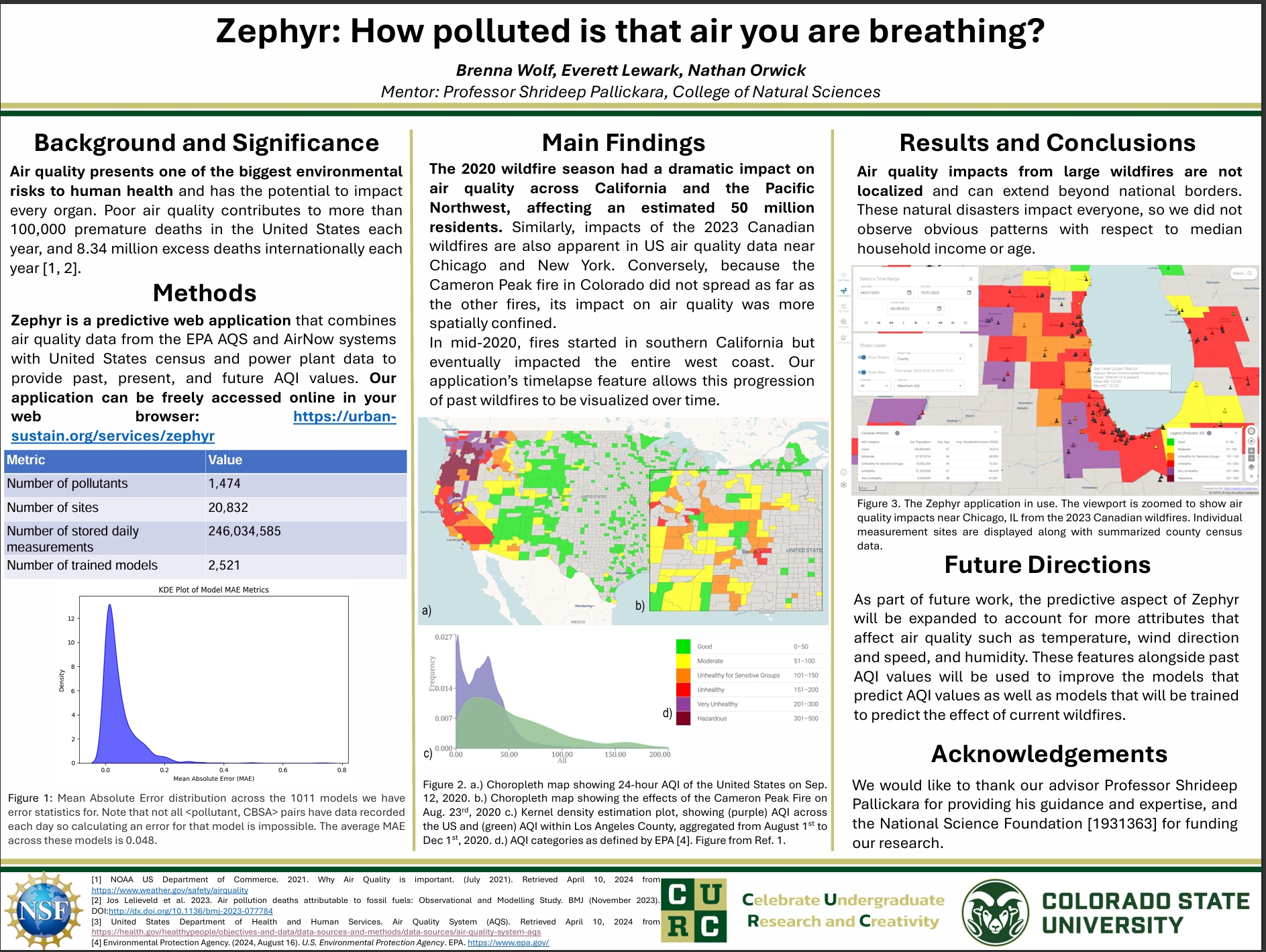
Air quality presents one of the biggest environmental risks to human health, having the potential to impact every organ and ranking second only to communicable diseases in public health risk. Air pollution contributes to reduced lung function, oxidative stress, and immunosuppression among other adverse health risks. Poor air quality contributes to more than 100,000 premature deaths in the United States each year, and 8.34 million excess deaths internationally each year. Continuous access to air quality data is key to educating citizens and driving legislative changes. The EPA has a large number of outdoor air quality monitoring sensors that harvest data regarding various airborne pollutants including particulate matter, ozone, carbon monoxide, nitrogen dioxide, and sulfur dioxide. We have designed a browser-based tool, Zephyr, that allows users to interactively analyze longitudinal (starting in 1980) air quality data tracking over 1400 different pollutants. An added feature of Zephyr is integration with the 2020 US census data to explore how socioeconomic factors correlate with exposure to poor air quality. Zephyr also overlays infrastructure data relating to coal and gas fueled power plants allowing users to assess how proximity to such power plants impacts air quality. We have also incorporated support for animating pollutant-specific variations so that users may assess air quality changes over time during transient, but often prolonged, events such as wildfires. Finally, the tool provides 7-day air quality forecasts using SARIMA models that provide insights into time-series trends. These models are fine-tuned for each metropolitan region to boost accuracy.