
Auditioning candidate Mycobacterium tuberculosis homing peptides using a phage display genetics platform.
Category: Research Poster
Author(s): Josie Small, Ana Carolina Takatsu Fonseca
Presenter(s): Josie Small
Mentors(s): Gregory Robertson
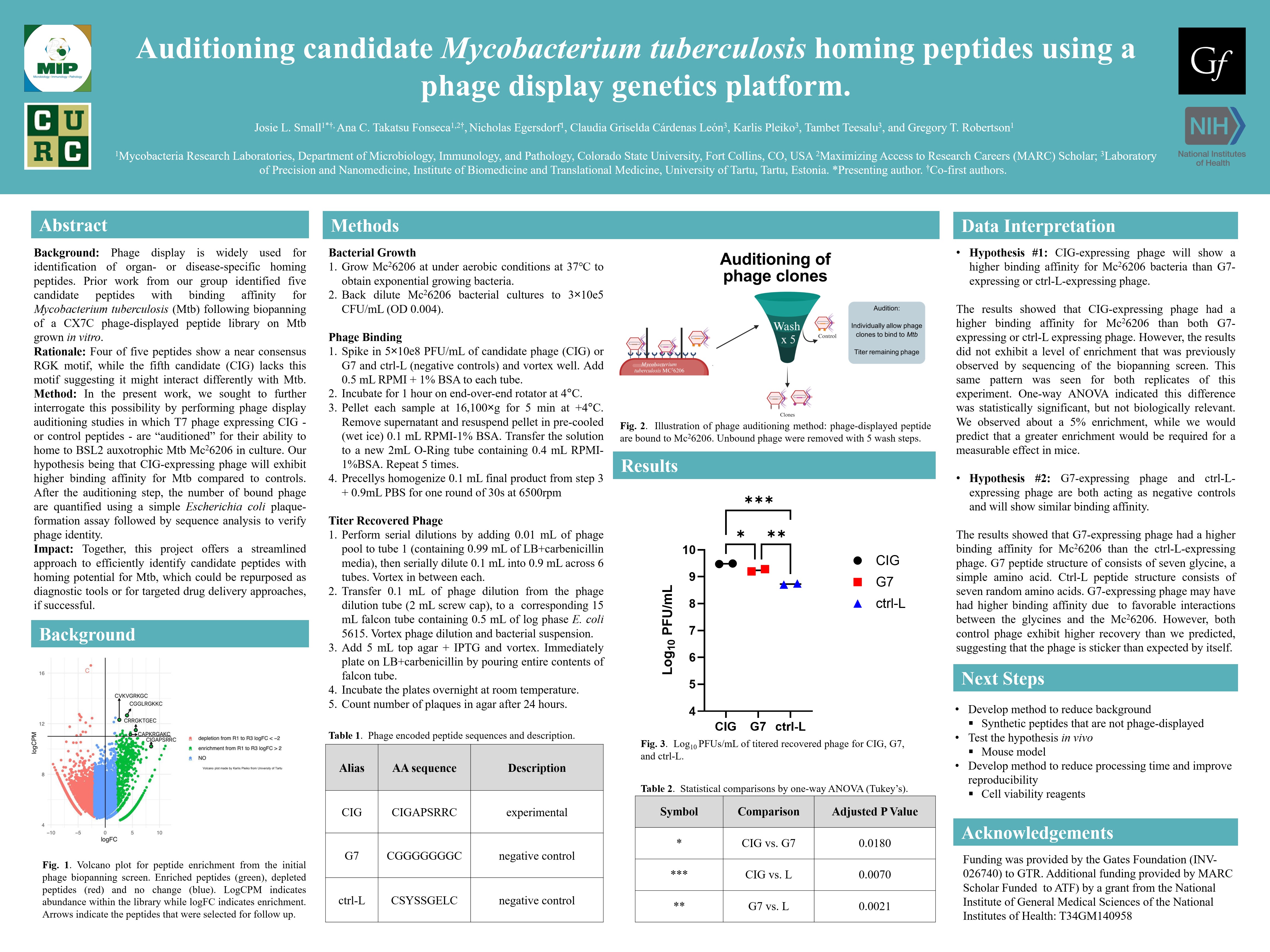
Josie L. Small1*†, Ana C. Takatsu Fonseca1,2†, Nicholas Egersdorf1, Claudia Griselda Cárdenas León3, Karlis Pleiko3, Tambet Teesalu3, and Gregory T. Robertson1 1Mycobacteria Research Laboratories, Department of Microbiology, Immunology, and Pathology, Colorado State University, Fort Collins, CO, USA 2Maximizing Access to Research Careers (MARC) Scholar; 3Laboratory of Precision and Nanomedicine, Institute of Biomedicine and Translational Medicine, University of Tartu, Tartu, Estonia. *Presenting author. †Co-first authors. Phage display is widely used for identification of organ- or disease-specific homing peptides. Prior work from our group identified five candidate peptides with binding affinity for Mycobacterium tuberculosis (Mtb) following biopanning of a CX7C phage-displayed peptide library on Mtb grown in vitro. Four of five peptides show a near consensus RGK motif, while the fifth candidate (CIG) lacks this motif suggesting it might interact differently with Mtb. In the present work, we sought to further interrogate this possibility by performing phage display auditioning studies in which T7 phage expressing CIG - or control peptides - are “auditioned” for their ability to home to BSL2 auxotrophic Mtb MC2 6206 in culture. Our hypothesis being that CIG-expressing phage will exhibit higher binding affinity for Mtb compared to controls. After the auditioning step, the number of bound phage are quantified using a simple Escherichia coli plaque-formation assay followed by sequence analysis to verify phage identity. Together, this project offers a streamlined approach to efficiently identify candidate peptides with homing potential for Mtb, which could be repurposed as diagnostic tools or for targeted drug delivery approaches, if successful.