
Improving the Synthesis of Menaquinone Derivatives Utilizing Leaving Group-properties
Category: Research Poster
Author(s): Mark Kappus
Presenter(s): Mark Kappus
Mentors(s): Debbie Crans, Andrew Schlink, Skyler Markham
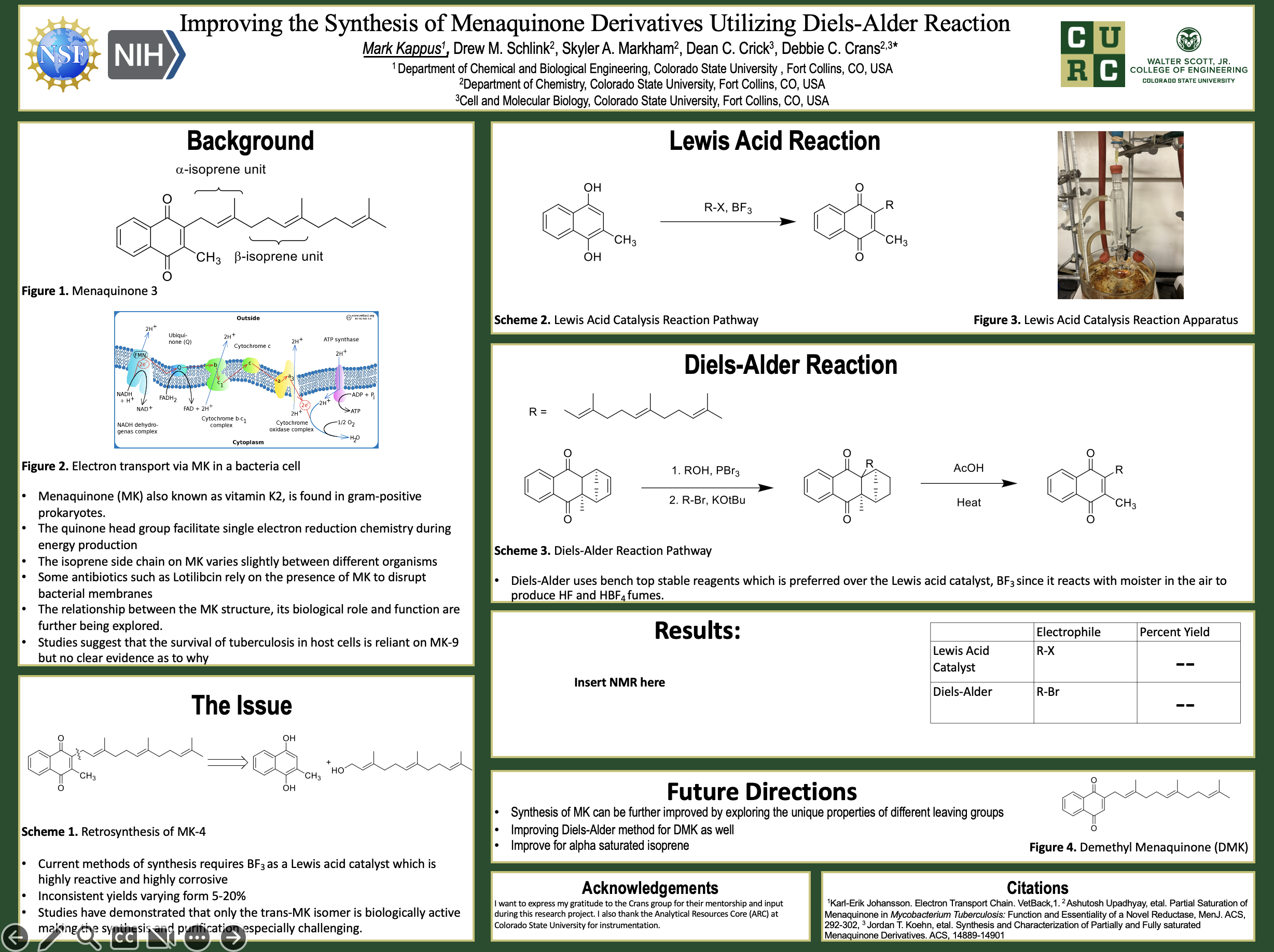
Menaquinone (MK), also known as vitamin K2, is commonly found in bacterial membranes. In this study, we focus on improving the synthesis of MK derivatives by changing the leaving group during the isoprenyl reaction. MK serves as the quinone that shuttles electrons between membrane-bound proteins during the production of energy in the electron transport chain (ETC) of certain procaryotes. The quinone head group on MK facilitates single electron reduction chemistry that occurs during the shuttling of electrons essential for this process, while its isoprenyl side chain varies in length and degree of saturation across different organisms. The current synthesis results in low yield (~20%), and we hypothesize that the choice of leaving group significantly impacts the amount of side product formation and thus, appropriate choice of leaving group will increase the yield. The differences in reactions with chlorine, bromine, mesylate, and tosylate as leaving groups were all considered due to their differing electronic properties and ability to enhance the desired reaction efficiency. To assess the impact of different leaving groups, the percent yields of products were determined using nuclear magnetic resonance (NMR) and will be discussed at the poster.