
Combinational Treatment of Cannabidiol and Trazadone mitigate proteotoxicity In C.elegans beta-amyloid Model
Category: Research Poster
Author(s): Makayla Linfoot, Abdullatif Alsulami, Ava Holzer, Stephanie McGrath, Julie Moreno
Presenter(s): Makayla Linfoot
Mentors(s): Julie Moreno
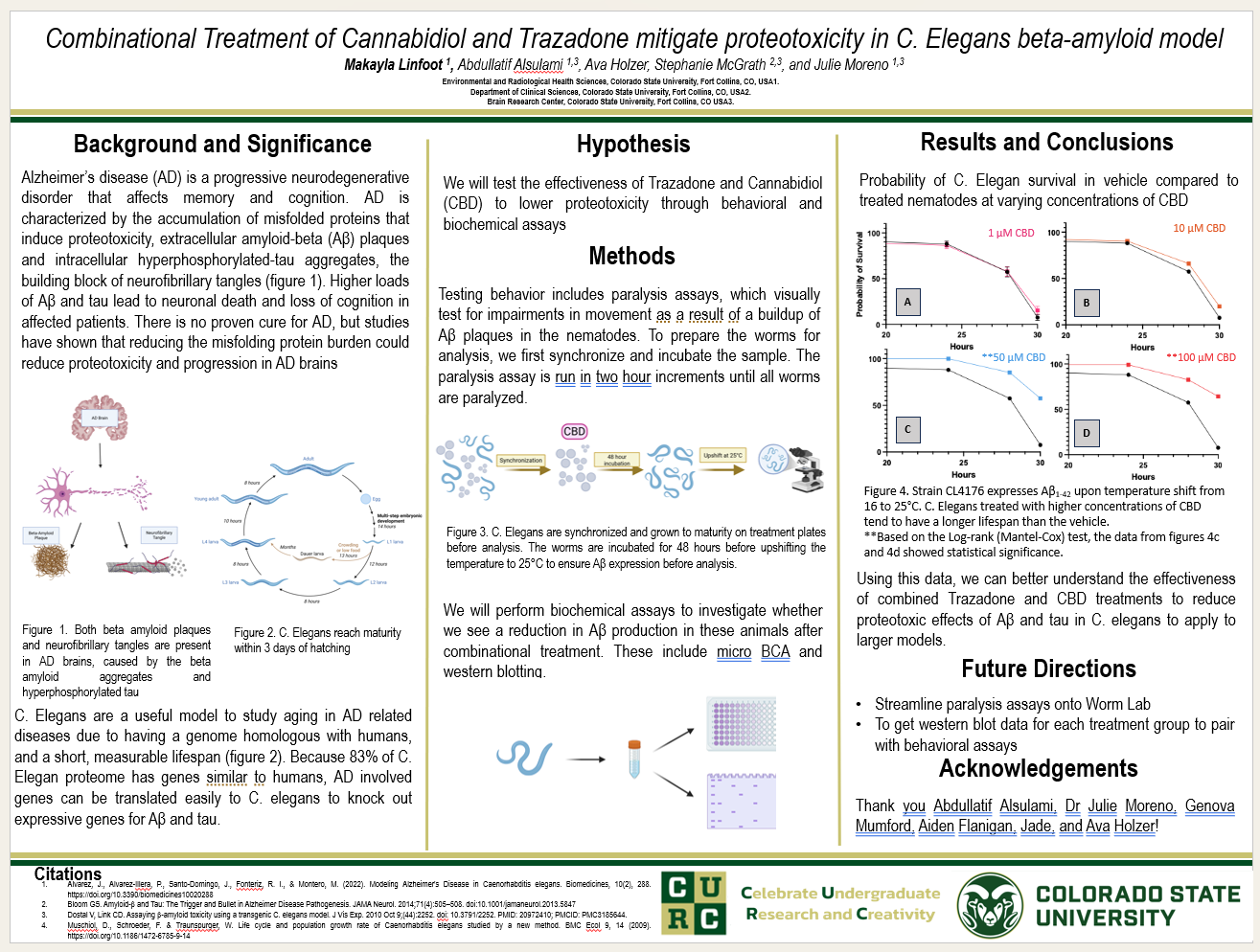
Combinational Treatment of Cannabidiol and Trazadone mitigate proteotoxicity In C.elegans beta-amyloid Model Makayla Linfoot1, Abdullatif Alsulami1,3, Ava Holzer, Stephanie McGrath2,3 and Julie Moreno1,3 Environmental and Radiological Health Sciences, Colorado State University, Fort Collins, CO, USA1. Department of Clinical Sciences, Colorado State University, Fort Collins, CO, USA2 Brain Research Center, Colorado State University, Fort Collins, CO, USA3 Alzheimer’s disease (AD) is a progressive neurodegenerative disorder that affects memory and cognition. AD is characterized by the accumulation of misfolded proteins that induce proteotoxicity, extracellular amyloid-beta (A) plaques and intracellular hyperphosphorylated-tau aggregates, the building block of neurofibrillary tangles (NFTs). Higher loads of A and tau lead to neuronal death and loss of cognition in affected patients. There is no proven cure for AD, but studies have shown that reducing the misfolding protein burden could reduce proteotoxicity and progression in AD brains. Cannabidiol (CBD) and Trazadone were both shown to modulate proteotoxicity in AD rodent models. C. elegans are a useful model to study aging and AD related diseases due to having a genome homologous with humans, and a short, measurable lifespan. We will test the effectiveness of Trazodone and CBD, separately and synergistically, on AB induced paralysis on animals that model AB in their muscles. We will perform behavioral and biochemical, western blotting, analyses to investigate a possible reduction in AB production in these animals after treatment. Using this data, we can better understand the effectiveness of combined Trazodone and CBD treatments to reduce proteotoxic effects of AB and tau in C. elegans to apply to larger models. Works Cited Alvarez, J., Alvarez-Illera, P., Santo-Domingo, J., Fonteriz, R. I., & Montero, M. (2022). Modeling Alzheimer's Disease in Caenorhabditis elegans. Biomedicines, 10(2), 288. https://doi.org/10.3390/biomedicines10020288 Bloom GS. Amyloid-β and Tau: The Trigger and Bullet in Alzheimer Disease Pathogenesis. JAMA Neurol. 2014;71(4):505–508. doi:10.1001/jamaneurol.2013.5847