
Effect of Attentional Load on Memory Binding: Implications for Alzheimer’s Disease
Category: Research Poster
Author(s): Kenna Waldrop, Sanjiti Sharma
Presenter(s): Kenna Waldrop
Mentors(s): Carol Seger
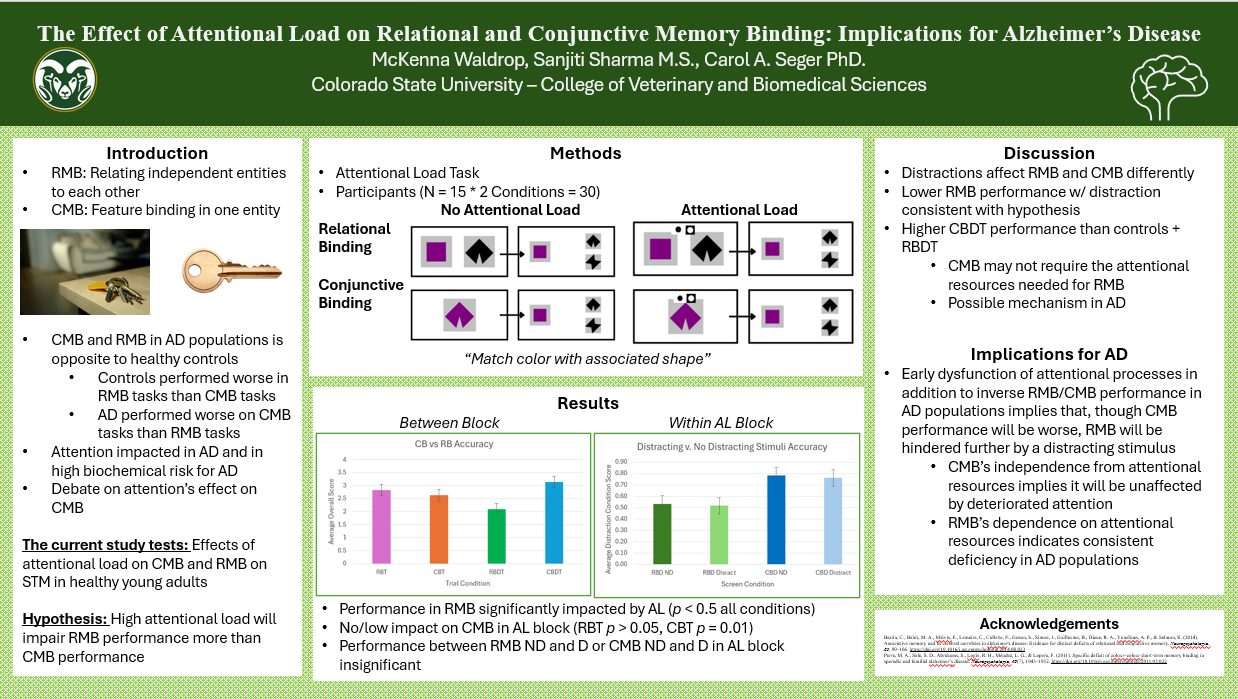
Memory binding forms the basis of short-term and long-term learned associations of objects and context, forming unified representations of objects in our perceptions. Memory binding can be divided into two categories: relational and conjunctive. Relational binding is the association between multiple stimuli while maintaining their independence. Conjunctive binding is the unification of stimuli into one entity. Relational memory can be thought of as remembering that one has placed their key onto a desk, while conjunctive memory can be thought of as combining all of the features of a key (head, ridges, shaft) into one object (key). The differences between relational and conjunctive memory binding performance have been implicated as early cognitive markers for preclinical Alzheimer’s Disease (AD), a disease known for its severe memory and attentional deficits, and have proved consistent against other dementias. This study aims to examine the impact of attentional deficits on conjunctive and relational short-term memory binding in healthy young adults and explores the implications they have for Alzheimer’s Disease cognitive marking and diagnosis.