
Detection of prions in skeletal muscle of gene-targeted mice infected with Nordic CWD
Category: Research Poster
Author(s): Madeline Judson
Presenter(s): Madeline Judson
Mentors(s): Diana Lowe
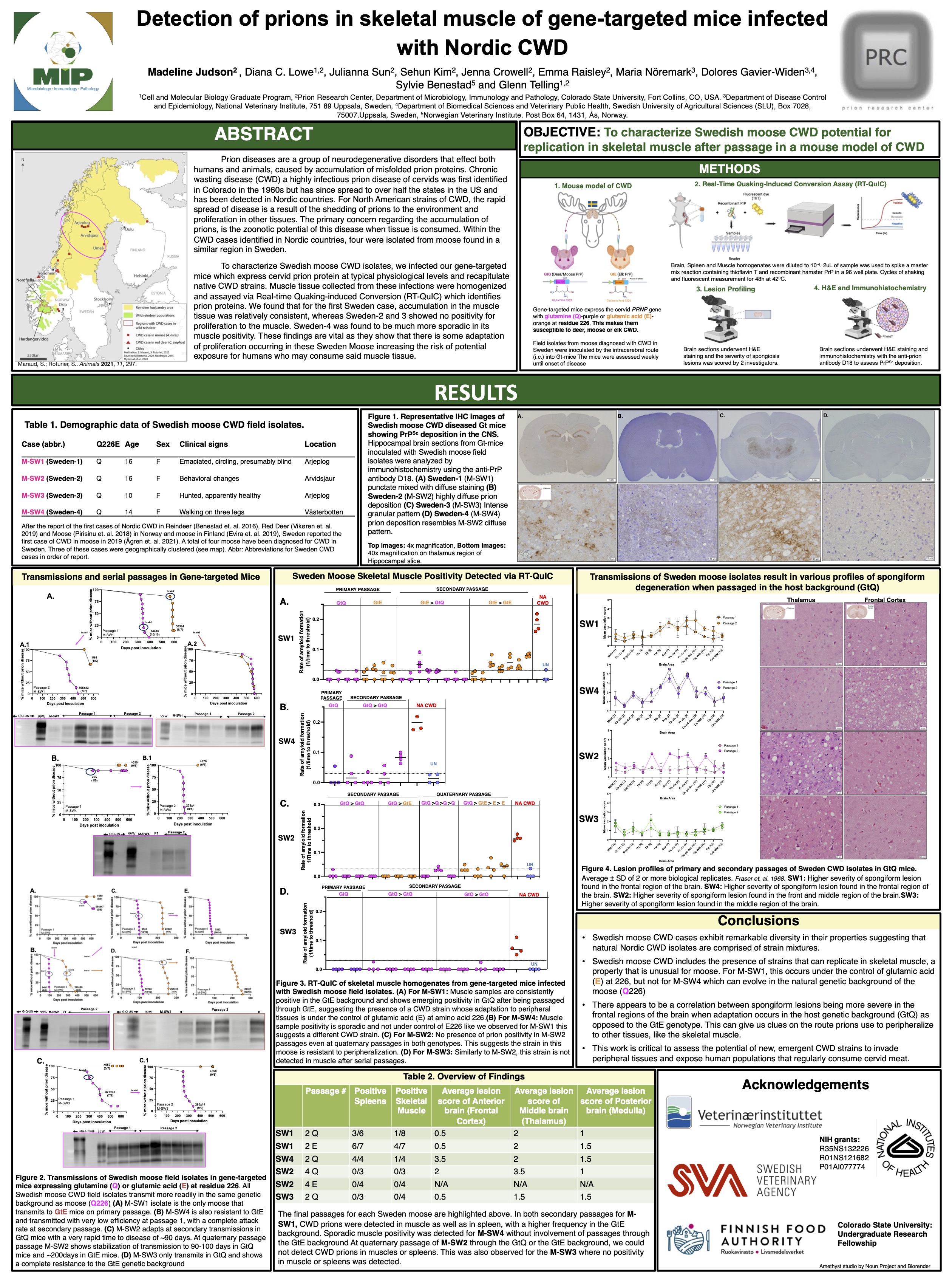
Prion diseases are a group of neurodegenerative disorders that effect both humans and animals, caused by accumulation of misfolded prion proteins. Chronic wasting disease (CWD) a highly infectious prion disease of cervids was first identified in Colorado in the 1960s but has since spread to over half the states in the US and has been identified in Nordic countries. For North American strains of CWD, the rapid spread of disease is a result of the proliferation of prions to the environment and other tissues. The primary concern regarding the accumulation of prions, is the zoonotic potential of this disease when tissue is consumed. Within the CWD cases identified in Nordic countries, four were isolated from moose found in a similar region in Sweden. To characterize Swedish moose CWD isolates, we infected our gene-targeted mice with these isolates, which express cervid prion protein at typical physiological levels and recapitulate native CWD strains. Muscle tissue collected from infections of these moose CWD into these mice were then homogenized and assayed via Real-time Quaking-induced Conversion (RT-QuIC) which identifies prion proteins. We found that for the first Sweden case, accumulation in the muscle tissue was relatively consistent, whereas Sweden-2 and 3 showed no positivity for proliferation to the muscle. Sweden-4 was found to be much more sporadic in its muscle positivity. These findings are vital as they show that there is some adaptation of proliferation occurring in these Sweden Moose increasing the risk of potential exposure for humans who may consume said muscle tissue.