
Comparative Study of Electrolyte Composition in Tin Electrodepositions
Category: Research Poster
Author(s): Erik Hiserodt
Presenter(s): Erik Hiserodt
Mentors(s): Amy Prieto, Jessica Gallawa
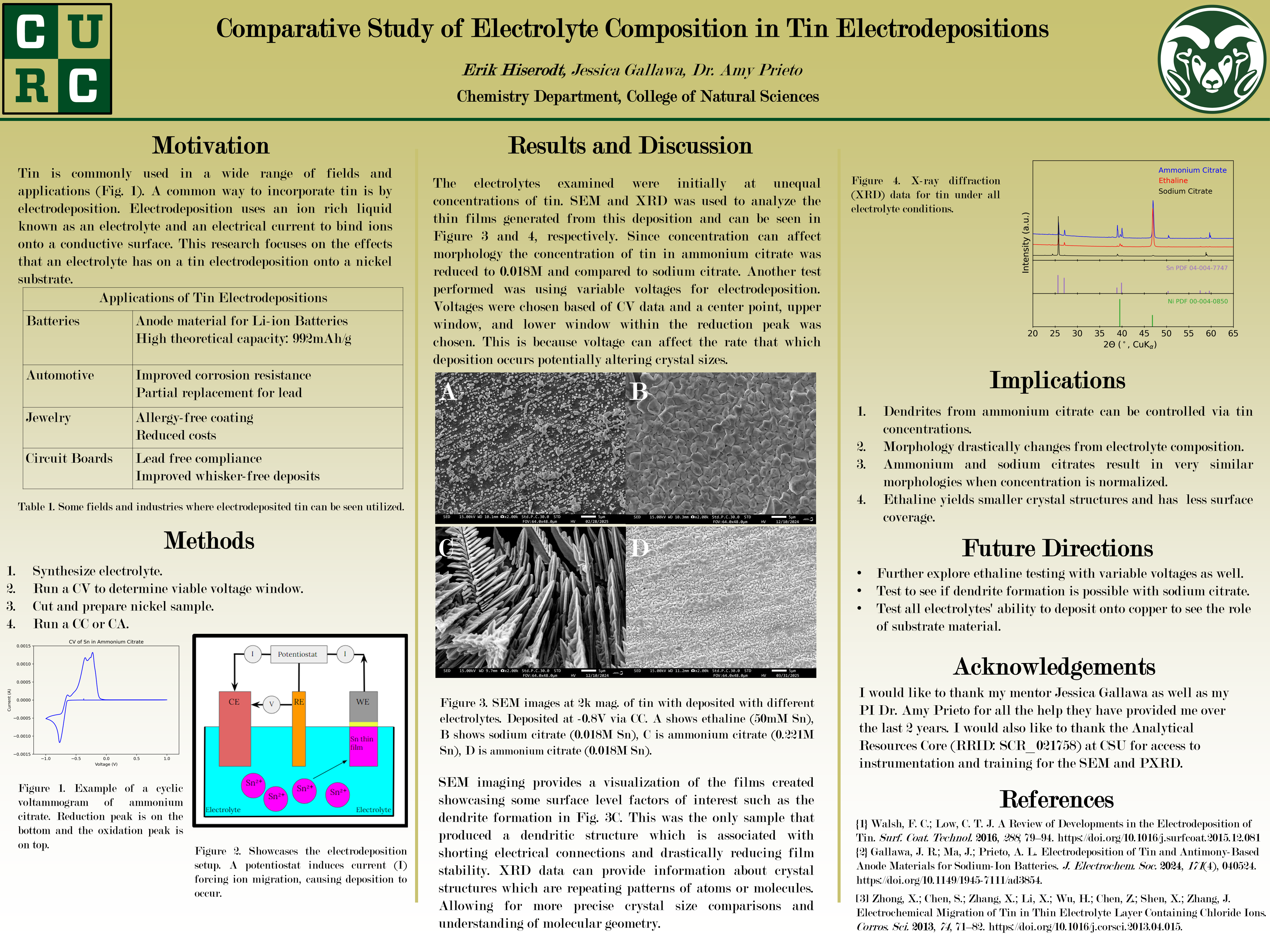
Tin is commonly used and deposited on various materials in fields like batteries, microelectronics, jewelry, and the automotive industry. A common deposition strategy is known as electrodeposition. Electrodeposition utilizes a liquid rich with ions (electrolyte) and an electrical current in order to bind ions onto a conductive surface. The purpose of this study is to understand the properties that can vary when the electrolyte solution is changed for the electrodeposition of tin. Both aqueous and non-aqueous electrolytes were examined under various electrochemical techniques. These were then characterized primarily by scanning electron microscopy and powder X-ray diffraction to determine features such as size, morphology, oxidation state, and molecular geometry. Preliminary results show that the choice of electrolyte drastically alters these features. These differences can primarily be seen in the preferred orientation of tin and the size distribution for the crystals that form. This work aims to contribute an objective evaluation for tin electrodeposition effects based on electrolyte composition.