
Global STING knockout differentially alters behavioral and nigrostriatal phenotypes of mice subjected to the rotenone model of Parkinson’s disease in a sex-dependent manner
Category: Research Poster
Author(s): Abby Bibb
Presenter(s): Abby Bibb
Mentors(s): Ronald Tjalkens, Adam Schuller, Savannah Rocha
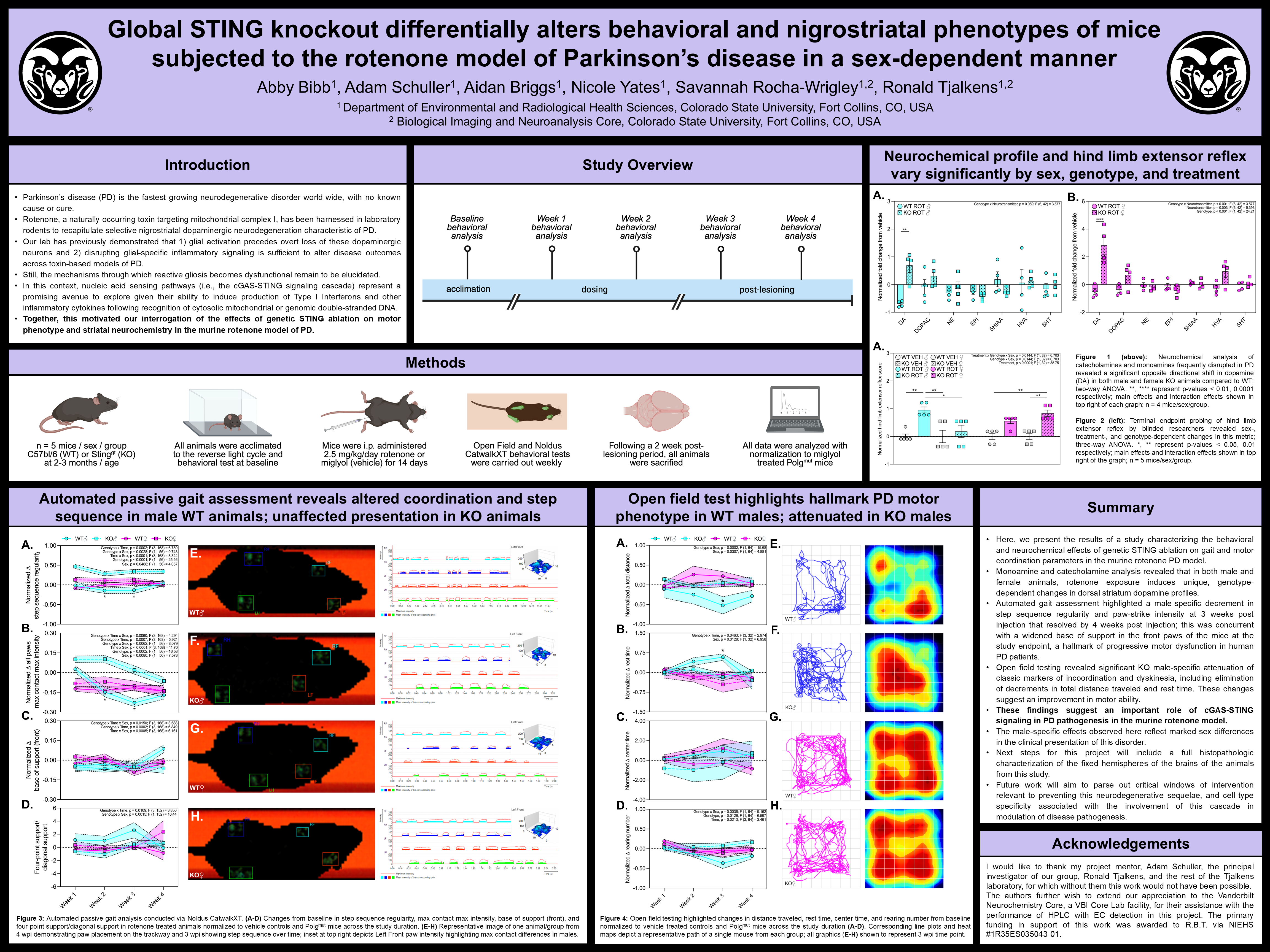
Parkinson’s disease (PD) is the fastest growing neurodegenerative disorder world-wide, with no known cause or cure. Rotenone, a mitochondrial complex I inhibitor and pesticide, has been harnessed in laboratory rodents to recapitulate the selective loss of nigrostriatal dopaminergic neurons characteristic of human PD, which is associated with mitochondrial dysfunction, including mtDNA damage and release. This motivates the interrogation of cytosolic nucleic acid sensing pathways, like the cGAS-STING signaling cascade, in this context. To this end, we sought to explore the effects of genetic STING ablation on behavior and nigrostriatal pathology in the murine rotenone model of PD. Male and female WT or STING KO mice were I.P. injected with 2.5 mg/kg/day rotenone or vehicle for 14 days followed by a 14 day post-lesioning period. Baseline behavioral data was collected prior to initial rotenone insult and subsequently compared against weekly timepoint data via open field and NoldusXT Catwalk gait analysis. This revealed significant treatment-dependent changes in male WT animals indicative of motor dysfunction which were not present in KO or female animals. These findings suggest a role of cGAS-STING signaling in PD pathogenesis in the murine rotenone model. The male-specific effects observed here reflect marked sex differences in the clinical presentation of PD. Future work will aim to parse out cell-type specificity of STING signaling relevant to these neurodegenerative sequelae.