
Evaluating the Bidirectional Relationship between Performance and Burnout at Work: An Extension of the Job Demands-Resources Model
Category: Research Poster
Author(s): Lander Wilkinson, Katelynn Burgess, Kesea Nutter
Presenter(s): Lander Wilkinson
Mentors(s): Joshua Prasad
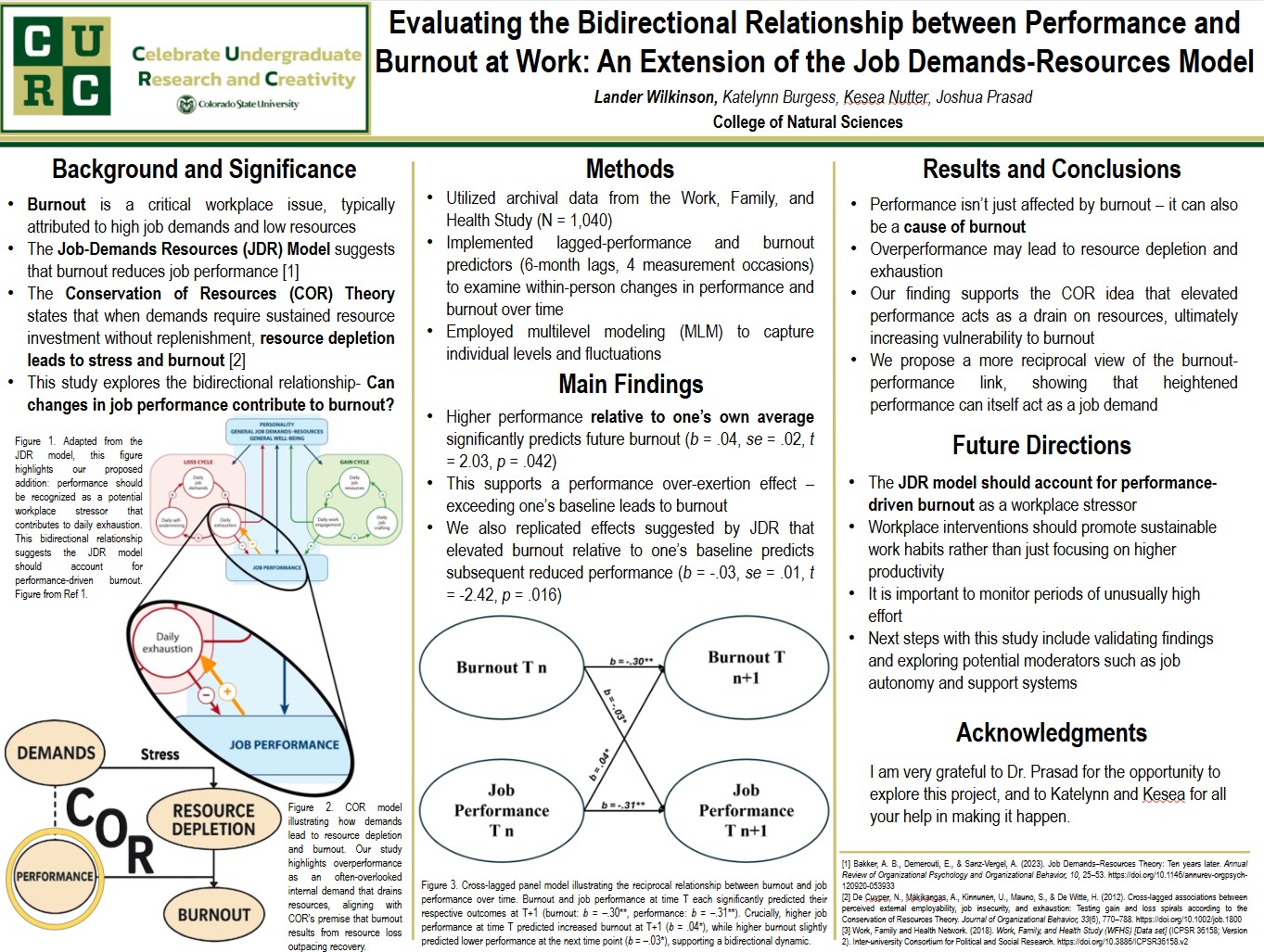
Burnout is a growing concern in the workplace, often attributed to excessive job demands and inadequate resources. The Job Demands-Resources model (JDR) suggests that burnout leads to diminished job performance, yet the potential for performance to drive burnout has received less attention. Using archival data from the Work, Family, and Health Study (N = 1,040), we examined whether fluctuations in individual job performance predict subsequent burnout at the within-person level. We used multilevel modeling analyses with a lagged-performance predictor to assess whether deviations from an individual’s average performance impact later experiences of burnout. This revealed that increases in job performance relative to an individual’s average predicted higher future burnout (b = .004, se = .002, t = 2.03, p = .042). This suggests a performance over-exertion effect–sustaining effort beyond one's baseline. While prior research supports the idea that burnout leads to diminished performance, our findings indicate that pushing oneself beyond typical performance levels may also deplete resources and contribute to later burnout. These results challenge the JDR model’s assumption of a unidirectional relationship between burnout and performance, highlighting the need to consider performance-driven burnout as a potential mechanism. Implications of these findings include the importance of sustainable work practices and resource allocation to prevent overexertion and long-term exhaustion. Future research should validate these findings using additional datasets and explore potential moderating factors, such as job autonomy and support systems.