
Effects of acute stress on midbrain circuitry and innate fear behavior
Category: Research Poster
Author(s): Bell Lopez, Brent Myers, Ana Valeria Castro Romero, Christopher Vaaga, Jordan Carroll
Presenter(s): Bell Lopez
Mentors(s): Christopher Vaaga
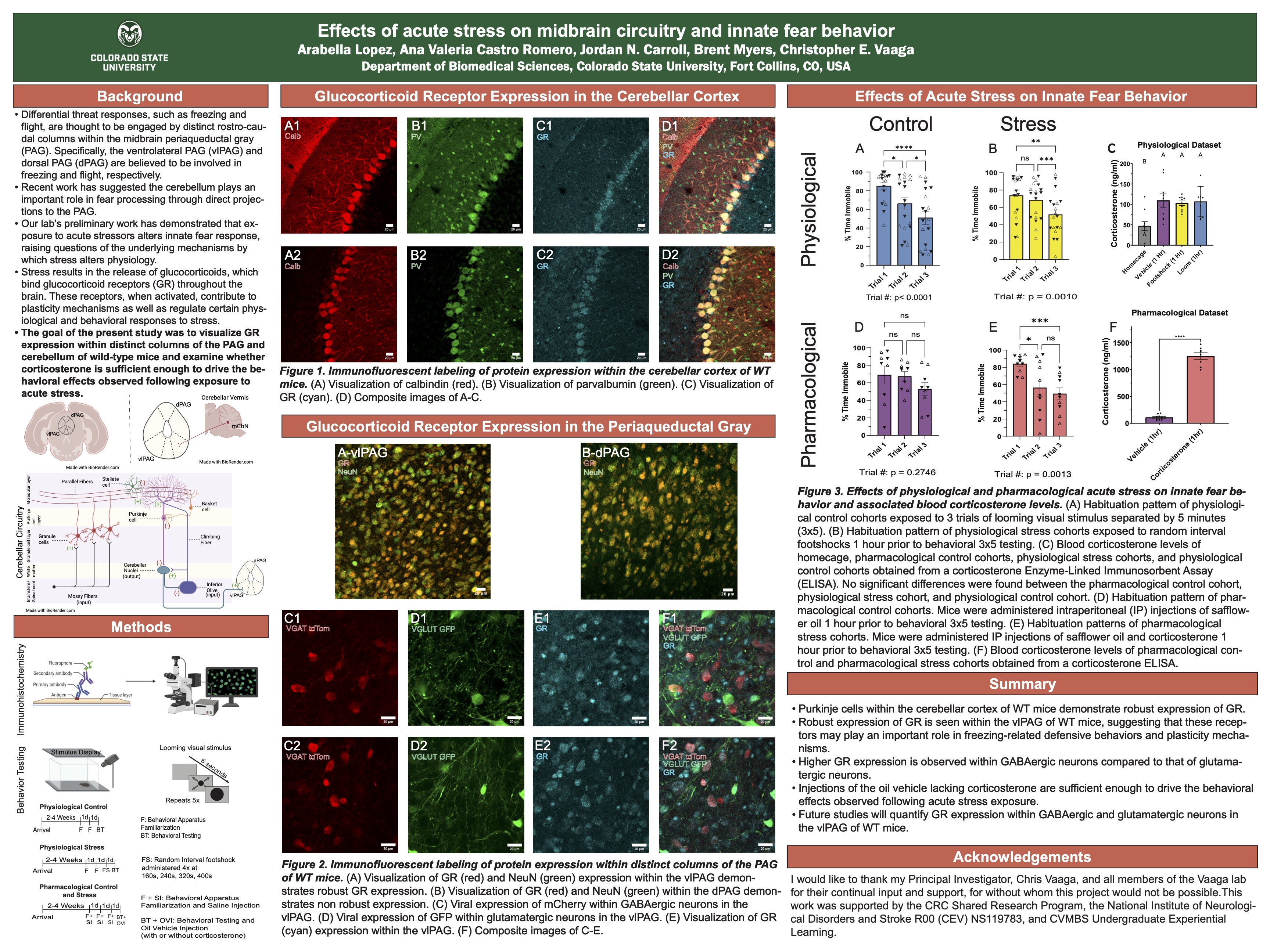
The dedicated neural circuitry underlying innate fear mechanisms allows animals to assess and respond to environmental and/or predatory threats, ultimately aiding in their overall survival. Differential threat responses, such as freezing and flight, are thought to be engaged by distinct rostro-caudal columns within the midbrain periaqueductal gray (PAG). Although the cerebellum is traditionally viewed as a motor structure, recent work has suggested it also plays an important role in fear processing, including via direct projections to the PAG. Our lab’s preliminary work has demonstrated that exposure to acute stressors alters innate fear responses, raising questions about the underlying mechanism by which stress alters physiology. Stress results in the release of steroid hormones, including corticosterone, which bind glucocorticoid receptors (GRs) throughout the brain. Glucocorticoid receptor activation contributes to plasticity mechanisms and can regulate behavioral and physiological responses to stressful events. The goal of the present study was to quantify glucocorticoid receptor expression within distinct columns of the PAG and cerebellum of wild-type mice and examine whether corticosterone itself is sufficient to drive the behavioral effects observed following acute stress. GR expression was visualized using immunohistochemistry and demonstrated differential expression across PAG columns and layers of the cerebellar cortex. Understanding the role of GRs in the PAG and cerebellum will provide a deeper understanding of how GR activation modulates innate fear circuitry. This work was supported by the CRC Shared Research Program, the National Institute of Neurological Disorders and Stroke R00 (CEV) NS119783, and CVMBS Undergraduate Experiential Learning.