
Colonial Influence and Cultural Appropriation in 19th-Century American Dress
Category: Research Poster
Author(s): Megan Greenly
Presenter(s): Megan Greenly
Mentors(s): Paula Alaszkiewicz
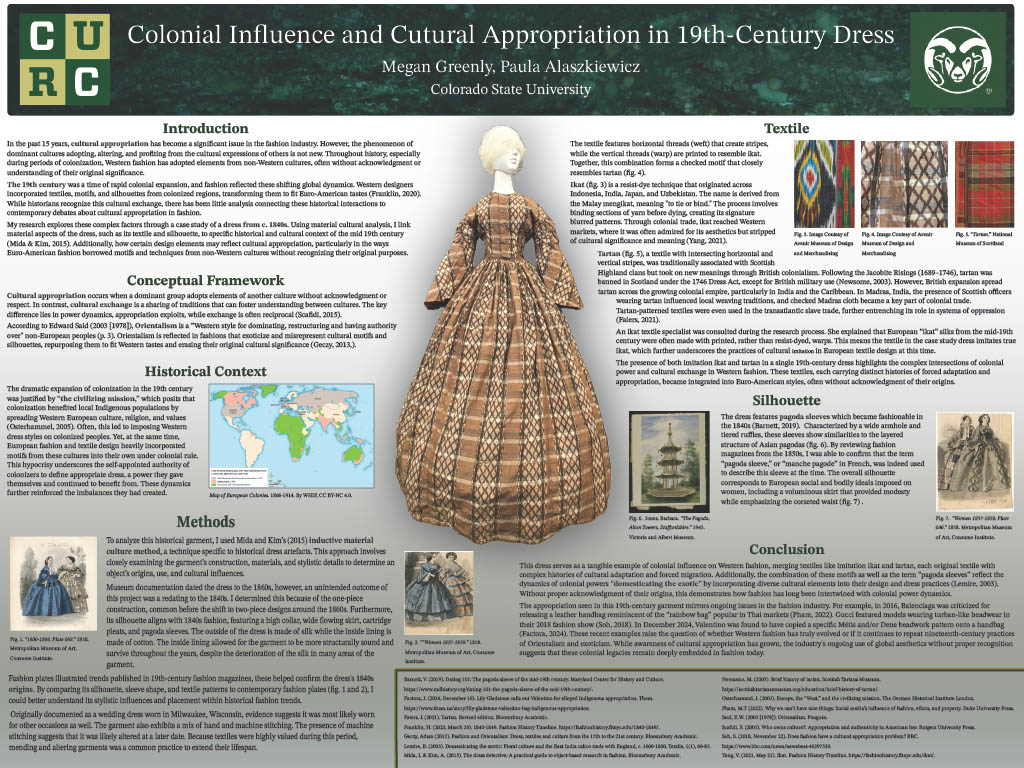
Over the past fifteen years, Western fashion brands have repeatedly faced accusations of cultural appropriation for profiting from the exploitation of marginalized cultures. While cultural exchange in fashion predates the 21st century and has been studied by historians, there is little scholarship connecting these past interactions to contemporary cultural appropriation. My research investigates how American dress from the 1860s reflects the colonial dynamics of its time and connects to recent issues of appropriation. The dress is made from a patterned silk combining two culturally distinct motifs: tartan and ikat. Tartan originated in Scotland and moved through colonial networks from the Indian subcontinent, the Caribbean, and West Africa. Ikat, or warp-resist dyeing, is found in the textiles of Indonesia, India, Japan, and Uzbekistan. Additionally, this dress features recognizable pagoda sleeves, referencing Asian architecture. These design details align with the expansion of European and American colonial powers, fueled by the harmful ideology of the “civilizing mission.” Yet, paradoxically, Euro-American fashion and textiles incorporated culturally significant styles from colonized peoples. To analyze the garment, an inductive material culture method, specific to historical dress artifacts, will be employed. Using this method and drawing from my fashion design studies, I will identify the garment’s construction details and utilize contemporaneous fashion illustrations to determine its origins, timeline, potential alterations, and similarities to popular fashions of the time. I argue that this dress, made by a colonial power with styles from colonized regions, reflects the power dynamics of recent cultural appropriation.