
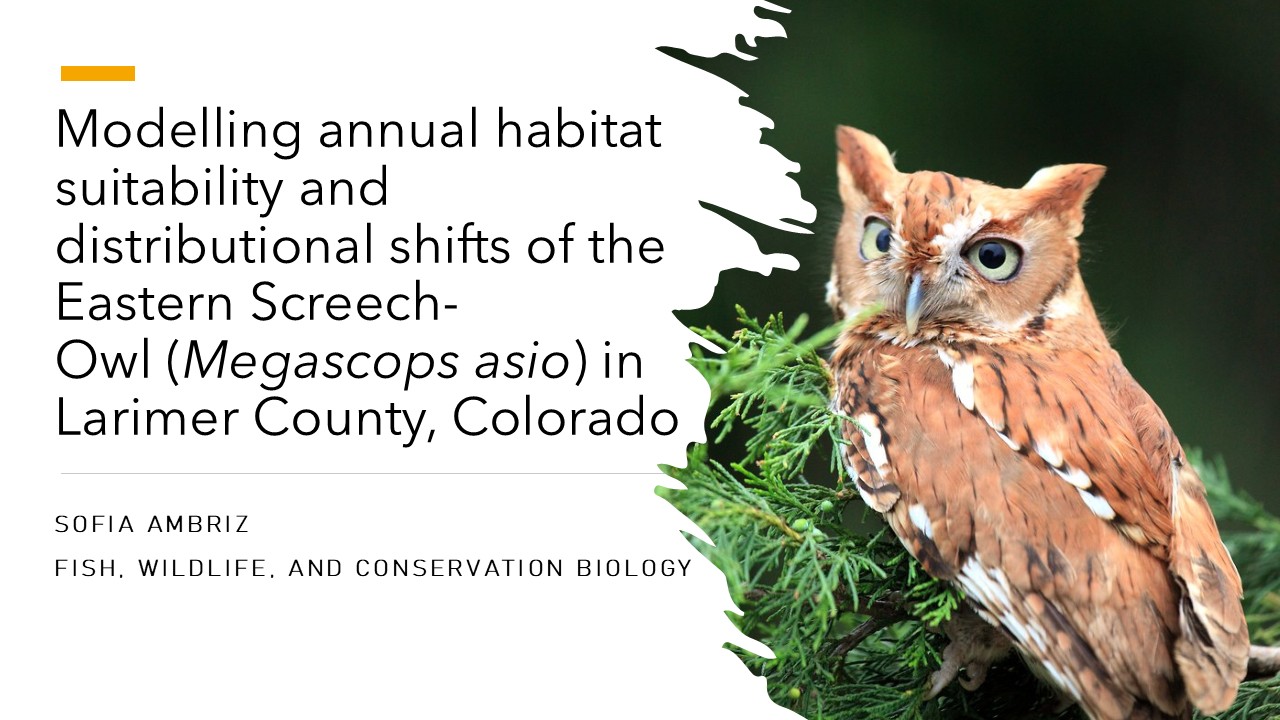
Modelling annual habitat suitability and distributional shifts of the Eastern Screech-Owl (Megascops asio) in Larimer County, Colorado
Category: Oral Presentation
Author(s): Sofia Ambriz
Presenter(s): Sofia Ambriz
Mentors(s): Nelson Gathuku
Exploring how species respond to environmental gradients and anthropogenic pressures is a key goal in species conservation and ecology, especially at the edge of their ranges, where these factors are dynamic seasonally and/or annually. Ecological models are useful for linking presence data and environmental covariates to predict habitat use and assess shifts in space utilization across time. Using 3 years of data (2021-2023), this study aims to create annual habitat suitability maps for the Eastern Screech-Owl in Larimer County, which is severely understudied. Eastern Screech-Owls are a unique species as they adapt well to suburban areas and are considered an indicator species for the health of riparian areas. Thus, understanding what factors influence their habitat and how their distribution has changed, is critical to assessing the impact of urban development and habitat loss. Occurrence data were obtained from eBird within Larimer County, which included presence data and inferred absence data/background needed for species distribution modeling. A Random Forest approach will be used to model habitat suitability. We will process the raster data to the extent of Larimer County, and values for each variable will be extracted at presence-absence points. To assess shifts in distribution, we will extract the covariates for each year. We expect the following features to influence screech-owl distribution: distance to water, annual temperature, elevation, tree species, height, and canopy, and human settlements. Therefore, we hypothesize that Eastern Screech-Owl distribution will shift closer to Fort Collins due to increased urban development and associated land use changes.