
Mauritius and the Chagos Islands: The Struggle for Full Decolonization in Domestic Politics and Foreign Policy
Category: Oral Presentation
Author(s): Venus Balendra
Presenter(s): Venus Balendra
Mentors(s): Peter Harris
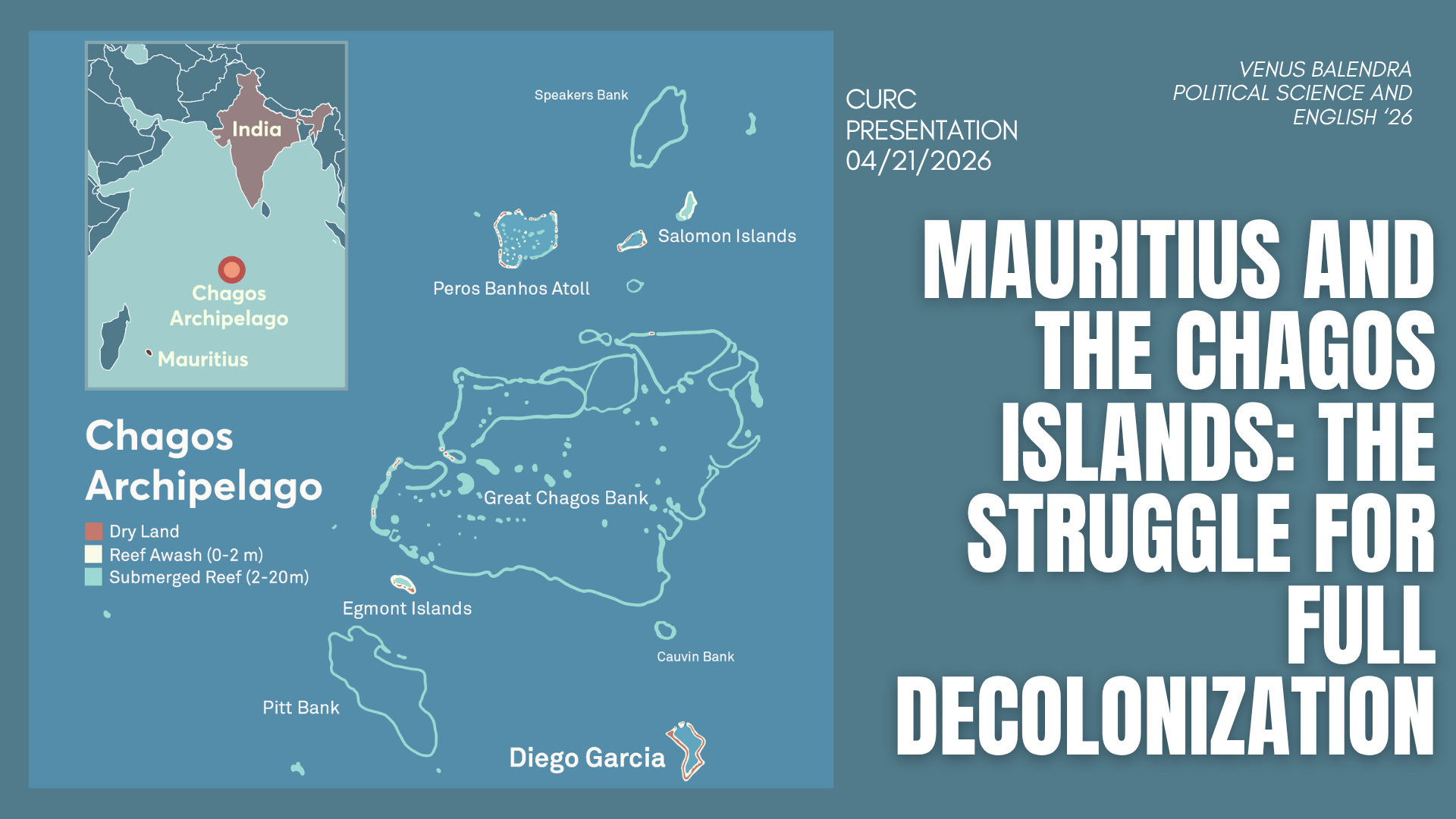
This presentation examines the Chagos Archipelago dispute and its significance for Mauritian domestic politics and foreign policy. Although Mauritius gained independence in 1968, the detachment of the Chagos Islands in 1965 meant that decolonization remained incomplete. This unresolved issue has since evolved into a central feature of Mauritian political life. The presentation traces this development chronologically, showing how the issue moved from a constitutional contradiction at independence to a lived social and political concern. The forced displacement of the Chagossian population brought the consequences of excision directly into Mauritian society, linking the dispute to questions of inequality, marginalisation, and justice. Over time, the issue became embedded in parliamentary processes, civil society mobilisation, and electoral politics. Particular attention is given to the role of activist movements in reframing Chagos as not only a question of sovereignty, but also of militarisation, imperialism, and the right of return. The presentation also considers the international dimension of the dispute, focusing on Mauritius’s engagement with legal and diplomatic institutions. The 2019 advisory opinion of the International Court of Justice marked a turning point, providing legal validation for Mauritius’s claims and strengthening its position in negotiations. Overall, the Chagos dispute illustrates how incomplete decolonization continues to shape both domestic political identity and international strategy.