
Combined Effects of Cannabis and Alcohol on Error Recognition
Category: Research Poster
Author(s): Cole Campbell, Patricia Davies, William Gavin
Presenter(s): Cole Campbell
Mentors(s): Patricia Davies, William Gavin
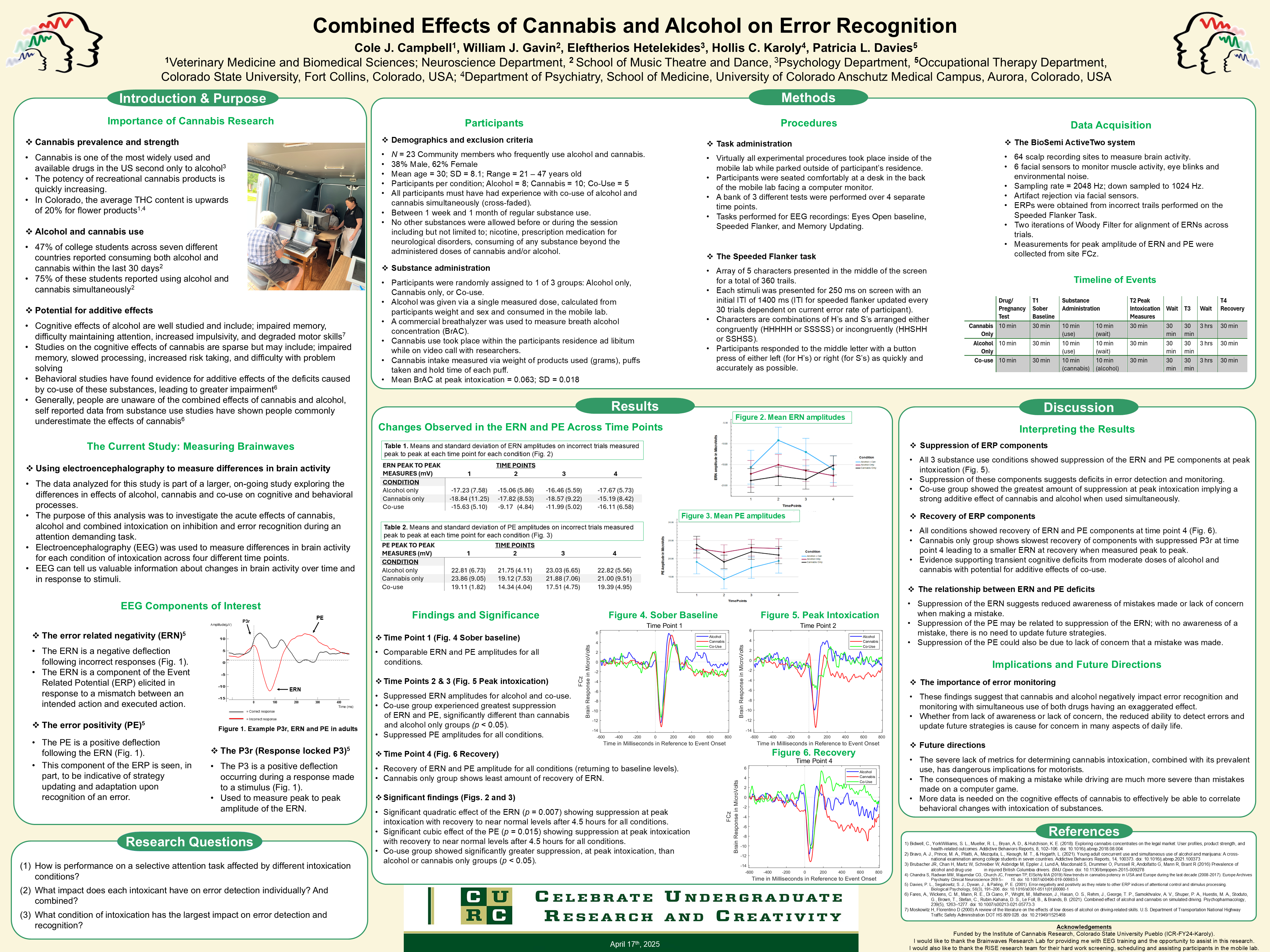
Cannabis is rapidly becoming one of the most widely used and available drugs across the U.S. second only to alcohol. But conversely to alcohol, very little is understood about the cognitive impacts of cannabis and its active component THC. Using electroencephalography (EEG) we can observe differences in brain activity related to the impact of intoxication on cognitive processing over time. This study examined the acute effects of cannabis and alcohol intoxication on inhibition during an attention demanding task across four time points. Both performance and brain activity measures were obtained during a speeded flanker task for alcohol only, cannabis only and co-use groups. We focused on brain activity associated with performance monitoring, error detection (error related negativity, ERN) and adaptation (error positivity, PE). These components of the event related potential (ERP) are elicited when a mistake is made and are seen as the brain’s response to a mismatch between an intended action and an executed action. While all groups showed suppressed brain activity for ERN and PE at peak intoxication, the co-use group was significantly greater. The PE showed a significant cubic trend (p = 0.032) reflecting the suppression of the PE following intoxication, then a recovery of the PE in later time points. The reduced amplitudes of ERN and PE across intoxication conditions highlights deficits caused by alcohol and cannabis on inhibitory control. These effects were significantly greater in the combined intoxication group providing evidence of a strong additive effect.