
Charged Crystal Exfoliation
Category: Research Poster
Author(s): Laura Richards, Spencer Lenius, Stefania Miranda
Presenter(s): Laura Richards
Mentors(s): Yulia Maximenko
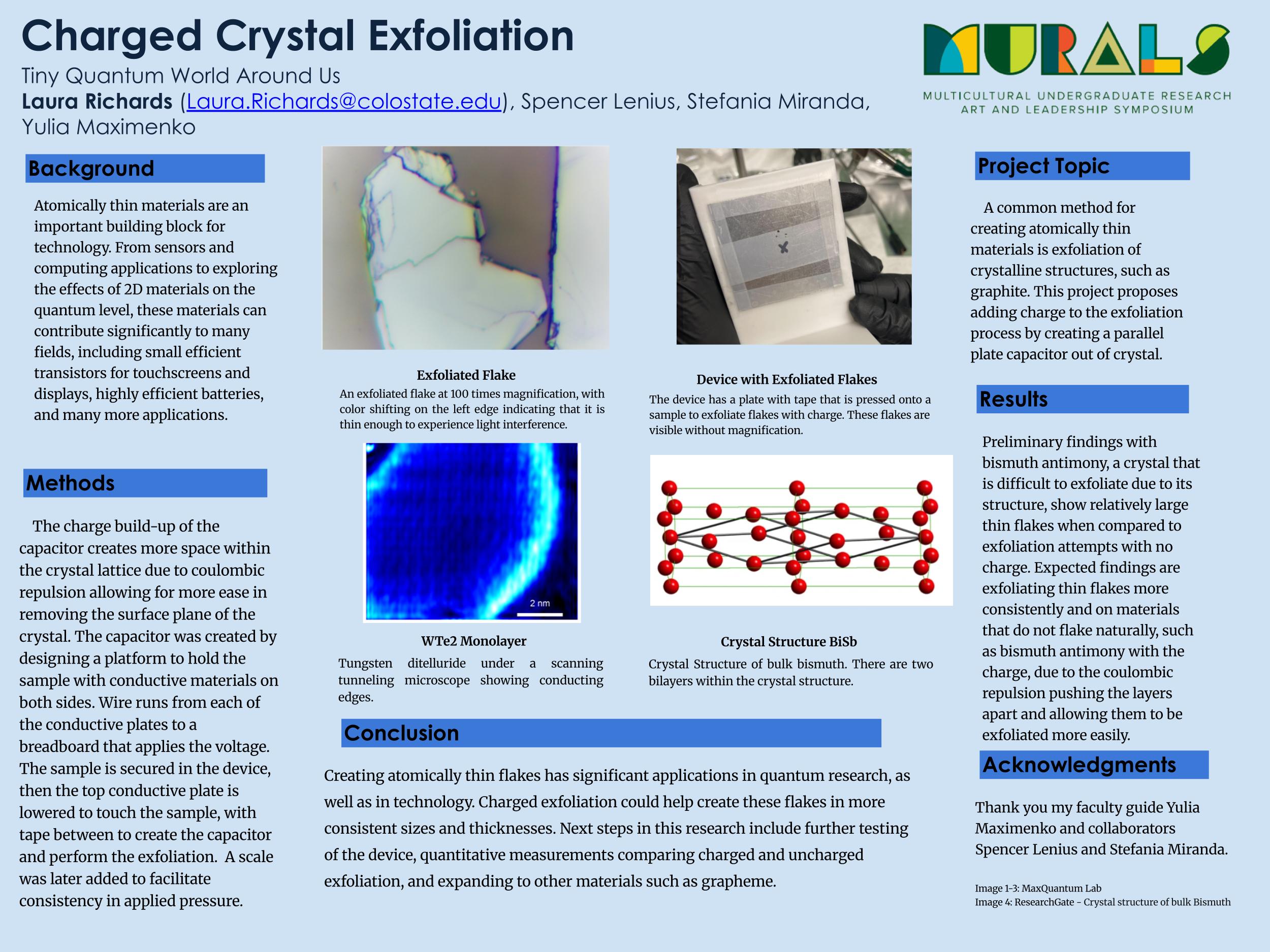
Atomically thin materials are an important building block for technology. From sensors and computing applications to exploring the effects of 2D materials on the quantum level, these materials can contribute significantly to many fields, including small efficient transistors for touchscreens and displays, highly efficient batteries, and many more applications. Atomically thin materials are the most useful when they are thin and uniform, and larger flakes with good uniformity are desirable. A common method for creating atomically thin materials is exfoliation of crystalline structures, such as graphite. This project proposes adding charge to the exfoliation process by creating a parallel plate capacitor out of crystal. The charge build-up of the capacitor creates more space within the crystal lattice, due to coulombic repulsion. allowing for more ease in removing the surface plane of the crystal. The capacitor was created by designing a platform to hold the sample with conductive materials on both sides. Wire runs from each of the conductive plates to a breadboard that applies the voltage. The sample is secured in the device, then the top conductive plate is lowered to touch the sample, with tape between to create the capacitor and perform the exfoliation. A scale was later added to facilitate consistency in applied pressure. So far, the project shows visibly larger flakes as well as a greater quantity of flakes when exfoliated with charge and viewed under an optical microscope. Next steps include further testing with various crystal types and quantitative measurements using atomic force microscopy.