
Deep Soil Organic Carbon in Semi-Arid No- Till Systems: Additive Impacts of Cover Crops
Category: Research Poster
Author(s): Cate McPherson, Miriam Hill
Presenter(s): Cate McPherson
Mentors(s): Catherine Stewart
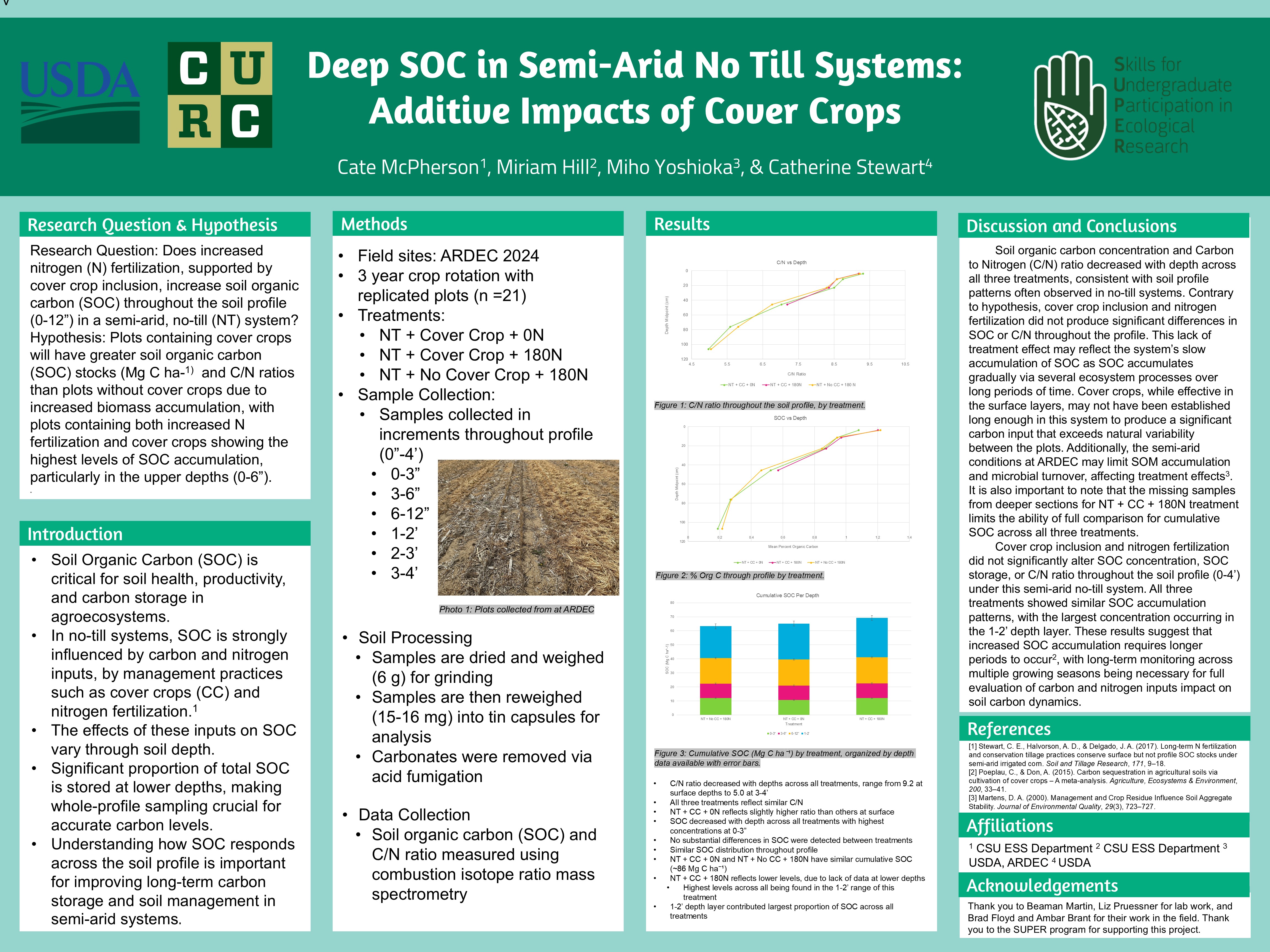
Soil organic carbon (SOC) is a key indicator of soil health and plays an important role in ecosystem stability. Agricultural management practices heavily influence SOC, particularly under conservation tillage systems where differences in carbon and nitrogen inputs drive SOC changes. Two strategies commonly used in agriculture to support crop productivity and soil health include the use of cover crops and increased nitrogen (N) fertilization. This study examines if increasing C inputs by adding conservation practices such as cover crop and increased N fertilization is more beneficial than no-tillage (NT) along on SOC in semi-arid agroecosystems. This study also examines throughout the soil profile (1-12’) as SOC stability varies by depth, and can be unequally distributed. Soils were collected from plots at ARDEC (Agricultural Research, Development, and Education Center) under a three-year NT irrigated forage crop rotation with replicated treatments of tillage, N rates and cover crop. We sampled from depths throughout the profile (1-12’) and analyzed for SOC, TN d13C using combustion isotope ratio mass spectrometry. Analyses aim to determine whether increased crop inputs with cover crop integration effectively contribute to SOC accumulation throughout soil depths. In understanding these results effective management strategies can be chosen to balance productivity with soil health and carbon storage in semi-arid systems.