
Clinical Predictors of Split-Belt Treadmill Adaptation Aftereffects in People with Multiple Sclerosis
Category: Research Poster
Author(s): Colin Murphy, Brett Fling, Isaac Bast
Presenter(s): Colin Murphy
Mentors(s): Isaac Bast
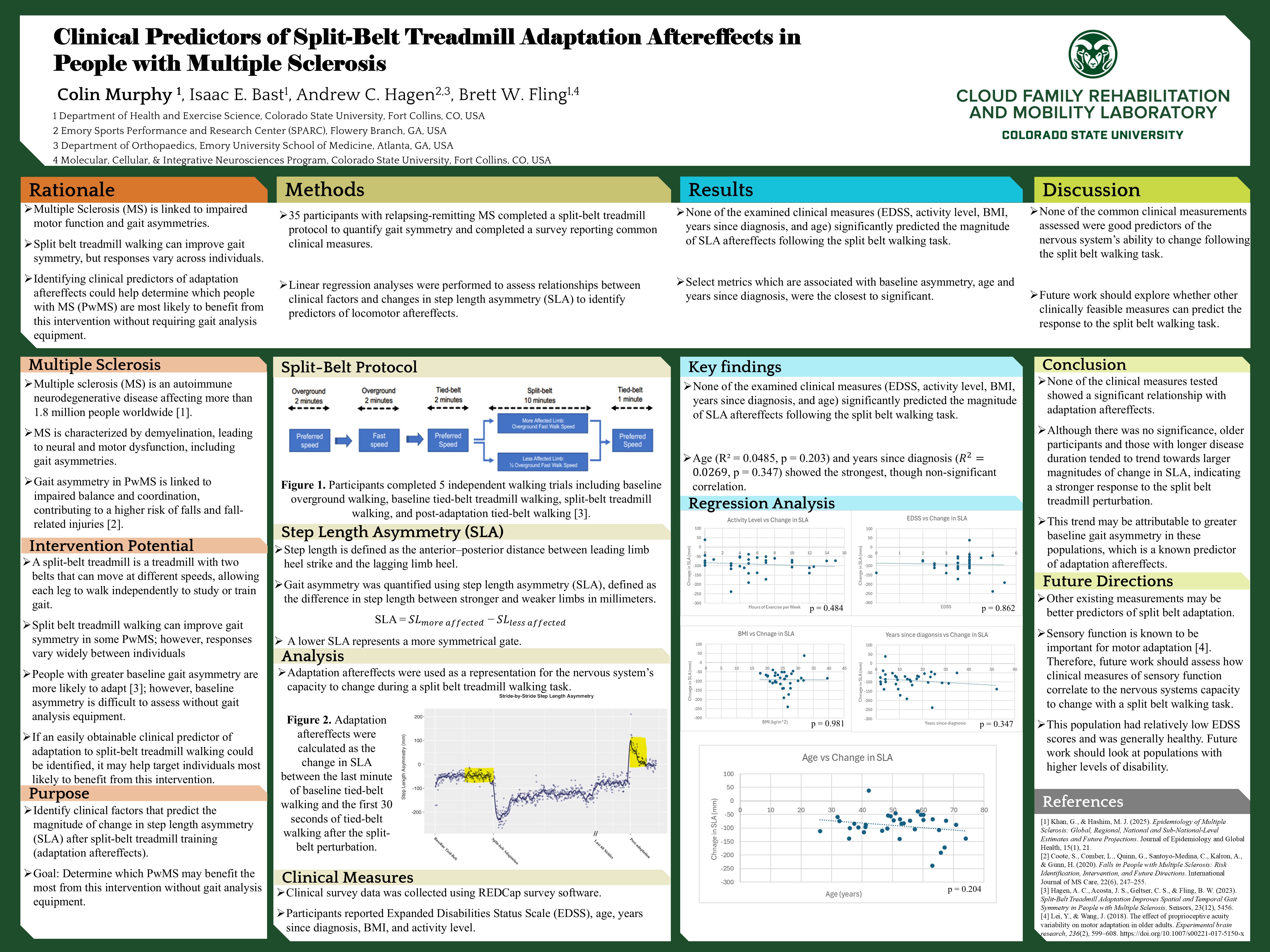
Multiple sclerosis (MS) is a neurodegenerative disease characterized by demyelination of neurons, causing impaired neural communication and sensorimotor dysfunction. Many people with MS (PwMS) develop gait asymmetries due to unilateral weakness, which increases fall risk. A recent study found that walking on a split-belt treadmill, a device with two belts that can move at different speeds, can induce locomotor adaptation and temporarily alter gait symmetry. Although PwMS can adapt their gait, the adaptation response varies across individuals. The purpose of this analysis is to assess which clinical factors predict the magnitude of adaptation aftereffects during split-belt treadmill walking. Thirty-five PwMS completed a split-belt treadmill protocol including baseline tied-belt walking, a split-belt phase, and a return to tied-belt walking. Participants completed a survey reporting common clinical measures before the task. Gait asymmetry was quantified using step length asymmetry (SLA), the difference in step length between stronger and weaker limbs. Adaptation aftereffects were calculated as the change in SLA between the second half of baseline tied-belt walking and the first 30 seconds of tied-belt walking after the split-belt perturbation. These values were compared to clinical measurements. No significant associations were observed between the clinical measures and the adaptation aftereffect. However, age and years since diagnosis had the strongest, though non-significant, associations with aftereffect magnitude and may reflect baseline gait asymmetry differences. Future work should focus on identifying clinical metrics associated with aftereffect magnitude to help determine which individuals with MS may benefit most from this rehabilitation intervention without requiring treadmill testing.