
How Rewards May Influence Motivation for Decisional Exploration
Category: Research Poster
Author(s): Payton Schueppert, Joseph Martis
Presenter(s): Payton Schueppert
Mentors(s): Carol Seger
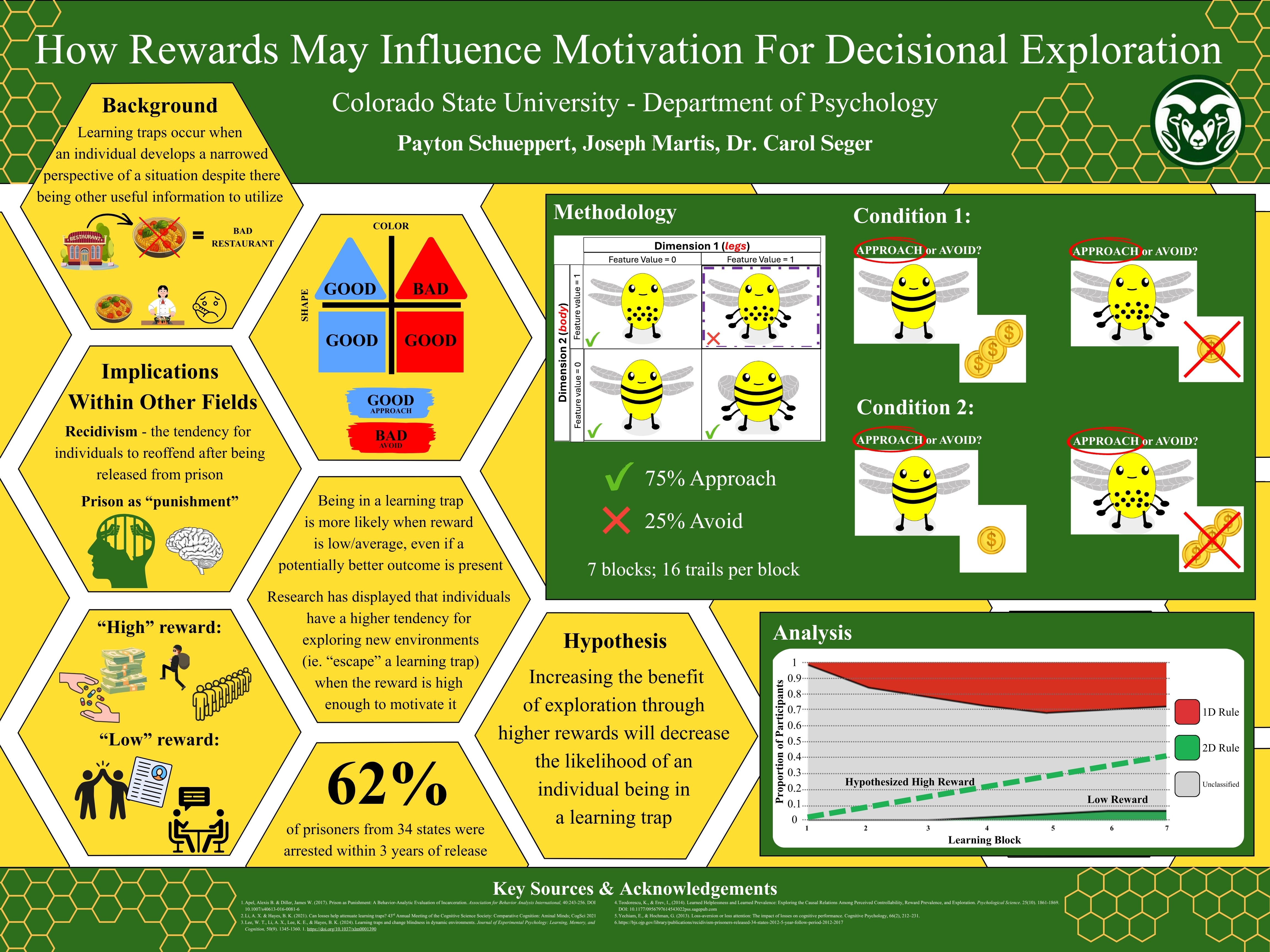
Learning traps occur when an individual develops a narrowed perspective of a situation despite there being other useful information to utilize. Previous research has characterized traps with overly selective attention as well as quick, yet poorly informed, decision making. Literature on behavioral adaptation has emphasized the importance of reward and punishment intensities on promoting the development of new behavior, ie. “escaping” a learning trap. This can be applied to recidivism, the tendency of an individual to reoffend after being released from prison. It is common for former inmates to go back to a life of crime due to familiarity. In these scenarios, narrowed beliefs may influence this decision-making behavior. I believe learning-traps may be a factor in recidivism and the effectiveness of post-release rehabilitation programs. My study aims to manipulate the amount of reward/punishment that participants receive for correct/incorrect actions. Research has displayed that individuals have a higher tendency for exploring new options/environments when the reward is high enough to motivate it. This research suggests that, unless a high reward is present to motivate individuals to influence behavior, individuals tend to repeat previous behaviors, even if the possibility of a better outcome is present. I hypothesize that by increasing the benefit of exploration through higher rewards, individuals will be less likely to fall into, and stay in, a learning trap.