
Comparative Morphological Analysis of the Leopard Frog Complex in Colorado
Category: Research Poster
Author(s): Finn Ward
Presenter(s): Finn Ward
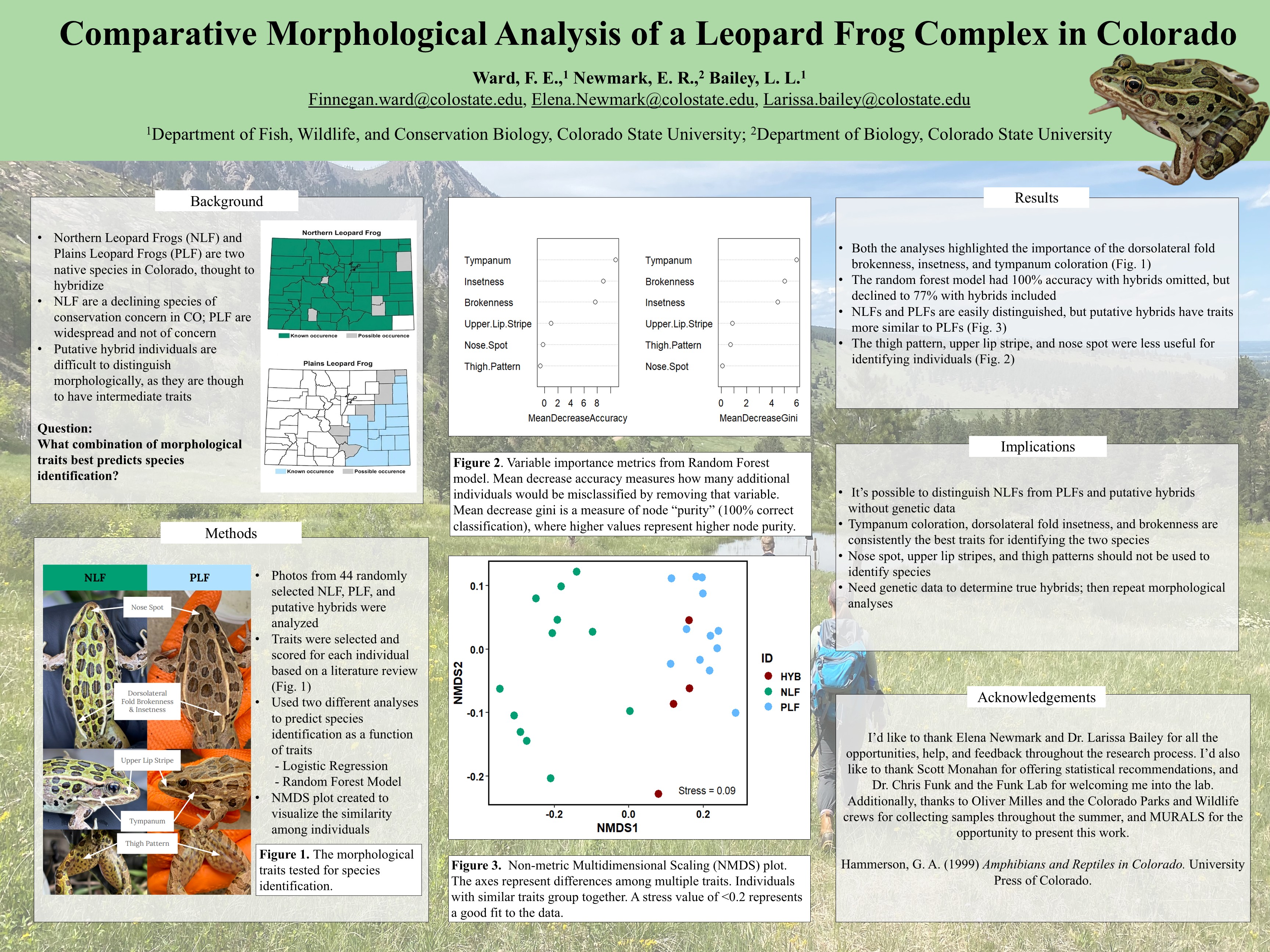
Hybridization is a unique conservation issue that can lead to reduced fitness and loss of local adaptations which directly inform management practices, especially for species of conservation concern. The ability to distinguish hybrids with only morphology is very helpful for wildlife managers, but often requires genomic analysis. The Northern Leopard Frog (Lithobates pipiens; NLF) and Plains Leopard Frog (Lithobates blairi; PLF) are two native species of leopard frog in Colorado which have been shown to hybridize in areas where their ranges overlap in the southeastern region of the state. NLFs are listed as a Tier 1 species of conservation concern in Colorado, with significant population declines throughout the state but especially on the Front Range, whereas PLFs have stable populations and are not of conservation concern. Morphologically, NLFs and PLFs are very similar, but there is previous characterization of hybrids. The goal of this study is to determine the morphological characteristics that distinguish between NLFs, PLFs, and hybrids. We collected tissue samples and morphological photographs of leopard frogs throughout Colorado, and randomly sampled 20 individuals of each species and 4 putative hybrids. These randomly sampled individuals were categorically scored on a variety of traits that are hypothesized to distinguish between species. Traits will be modeled with a logistic regression curve and the fit of the models will be assessed with a chi-squared test. Eventually, we will be able to incorporate genetic data to assess the reliability of identifying hybrids morphologically and establish the best combination of traits for identifying species.