
From Color to Spatial Cues: How Prior Experience Influences Future Learning in Rabbits
Category: Research Poster
Author(s): Ember Albrecht
Presenter(s): Ember Albrecht
Mentors(s): Sophia D'Agostino
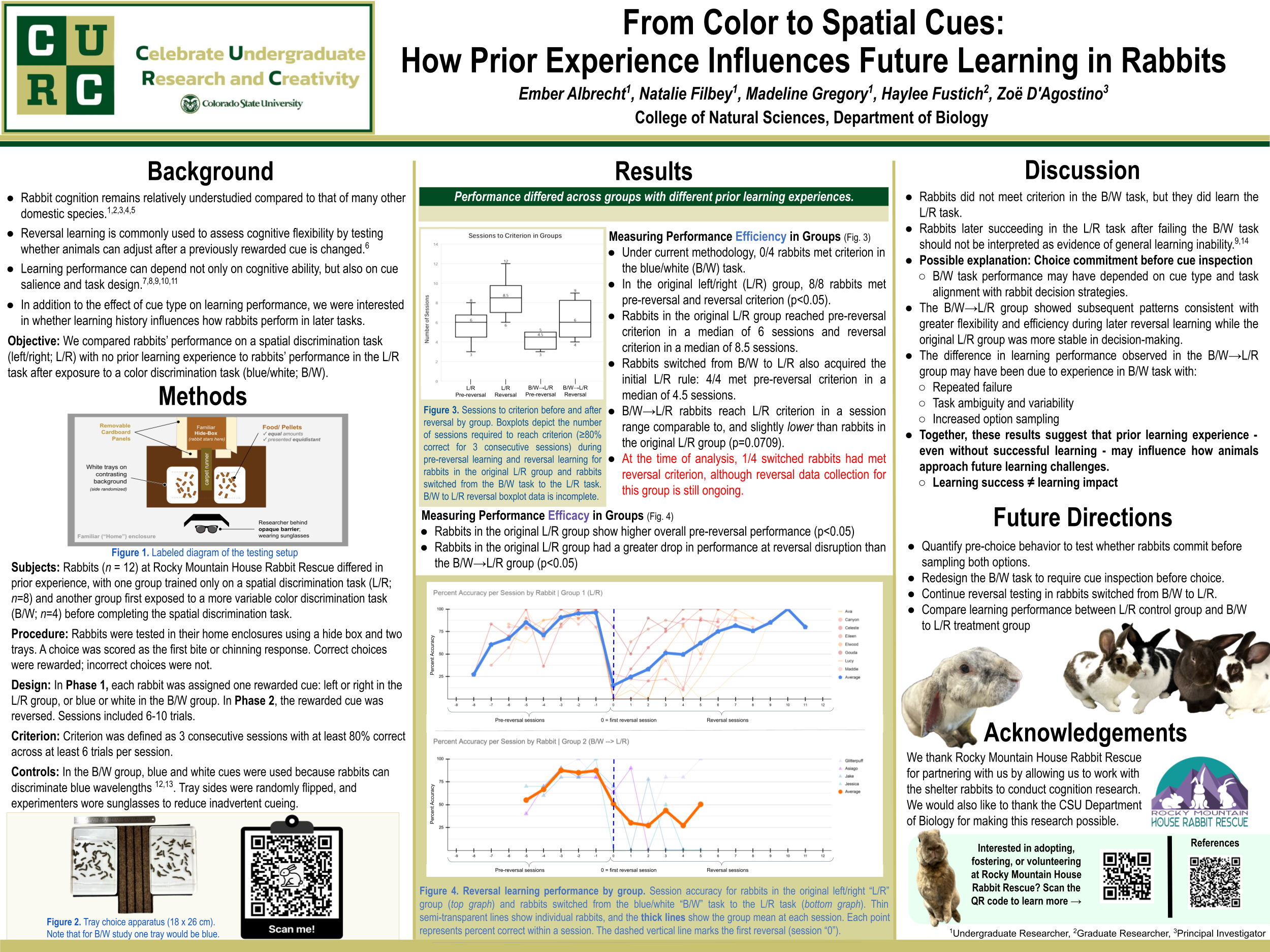
Most rabbit cognition research focuses on neuroscience and associative learning, with relatively few behavioral studies examining cognitive flexibility via voluntary participation in learning tasks. Reversal learning is commonly used to assess cognitive flexibility by testing whether animals can learn an initial, rewarded cue and adjust after the previously rewarded cue is changed. As part of an ongoing reversal learning study, we exposed a group of domestic rabbits to a color discrimination task followed by a spatial discrimination task and compared their learning performance to a group of rabbits that only participated in the spatial discrimination task. Rabbits exposed to the more variable color discrimination task did not meet criterion but subsequently learned the spatial discrimination rule. Rabbits without prior learning experience showed higher overall pre-reversal performance (p<0.05) in the spatial discrimination task but had a greater drop in performance at reversal disruption than the rabbits exposed to the color discrimination task (p<0.05). Rabbits with a learning history reached reversal criterion in a session range comparable to, and slightly lower than the other group (p=0.0709). Rabbits with prior learning experience showed patterns consistent with greater learning efficiency and flexibility at reversal disruption. Rabbits without prior learning experience had higher performance following rule acquisition but experienced a greater drop in performance at reversal disruption. Our results suggest that learning history may shape distinct aspects of behavior such as rule acquisition, decision-making stability, learning speed, and cognitive flexibility.