
Cultivation Strategies to Enhance Cyanobacterial EPS Production for Soil Stabilization
Category: Research Poster
Author(s): Ashley Tieszen
Presenter(s): Ashley Tieszen
Mentors(s): Paycen Harroun
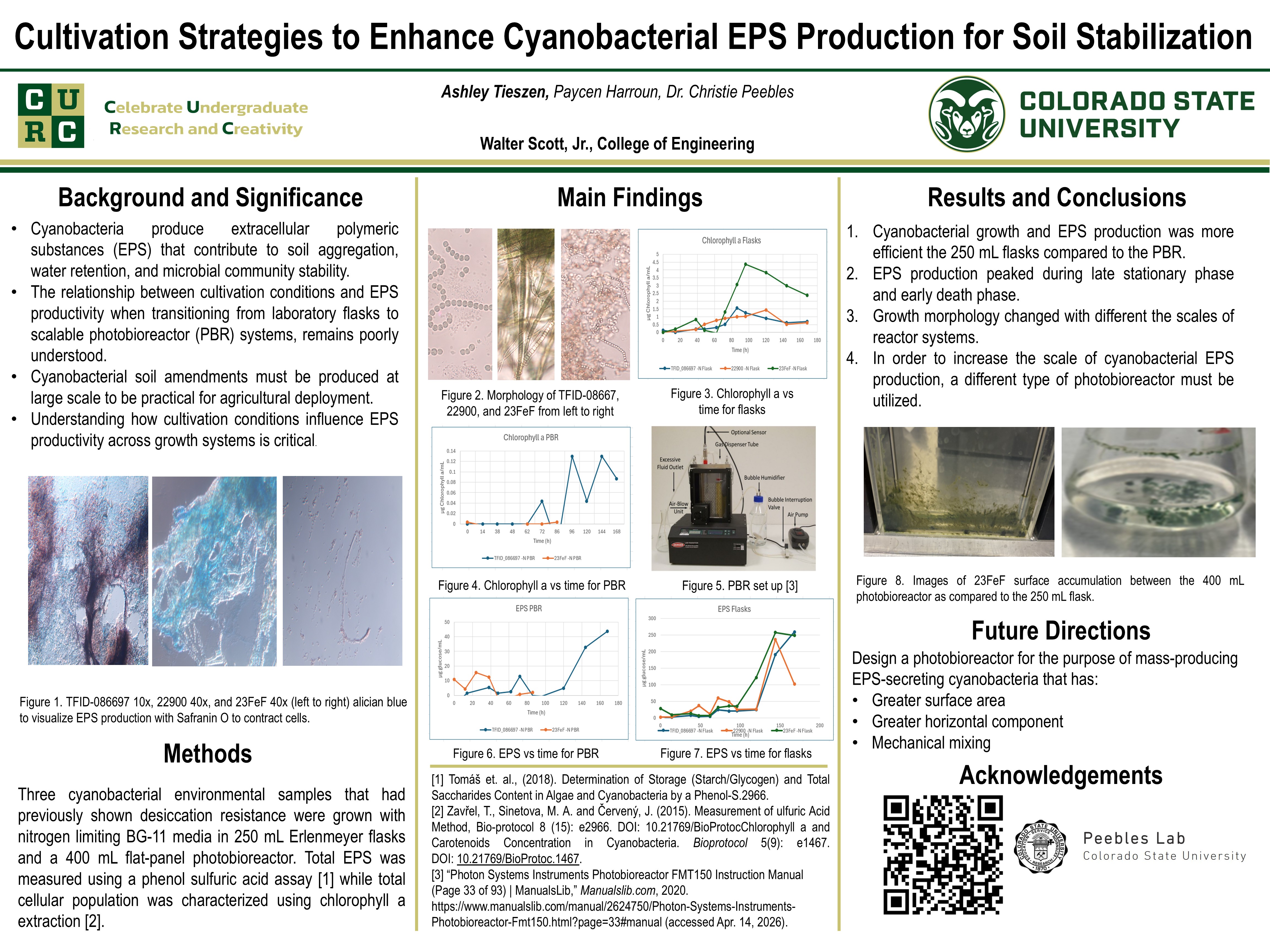
Cyanobacteria produce extracellular polymeric substances (EPS) that contribute to soil aggregation, water retention, and microbial community stability. These properties make cyanobacteria promising candidates for applications in soil restoration and bioengineered soil systems. However, the relationship between cultivation conditions and EPS productivity, particularly when transitioning from laboratory flasks to scalable photobioreactor systems, remains poorly understood. Because cyanobacterial soil amendments must be produced at large scale to be practical for agricultural deployment, understanding how cultivation conditions influence EPS productivity across growth systems is critical. This study investigates how nitrogen availability and cultivation format affect EPS production in filamentous cyanobacteria. Cultures were grown under nitrogen-replete and nitrogen-limited conditions in both shake flasks and a bench-scale photobioreactor system. Biomass accumulation was monitored using optical density and chlorophyll a extractions, while EPS production was quantified using the phenol–sulfuric carbohydrate acid assay. Understanding these interactions will inform scalable cultivation strategies for EPS-producing cyanobacteria and support their development as bioengineered soil stabilization technologies.