
Tracking Condensin Activity in Yeast Cells via Methyltransferase Fusion and Long Read Sequencing
Category: Research Poster
Author(s): Fisher Martenson, Teagan Rockwood, Sarah Swygert
Presenter(s): Fisher Martenson
Mentors(s): Teagan Rockwood, Sarah Swygert
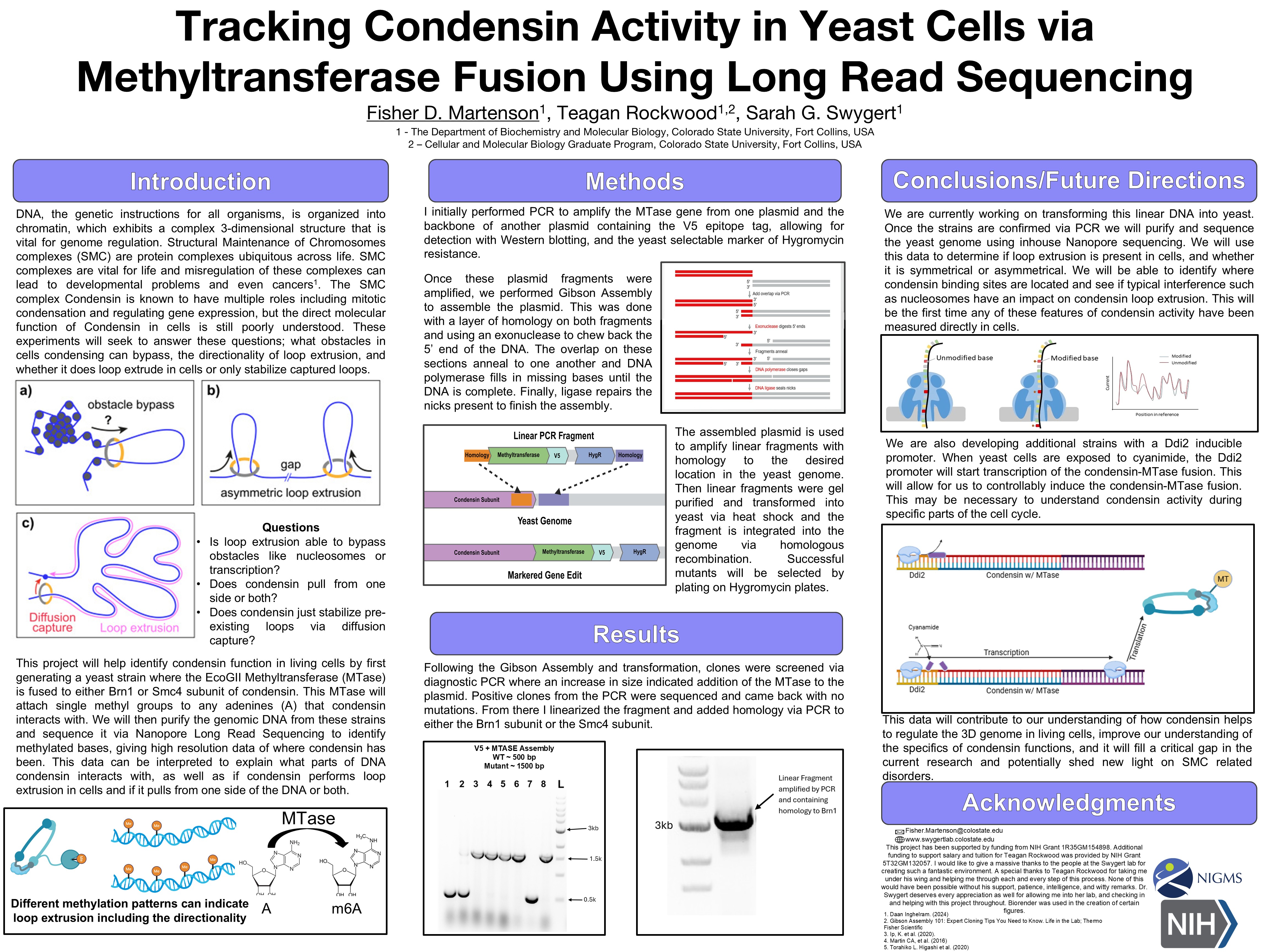
Condensin is a structural maintenance of chromosomes (SMC) protein complex known to alter the three-dimensional structure of chromatin. This protein is essential for compacting chromosomes during mitosis, and condensing chromatin during quiescence. Studies have shown that condensin does this through a process called loop extrusion. However, how loop extrusion functions at the molecular level within cells is unknown. Obtaining greater understanding of SMC complex activity and how it affects chromatin structure has potential to further basic science and medical genetic research. I plan to determine the function of condensin in quiescent cells by fusing it to a methyltransferase (MTase). To construct the condensin-MTase strain in yeast, I will make a plasmid that contains a yeast selectable marker and EcoGII methyltransferase. I will then use PCR to make a linear amplicon of the plasmid containing homology for the condensin subunit SMC4, which will then be transformed into yeast. The condensin-MTase will methylate DNA that becomes incorporated into condensin loops. I will then purify yeast genomic DNA from these strains and use long read Nanopore sequencing to detect methylated DNA to determine the DNA regions condensin interacted with, allowing me to establish the directionality and presence of loop extrusion. These experiments will elucidate the loop extrusion activity in cells, which has previously only been observed in artificial biochemical experiments. Given that mutations in SMC complexes drive a range of human diseases, a mechanistic understanding of loop extrusion in cells represents a critical step forward for basic biology and potential therapeutics.